Some clients arrive with the design already finished. This one sent an STL file: a full crucifix figure, modelled down to the crown of thorns, the folds of the loincloth and the tendons in the arms. There was nothing for us to draw. The job was to turn the file into metal, 18K yellow gold for the figure and platinum for the crown and the loincloth, without losing anything the client had modelled. That is what custom jewelry from 3D model files looks like on our production floor.
Most writing about 3D printed jewelry is about the printer. This is written from the casting side: what we do to a file before it becomes metal, what the file can predict and what it cannot, and the weights this piece actually came out at.
The short version
| Question | Answer from the bench |
|---|---|
| Can you make jewelry from my own 3D file | Yes. This piece was made straight from the client’s STL file, with no redrawing |
| Why is a file faster than a sketch | A sketch or an image goes through rounds of CAD renderings first. A finished file skips them |
| Will the metal match the file | The shape and the modelled detail, yes. The weight comes in lower than the file predicts |
| How much lower | The platinum parts here were predicted at 12.5 to 13 g and weighed 11.41 g |
| Can one file be made in two metals | Yes, as separate castings joined into one piece. This one is 18K gold and platinum |
Why a finished file is the fastest way in
When a client starts from a photo, a sketch or an AI image, a CAD designer has to interpret it. We send a rendering, the client corrects it, and we send another. A simple piece is usually settled in one or two versions, a complex one in two or three. Every round is a chance for a detail to drift: a fold drawn a little flatter, a face drawn a little younger.
A complete STL file removes that stage. The surfaces the client modelled are the surfaces we cast. Nobody on our side decides how the ribs should look or how deep the folds of the cloth should go, because the file already says so. For a sculptural piece like this one, that is the difference between getting the client’s figure and getting our version of it.
It also moves the clock. Our production time runs from the moment the design details are confirmed. With a file, that moment comes as soon as the client approves our plan for it, not after several rounds of renderings.
What we still do to a file before casting
Made straight from the file does not mean the file goes into the machine untouched. Three things happen first.
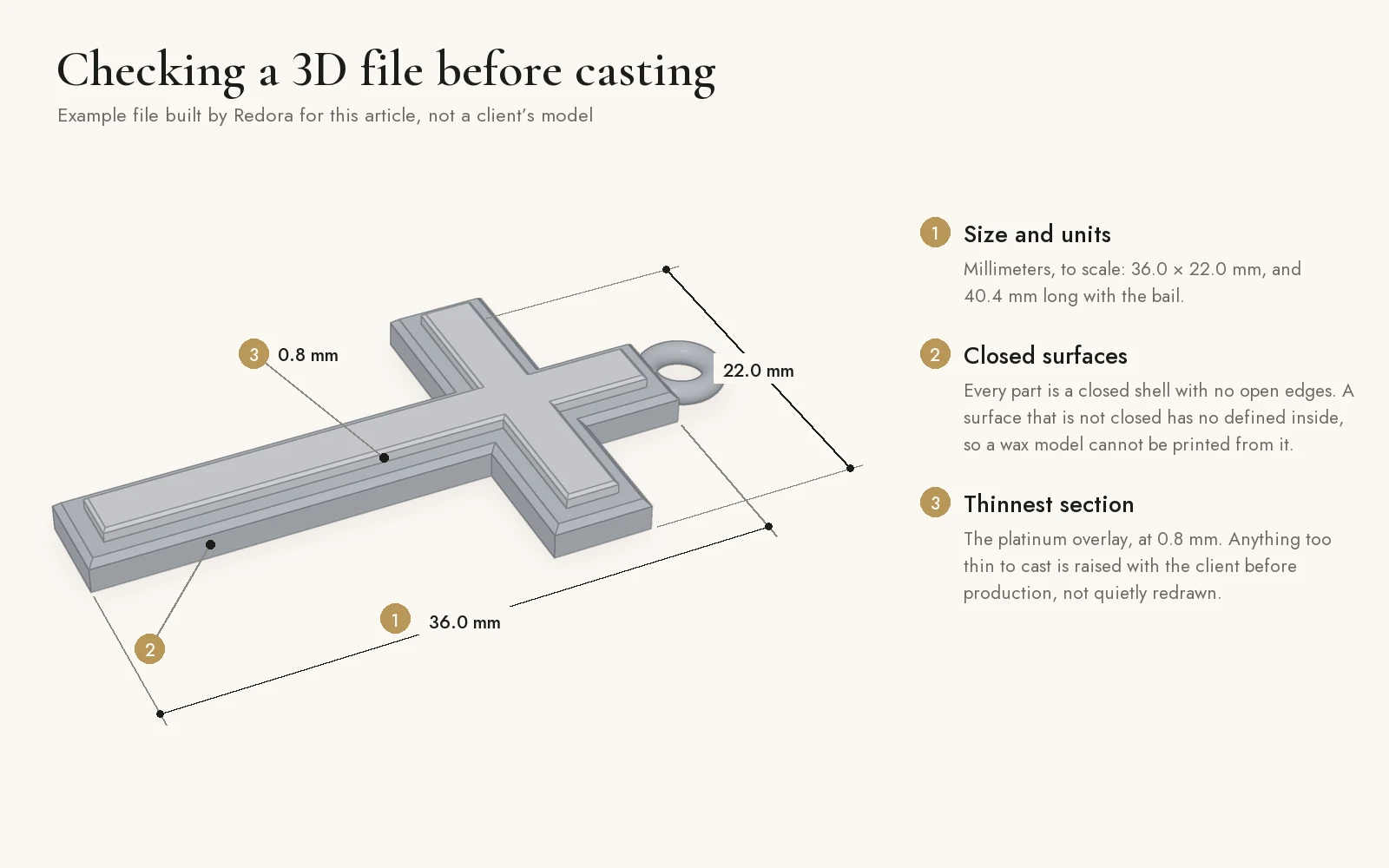
- We check it. Size and units, closed surfaces, and any wall or detail too thin to cast. A file drawn for a screen can look perfect and still have parts that metal cannot fill.
- We plan the metals. Which parts are gold and which are platinum decides where the model has to be cut.
- We predict the weight. The volume of each part tells us roughly what it will weigh in its metal, which is what the quote is built on.
If something in the file will not survive casting, we say so before anything is made and the client decides whether to change it. We do not quietly redesign a client’s model.
One file, two metals
Gold and platinum cannot share a casting. Platinum melts at roughly 1,770°C. 18K yellow gold melts well under 1,000°C. Each metal needs its own casting run, so a two metal design has to exist as separate parts before a wax model is produced from the file.
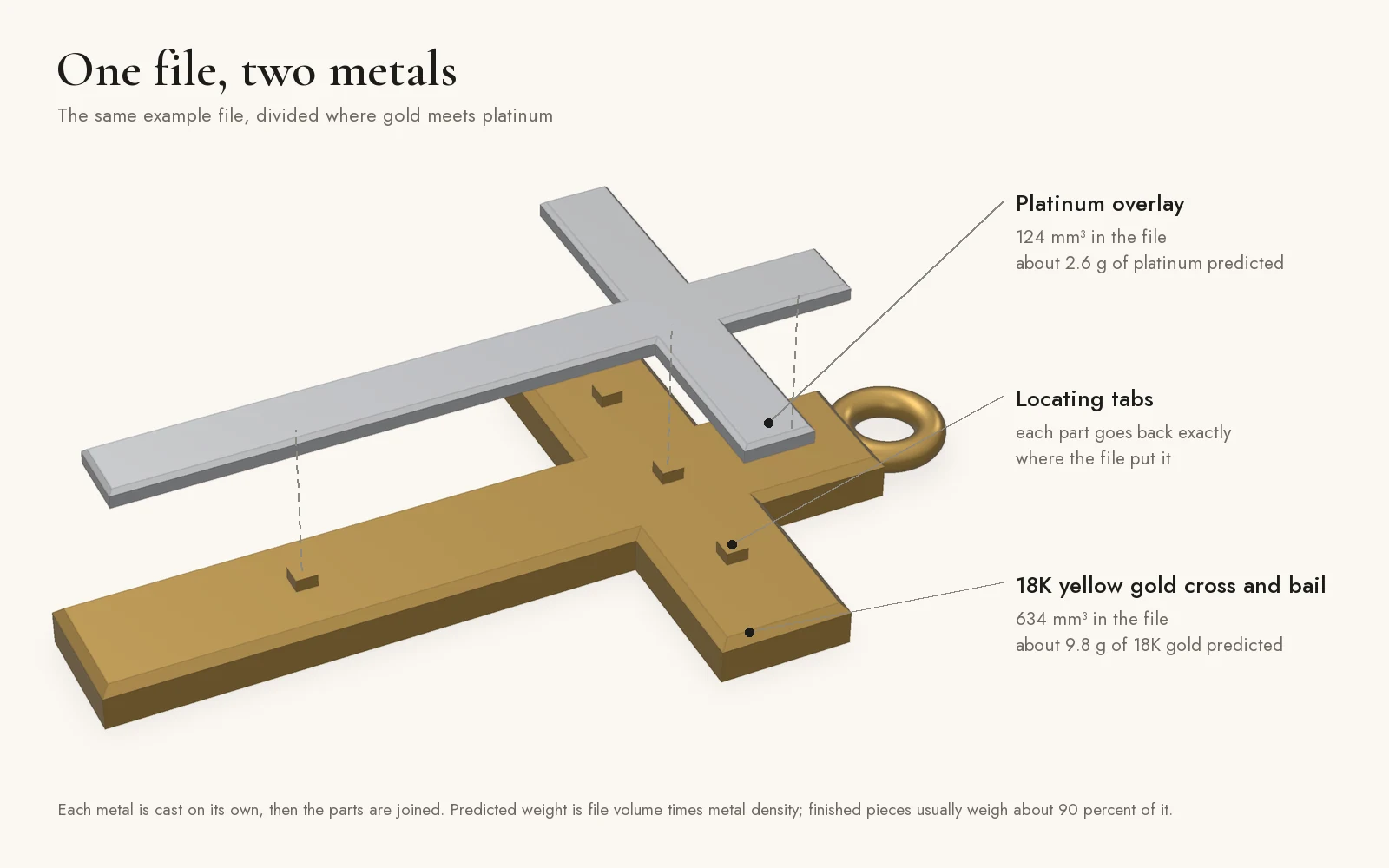
The split follows the metals. The crown of thorns and the loincloth are platinum, so they come away from the figure. The loincloth wraps all the way around the hips, which means the gold figure has to be divided at the waist as well, or the platinum cloth could never go on. That is why the legs are a separate casting. The small rectangular tabs where the pieces meet locate each part in exactly the place the file put it.
The bail sits behind the head, where it does not show from the front.
What the file predicted and what the metal weighed
A file cannot be weighed, only calculated. We take the volume of each part and multiply by the density of its metal. That number is always a little high, because the file has no casting loss in it and no metal filed and polished away. Across our production the finished weight lands at about 90 percent of what the model predicts.
| Parts | Metal | Predicted from the file | On our balance |
|---|---|---|---|
| Crown of thorns and loincloth | Platinum | About 12.5 to 13 g | 11.41 g, finished |
| The figure, all gold parts | 18K yellow gold | Not recorded | 26.51 g, before assembly |
The platinum parts came out at 88 to 91 percent of the prediction, depending on which end of the estimate you take. That is the same ratio we see on single metal pieces, so a two metal design is quoted the same way.
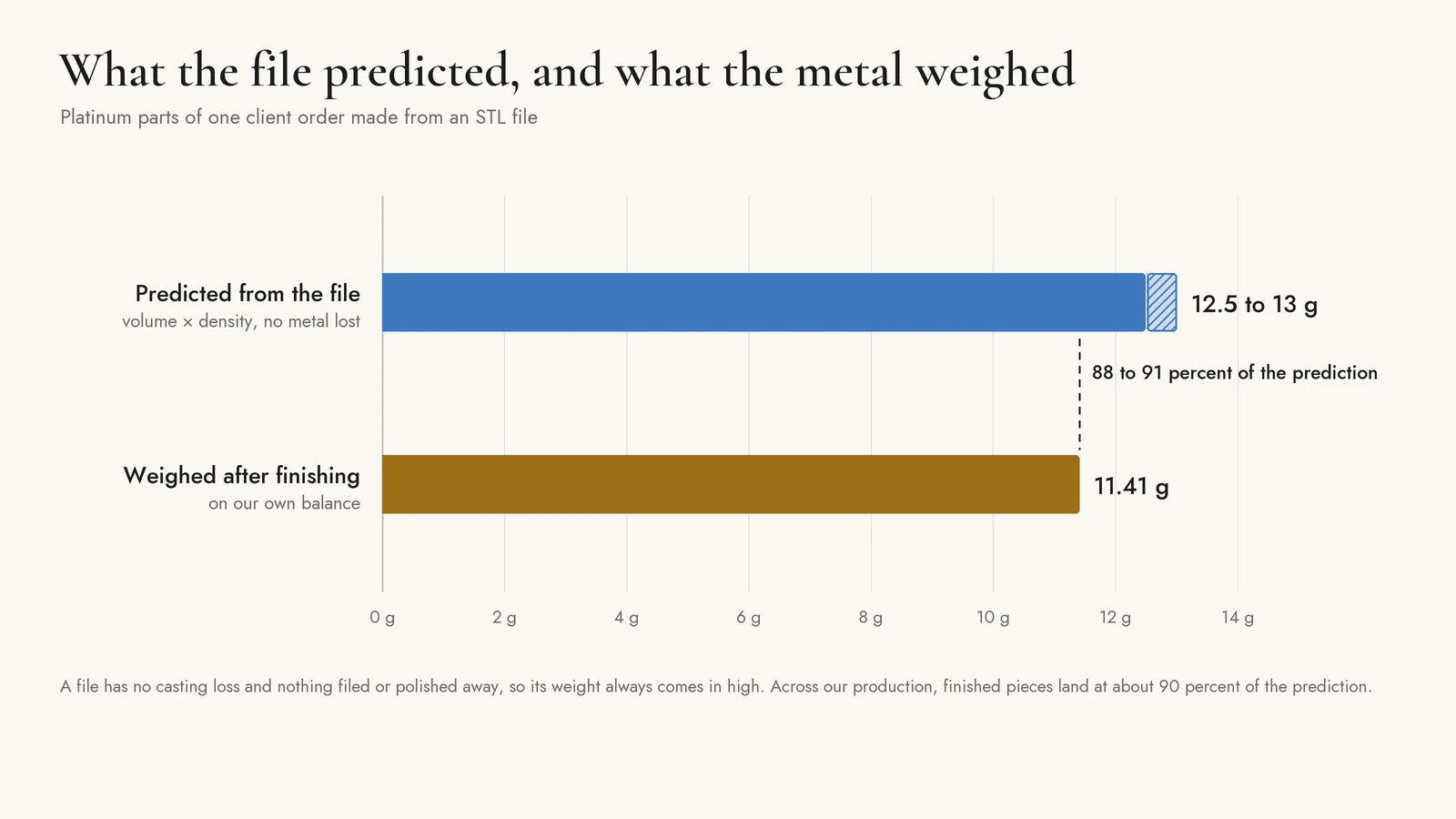
Metal going in is a different number again. We put in about 11 percent more metal than the finished weight, because casting, filing and polishing all take some.
Why the platinum parts weigh so much
The crown and the loincloth are a small share of the figure, yet they weigh 11.41 g. Platinum is about a third heavier than 18K gold for the same volume. A client who changes the metal on a finished model changes the weight with it, even though the file stays the same.
| 18K yellow gold | Platinum | |
|---|---|---|
| Alloy we run | 755 parts gold per thousand, sold as 18K (750) | 955 parts platinum per thousand, sold as Pt950 |
| Melting point | Well under 1,000°C | About 1,770°C |
| Weight of the same volume | Baseline | About a third heavier |
| Alloying surcharge over the metal price | 8 RMB per gram | 21 RMB per gram |
We run both alloys slightly above the stamp, so the finished piece tests at the stated purity after casting and polishing. The bail of this piece is stamped Au750.
The finished piece
After casting, each part is cleaned up, finished and joined into one figure. The two metals sit side by side: a warm 18K body, and a whiter crown and loincloth that read as cloth and thorn against it. From the back, the loincloth runs all the way around, and the bail stays out of sight behind the head.
Two things push back the other way
A file is followed exactly, and that includes its mistakes. If a finger is modelled thinner than metal can fill, or two parts were never meant to be cast apart, a file does not warn anyone. Our check catches what it can, but a client sending a file should expect a short list of questions before production, not an instant start.
Platinum also costs more to change your mind about. Its alloying surcharge is more than twice that of 18K, and melting a platinum piece down to reuse the metal costs far more than doing the same with karat gold. For a piece meant to be remade later, gold is the easier metal.
Sending us a 3D file
- The file itself. This client sent an STL
- The size the piece should be, in millimeters, if the file is not already to scale
- Which parts should be which metal: 9K, 10K, 14K, 18K or 22K gold, or platinum
- The finish, polished or matte, and where the bail or clasp should go if the file does not have one
- Engraving, if you want it, which is free in the wording and font you choose
A 3D file counts as an existing design, so it follows our standard path. The order starts with a 30 percent deposit, which covers the file preparation and the production slot. We send back the plan for the file, which parts go in which metal and the weight we expect, and materials are not ordered until you approve it. The deposit is fully refundable before that approval.
Production usually takes 7 to 10 days after design details are confirmed, and up to 15 days for a complex piece in two metals like this one. We ship by FedEx, DHL or UPS, and delivery usually takes 2 to 5 days, depending on destination and customs clearance.
For a client starting from a photo or an AI image instead of a file, the initial bangle case shows how the CAD rounds work. For clients who bring a stone instead of a file, bringing your own diamond covers that path, and what we check before a piece ships covers the last step.
Common questions
Can you make jewelry from my STL file?
Yes. We produce a wax model from the file and cast it in the metal you choose. The file is checked first for size, closed surfaces and anything too thin to cast, and we tell you before production if something needs to change.
Can a 3D print be turned into metal jewelry?
The print itself is not what we cast. We work from the file you printed, produce our own wax model from it, and cast that in solid gold or platinum. Send the file, not the print.
Will the finished piece match my 3D model exactly?
The shape and the detail you modelled are what we cast, with no redrawing. The weight is the part that changes: it usually lands at about 90 percent of what the model predicts, because casting and polishing take some metal off.
Can one design be made in gold and platinum together?
Yes. The two metals melt at very different temperatures, so each is cast separately and the parts are joined into one piece. The model has to be divided along the line where one metal meets the other.
Is it faster to send a 3D file than a sketch?
Usually. A sketch or an image needs rounds of CAD renderings before production can start. A finished file goes straight to our check, so the design details are confirmed sooner.
About the Author and Review Process
Edwin Lin is the founder of Redora Jewels, a factory-direct fine jewelry manufacturer based in Shenzhen with on-site production. The piece in this article was made from a client’s file on our production floor. The weights were read on our own balance, and the alloy and surcharge figures come from our own production. The client’s name is not published.
Redora Jewels has run as a manufacturing facility since 2011 and makes custom jewelry in solid gold and platinum, one piece at a time. If you have a file ready, start a project with Redora’s production team.