Can you bring your own diamond to a manufacturer and have the ring made around it? At Redora Jewels, yes. Some inquiries start with a stone rather than a picture. It might be a loose lab grown diamond bought online, or a grandmother’s stone out of a ring that no longer fits. The honest answer has three parts. We set stones we did not supply, and charge for the gold and the work, with no fee for the stone being yours. The stone is checked when it arrives, and nothing moves until we have both agreed on what it is and what condition it is in. And if it is damaged on our bench, we replace it with an equivalent stone or pay its agreed value.
Most writing on bringing your own diamond comes from retailers. For a retailer the stone is usually the largest part of the sale, so an outside stone is a lost sale before it is a technical question. This is written from the bench, where the only question is the stone itself.
The short version
| Question | Our answer |
|---|---|
| Will you set a stone you did not sell? | Yes, diamonds lab grown or natural, and colored stones |
| What do I pay? | The metal and the work, the same lines as any quote, minus the stone. No handling fee for the stone being yours |
| What do you need first? | The stone’s measurements in millimeters, from its report or from the stone itself |
| What happens when it arrives? | We check it, tell you the grade we read and any damage it already has, and both sides agree that record before anything is cut |
| What if it is damaged here? | Replaced with an equivalent stone, or its agreed value paid |
| How long does it take? | CAD in 1 to 3 days. Production 7 to 10 days for most pieces after design details are confirmed and the stone is on the bench |
A setting is built to millimeters, not carats
The first thing we ask for is not the carat weight. Prongs are modeled to a diameter, a basket to a length and a width, and the height of a setting to the depth of the stone. Weight decides none of those directly.
Two round diamonds sold as 1.00 ct can differ in diameter by a few tenths of a millimeter, depending on how each was cut. A shallow stone spreads wider. A deep one carries more of its weight below the girdle and faces up smaller. A seat cut for one will not hold the other properly, which is why the CAD is drawn around your stone and not around a catalog figure.
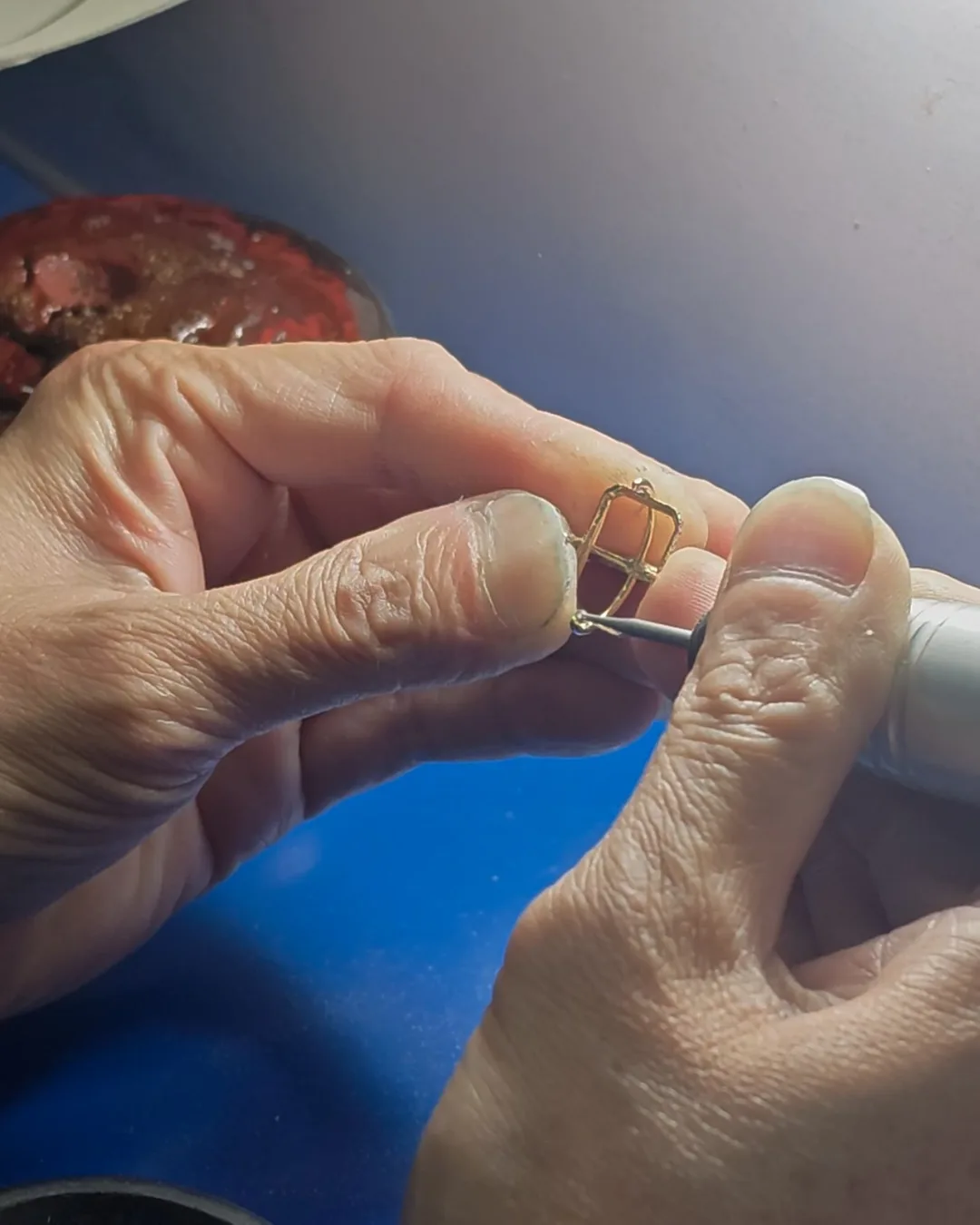
The photographs here follow one ring across our bench: the 20.06 ct emerald cut from our 20 carat size comparison. Its report gives three numbers, 18.16 x 12.73 x 8.29 mm, and those three numbers built the frame above. The last one is the one buyers forget. Depth is the stone’s height from table to point, and it decides how far the ring has to stand off the finger.
| What you have | What the setting is modeled from |
|---|---|
| A stone with a lab report | The report’s measurements, checked against the stone when it arrives |
| A stone with no report | The stone itself, measured before the CAD is final |
| A stone still in an old ring | The stone once it is out, because old prongs hide its edge |
| Small stones taken from older pieces | Each stone separately, because older accent stones are rarely one size |
Older cuts have different proportions from modern ones, so a stone out of an inherited ring is modeled as it is, not as the modern round its weight suggests.
What happens on the day the stone arrives
Nothing is cut, cast or set against a stone we have not looked at. When it arrives we check it and tell you what we see: the quality grade as we read it, and any chips, abrasions or worn edges it already carries. The next step waits until both of us agree on that record.
The record does two jobs. It answers the question buyers type most bluntly, which is whether a jeweler can swap a diamond. And it is the baseline any damage claim is measured against, which is what makes the promise further down something either side can check.
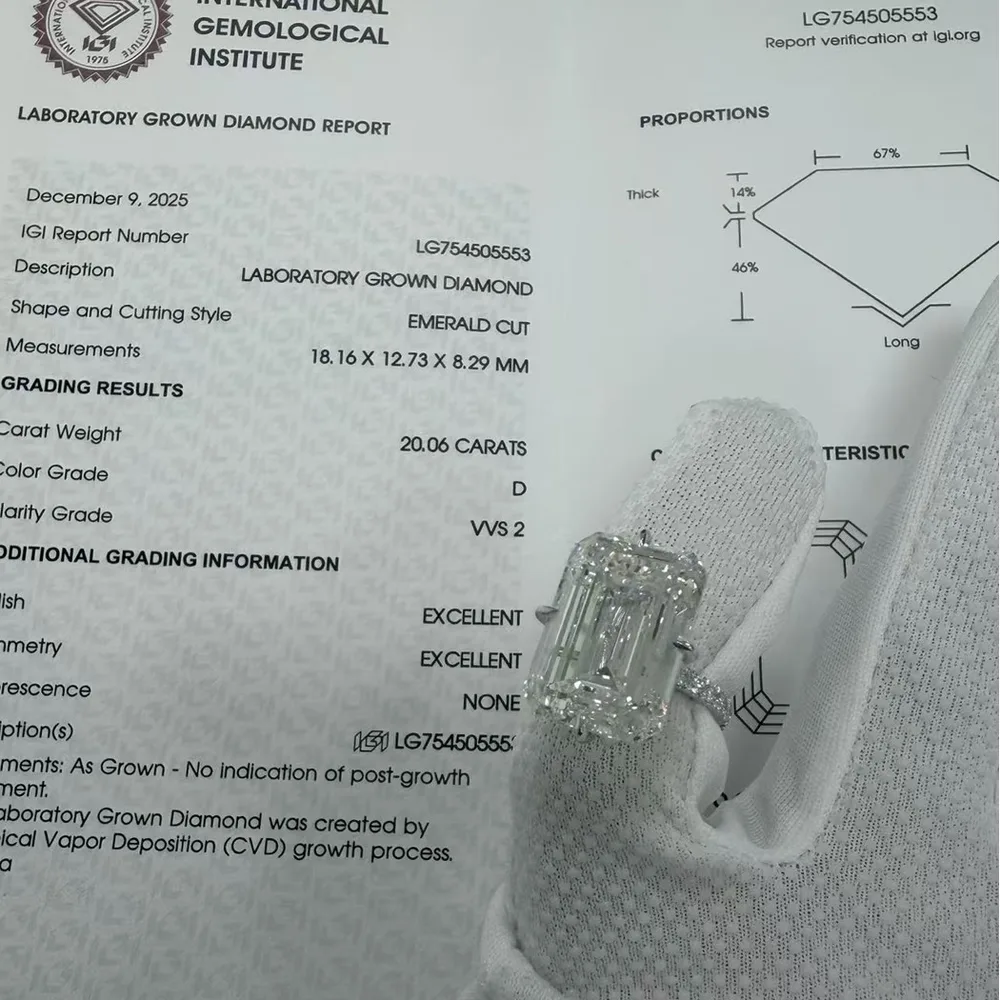
Our read of a grade is an opinion from the bench, not a laboratory report. Individual reports are rarely issued below roughly 0.30 ct, so most small stones arrive with no paperwork at all. For those, the arrival record is the only description of the stone that exists, which is the reason to make one before anything else happens.
Keep your own copy as well. Write down the report number, which IGI and GIA both let anyone look up on their websites, note the measurements, and photograph the stone. You see the finished piece in photographs and video before the balance is paid, and you can hold the stone in them against both records.
Where a stone actually gets hurt
A buyer on a Reddit engagement ring forum described a jeweler who declined to set their loose diamond and offered one of the store’s own instead, on the grounds that the store’s stones would not crack during setting. The buyer thought it sounded off, and was right to. A diamond does not become tougher because the person setting it also sold it.
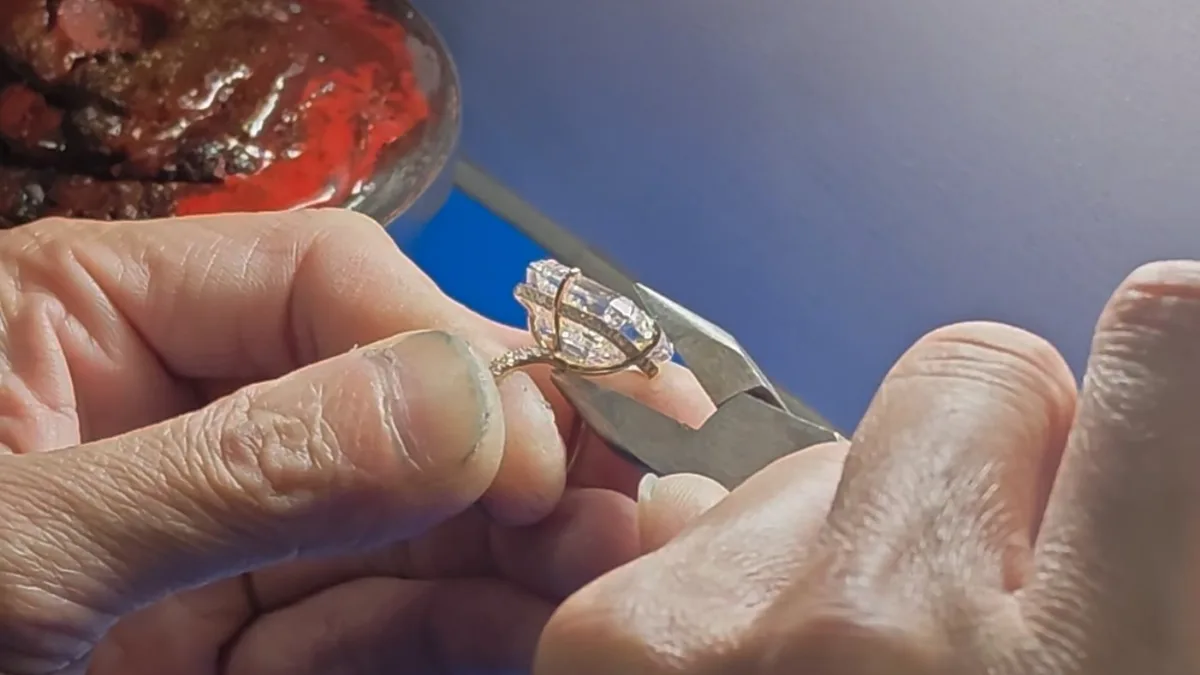
What changes the risk is the individual stone. For a diamond, the moment of real stress is when prongs are pressed down onto it, or a bezel is pushed over its edge. It is not the casting. The metal is cast and cleaned first, and the stone is set afterward. Lab grown and natural diamonds are set the same way and take that pressure the same way.
| What the stone has | Why it matters at that moment |
|---|---|
| A chip or feather that reaches the edge | Prong pressure can extend it, which is why it belongs on the arrival record |
| A very thin girdle | Less edge for a prong to bear on |
| Sharp points: pear tips, marquise tips, princess corners | The point needs a prong that covers it, usually a V-prong, decided in the CAD |
| A previous setting | Old prong seats sit exactly where edge damage hides, so it shows only once the stone is out |
| A softer colored stone such as emerald, opal or tanzanite | Less tolerance for pressure, and more care in polishing and cleaning afterward, so a bezel or lighter prongs may be the better design |
Who pays if it breaks
It is common for a jeweler to ask a customer to sign a release before setting a stone they did not supply, so that any damage stays with the owner. We do it the other way round. If your stone is damaged while it is on our bench, we replace it with an equivalent stone or pay its agreed value.
We can offer that because of the arrival record. A stone that came in with a chip at the edge is recorded with that chip. A stone that came in clean is recorded clean. If a stone arrives with damage near its edge, you hear about it before anything is cut, and the setting is chosen with it in mind.
What setting your own diamond costs
The quote has the same lines as any piece we make, with the stone line taken out. You pay for the metal and for the work. There is no handling fee and no surcharge for the stone being yours.
The metal is bought by weight. Casting and polishing lose about 11 percent of what goes in, so a finished 10 g piece needs 11.1 g of alloy at the start. We alloy above the stamp, 18K at 755 parts per thousand gold and 14K at 595, and a per gram alloying surcharge sits on top of the gold price. Karat also changes the weight of the same design:
| Karat | Fineness we work to | Same design, by weight |
|---|---|---|
| 18K | 755 | 10 g, the reference |
| 14K | 595 | About 9 g |
| 9K | 390 | About 8 g |
The work is priced per stone, not per carat. A solitaire is one stone to set. A halo around it can be twenty or more. Most setting styles cost the same per stone. Invisible setting runs about 50 percent more, and it is also the style most likely to give trouble on the bench.
So the useful way to compare quotes for a setting is in grams and in stone count, not in dollars alone. Ask for the finished weight at your size. The full split for a ring where we supply the stones is in our custom diamond ring cost breakdown.
If you are sending old gold as well
Some buyers send old gold with the stone: a broken chain, a ring that no longer fits, a single earring. We test its karat before anything is melted, and the gold it tests at goes against the new piece. You pay the difference.
Two details decide how far it goes. Old gold is counted at what it tests, not at what it is stamped. And melting is not gram for gram, because the new piece still loses about 11 percent in casting and polishing.
Three things push back the other way
Bringing your own lab grown diamond can save less than expected. Loose lab grown stones now cost little enough that, on a stone of a carat or two, the money saved by buying it yourself can be small next to the cost and effort of sending it across a border and having it checked. If you have not bought the stone yet, ask for the quote both ways: with your stone, and with one we source to the measurements the design needs. The material itself is covered on our lab grown diamonds page.
A stone that has lived in another ring has a history you cannot see yet. Wear on facet edges and chips under old prongs only show once the stone is out and under magnification. Setting does not cause that damage, but the arrival record will show it, and occasionally it changes what the stone can safely go into.
A colored stone can look different once it is set. Rework on our floor runs at 1 to 3 percent of pieces, and the most common reason is a natural colored stone that reads differently set than it did loose, because the metal behind it changes the color you see. If you are bringing a sapphire or an emerald, choose the metal color with that in mind. Yellow gold warms a stone and white gold cools it, and a pale stone shows the difference more than a saturated one.
The order of events, with your stone in it
| Stage | Where your stone is | What it costs you |
|---|---|---|
| Brief and quote | Still with you. We work from the report, or from photos and measurements | Nothing |
| Deposit and CAD | Still with you, or on its way. CAD in 1 to 3 days, modeled to its measurements | 30 percent, fully refundable until you approve the CAD |
| Arrival | Checked, graded as we read it, condition recorded and agreed | Nothing extra |
| Casting and finishing | Not involved. Only the metal is cast | Nothing extra |
| Setting | Under pressure, and covered by us | Nothing extra |
| Photos, video, balance | Set. You compare it against your own record | The remaining 70 percent |
Production takes 7 to 10 days for most pieces after design details are confirmed, as little as 5 for simple work and up to 15 for complex pieces. With your own stone, the clock also waits for the stone, because it cannot be set before it is here. The finished piece ships by FedEx, DHL or UPS, usually in 2 to 5 days depending on destination and customs clearance. Settle the ring size before the CAD is approved, since some rings cannot be resized once they are made. What happens to the deposit at each step is set out in what a custom jewelry deposit pays for.
The step that needs the most planning is not the setting. It is the journey. Carriers have their own rules on declared value and insurance for loose stones, and those rules sit with the sender. Talk to us before anything is posted, and send the stone once the brief and the quote are agreed.
Common questions
Can I bring my own diamond to a jeweler?
Many will set it and some will not, and the ones that will often ask you to sign a release first. We set stones we did not supply, record their condition on arrival, and cover them while they are on our bench.
Is there a setting fee for bringing your own diamond?
There is a setting fee, the same one that applies when we supply the stone, because the work is the same. There is no extra charge for the stone being yours.
How much does it cost to make a ring with your own diamond?
It is the metal plus the work. The metal depends on the finished weight and the karat, and the work depends mostly on how many stones are set. A photo of the design you want and the stone’s measurements are enough for a written quote, at no cost.
Can a jeweler swap my diamond?
It is the reason an arrival record matters. Ours notes the grade we read and the condition the stone came in, and both sides agree it before work starts. Keep your own copy with the report number and measurements, and compare the stone in the finished photographs before you pay the balance.
Can a diamond get damaged when it is being set?
It can happen, and for a diamond it is almost always at the moment prongs are closed. The risk sits in the individual stone: an existing chip at the edge, a thin girdle, or a sharp point left uncovered. If it happens on our bench, we replace the stone with an equivalent one or pay its agreed value.
Can you set a loose lab grown diamond I bought online?
Yes. Lab grown and natural diamonds are set the same way. Send the report or its measurements first, so the setting can be modeled before the stone travels.
My stone has no certificate. Can you still set it?
Yes. Most stones under roughly 0.30 ct never had one. The stone is measured and described in the arrival record instead, and that record is what we both work from.
Can you use my old gold as well?
Yes. It is tested for karat before it is melted, the gold it tests at is set against the new piece, and you pay the difference.
About the Author and Review Process
Edwin Lin is the founder of Redora Jewels, a factory-direct fine jewelry manufacturer based in Shenzhen with on-site production. The arrival check, the damage cover, the pricing lines, the fineness and loss figures and the rework rate in this article are the ones our production team works to. The photographs show a single ring on our bench, the 20.06 ct emerald cut engagement ring in 18K white gold, from empty frame to finished piece.
Redora Jewels has run as a manufacturing facility since 2011, making engagement rings and the rest of our custom jewelry to order. If you already have the stone, a photo of the design you want and the stone’s report or measurements are enough to begin: start a custom project with Redora’s production team.