Somewhere between the first sketch and the deposit, most clients ask the same question: if the size turns out to be wrong, can it be resized later? The retail answer is usually yes, most rings go up or down about two sizes. That answer is accurate for a plain band. It stops being accurate the moment stones reach the sides of the shank, and on a made to order piece our own answer is different again. We do not resize a finished ring. We produce it again at the correct size.
Both answers are defensible, and the reason they differ is worth understanding before you order anything, because the question is settled in CAD months before anyone picks up a saw.
The question is about circumference, not skill
A ring size is a length of metal. One US size is about 0.81 mm of inner diameter, which works out to roughly 2.55 mm of circumference. That number is the whole problem in one line. Going down three sizes means taking about 7.6 mm out of the band and closing what is left. Going up means cutting the shank and soldering in a piece of the same alloy, or stretching the metal, which thins it.
Watch a public thread where someone posts a photo and asks whether their ring can be sized down, and the trade replies are rarely about skill. A working jeweler in one r/askjewelers thread from September 2026 described the job as “removing 2.5 millimeters of material per size then squeezing it”. Several commenters in the same thread said they were capable of doing it and would still decline. One of them put it plainly: the ring needs to be remade.
That is the distinction buyers rarely get told. A jeweler refusing a resize is often not telling you they cannot do it. They are telling you that what comes back will be worse than what you handed over.
What sits on the shank decides the answer
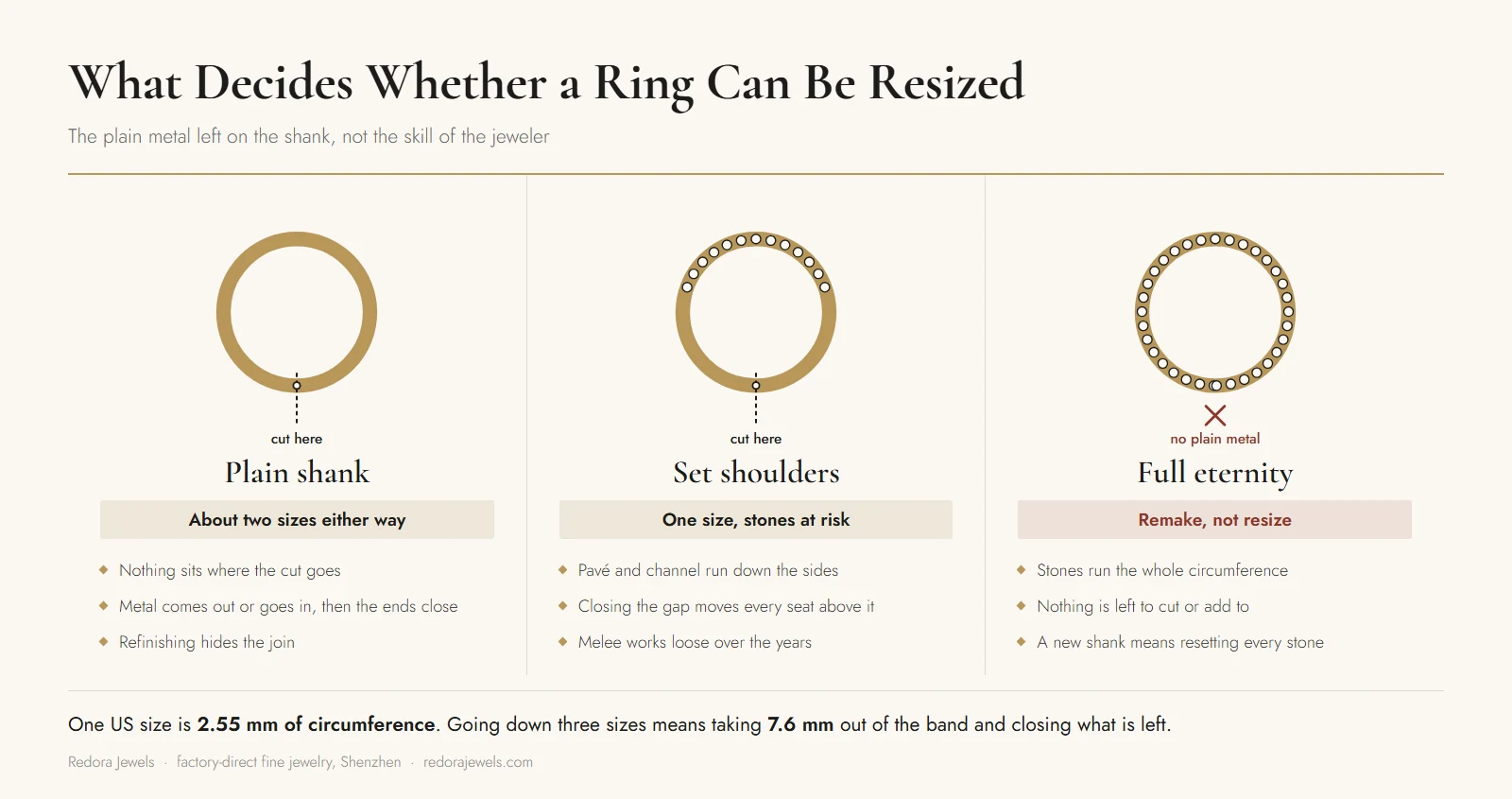
A resize happens at the bottom of the shank, directly opposite the center stone. Whether that is possible depends on one thing: how much plain metal is sitting there, and how far the stones come down the sides.
| Shank construction | Usual working range | What gives way first |
|---|---|---|
| Plain band, any width | About two sizes either way | Nothing structural. The join is refinished out |
| Solitaire on a plain shank | About two sizes | The head sits well clear of the work |
| Pavé or channel down the shoulders | One size at most | Seats shift as the gap closes, melee loosens |
| Half eternity | Rarely worth attempting | The plain section at the bottom is too short |
| Full eternity | Remake only | There is no plain metal anywhere on the circle |
| Wide patterned or engraved band | Remake only | The pattern breaks across the join and cannot be matched |
The middle row is where most disappointment lives, because it looks resizable. A pavé shank has plain metal at the bottom and stones only on the shoulders, so the photograph suggests there is room to work. What the photograph does not show is that squeezing a ring smaller changes the curve of the whole circle, including the part carrying stones. Shared bead settings hold two neighboring stones with the same piece of metal. Move that metal and both seats open.
This is not theoretical. In that same thread, a buyer with a split shank pavé ring described having it sized down from a 6 to a 4.25 and losing melee immediately, then five stones over eight years. The resize worked. It also started a slow leak.
The part nobody sees is how thin the shank already is
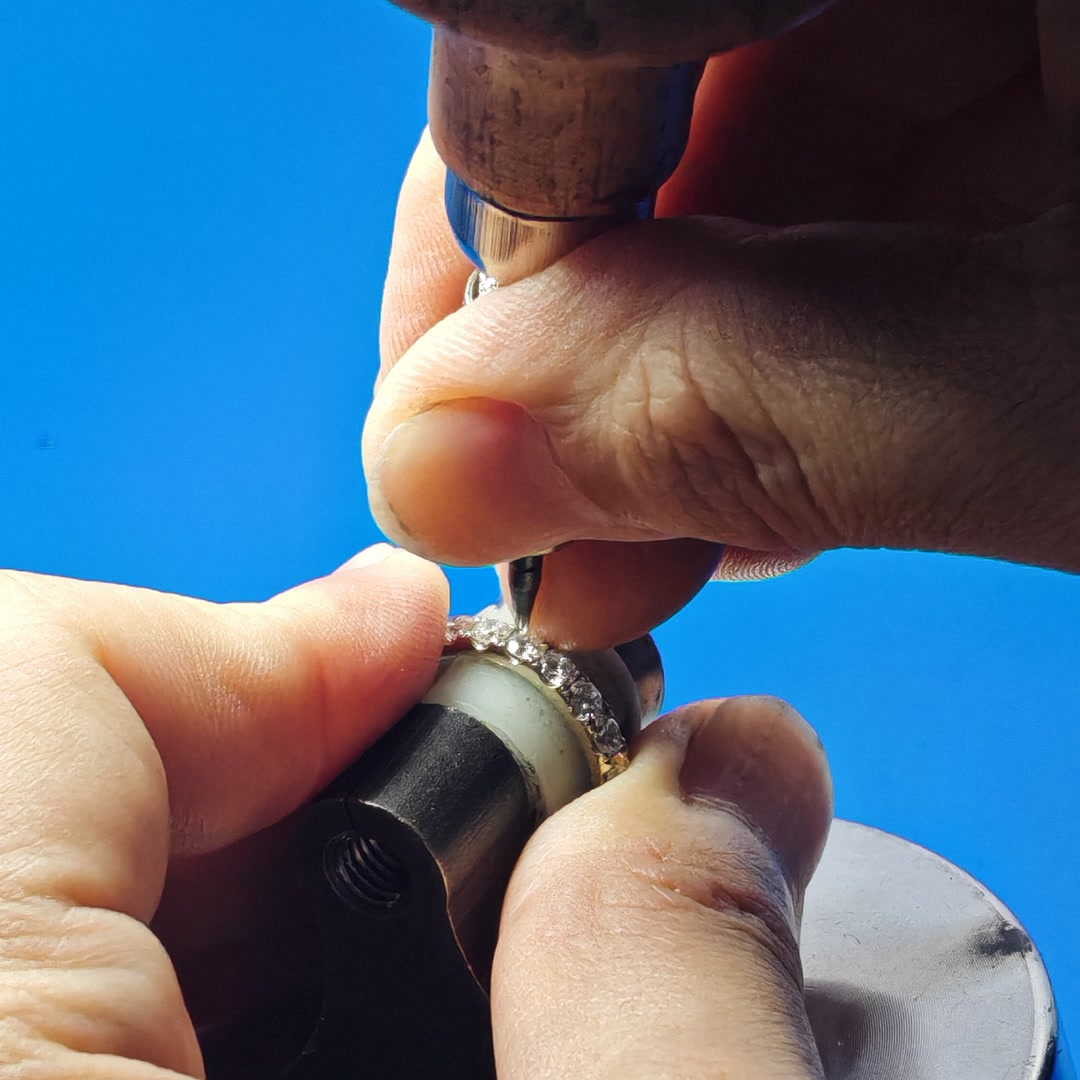
Under most stone set shoulders the metal is scooped out from below. It is a normal construction choice and there are two good reasons for it: the ring sits more comfortably against the finger, and the piece carries less gold for the same visual weight. Look at the underside of a commercial pavé ring and you will usually see the hollowed channel running under each row of stones.
The consequence only appears at resizing time. The area under the setting is already the thinnest part of the ring, and it is right beside the section being compressed. We cover the same logic in detail in our piece on how far a gold piece can be hollowed before the surface work suffers, and it applies here exactly: metal removed for one good reason is not available for a different job later.
Two numbers from our own production sit behind this. Casting and polishing lose about 11% of the metal that goes in, and a finished piece lands near 90% of what the CAD file predicts. A design that was already specified at the light end of its weight range has no margin left to give up at the bench.
Engraving sits exactly where the cut goes
Free custom engraving runs across our whole line, wording and font both open to the client, and the usual place for it is the inside of the shank at the bottom. That is the same few millimeters a resize removes.
In the same subreddit, a buyer had a hand engraved 18k band taken from a size 5 to a 4.5 by a local jeweler after being told the engraving would not be touched. It came back with letters missing from a word. Half a size is the smallest adjustment anyone makes, and it was enough.
If a piece carries engraving that matters, treat the size as fixed. There is no version of this where the text survives a shank cut untouched.
Bracelets, bangles and chains give three different answers
Rings dominate the question, but the same physics produces very different outcomes across the rest of the line, and clients are often surprised by which is which.
Chain bracelets and necklaces are the easy case. Length is built from repeating links, so adding or removing a few sections is straightforward work and the piece is unaffected either side of the change. If you are unsure of a length on a chain, that uncertainty costs you very little. The same is true across our gold necklaces and plain gold bracelets.
Tennis bracelets sit in the middle. They are also a line of links, so they can be shortened. The difference is that every link carries a stone, so shortening the bracelet removes diamonds along with length, and the clasp and the safety catch have to be repositioned afterwards. It is real work with a real cost, which is why wrist measurements come before CAD on our tennis bracelets rather than after.
Bangles are the hard case, harder than rings. A rigid bangle has to pass the widest part of the hand and then sit correctly on the wrist, so its internal dimension is doing two jobs at once and there is no margin in either. On a hinged bangle the hinge and the catch fix the geometry permanently. Once a bangle is finished, it is finished at that size. Thickness is fixed at the same stage, which is why we settle it in CAD: how thick a bangle should be, worked through on one order.
Earrings do not carry a fit dimension at all. Hoop diameter is a style decision, not a sizing one, so nothing here applies to them.
Why we remake rather than resize
Our position is narrow and we would rather state it up front than have a client run into it later. Once a ring or a bangle has been produced to a size, we do not alter it. If the size is wrong, we make the piece again.
The reasoning is that the circumference is not one specification among many, it is the spine that the rest of the design hangs off. Stone spacing, the arc the shoulders follow, the wall thickness under each seat, where the engraving falls: all of it was solved in CAD for one specific size. Cutting the finished piece means working against every one of those decisions at once.
It is also worth being honest about what a remake costs on our side, because the gold is the part people assume is lost and it is actually the part that survives. Metal is recoverable. Labor is not. Setting, finishing and QC all start from zero, casting and polishing take their 11% again, and the alloying surcharge is paid a second time: about 8 RMB per gram on 18k, 12 on 9k and 14k, and 21 on platinum. None of that is recovered by melting anything down.
Which is the real argument of this article. The cost of a wrong size is not a repair bill, it is a second production run, so the size deserves the same attention as the stone.
Getting the size right before anything is cast
Everything above is avoidable, and the checkpoints are all early.
Measure properly, twice, at a sensible hour. Our ring size chart and home measuring guide covers the paper strip method and the conversions. Fingers run smaller when cold and larger in heat, so a reading taken first thing on a January morning is not the size you want built.
Send both numbers if your knuckle is wider than the base of your finger. We can design around a two measurement gap. We cannot design around one number that turns out to be the wrong one of the two.
Say so if the size is actively changing. Pregnancy and significant weight change are the two cases where a full eternity design is the wrong choice regardless of budget, and where a plain or partly set shank earns its keep.
Ask for the fit aids to be built in rather than added later. Sizing beads, a sleeve or a euro shank all work far better designed into the CAD than soldered onto a finished ring, and they cost less that way too.
Use the CAD approval as the real deadline. Nothing is cast and no material is ordered until the rendering is approved, and the 30% deposit is fully refundable up to that point. We wrote about that boundary in what a custom jewelry deposit actually buys. Production runs 7 to 10 days after design details are confirmed, and the size is one of those details.
Common questions
How many sizes can a ring be sized down?
On a plain band, about two sizes is the usual comfortable range, and the metal is removed and the ends closed. With stones on the shoulders, one size is a more realistic ceiling. Beyond that the ring tends to come back out of round, which is what people are describing when they say a resized ring has visible points in it.
Can a full eternity ring be resized?
No. A full eternity band carries stones around the entire circumference, so there is nowhere to cut and nothing to add to. The only route to a different size is a new shank with every stone reset, which is a remake with extra steps.
Can you resize a pavé ring?
Usually about one size, and the stones nearest the work are the ones that pay for it. Shared bead settings hold neighboring stones in the same metal, so when the shank is compressed the seats open slightly. Some stones loosen straight away and others let go years later.
Can a bangle be resized?
Not on our side. A bangle has to clear the hand and then sit right on the wrist, and on a hinged design the hinge and catch lock the geometry. We take wrist measurements at the design stage and make the piece again if the size is wrong.
Can a tennis bracelet be resized?
Yes, by removing links, but each link carries a stone, so the bracelet loses diamonds along with length and the clasp and safety catch need repositioning. Getting the length right at CAD is cheaper than shortening it later.
Can a ring be resized more than once?
Each resize work hardens the metal around the join and leaves a little less material to work with. A plain band tolerates it better than a stone set one. On a piece you intend to keep for decades, plan on the size being set once.
What can I do if a ring is too big and cannot be resized?
Sizing beads soldered inside the shank, a horseshoe insert or a sleeve will all take up slack without cutting the ring, and a silicone adjuster is the zero risk version while you decide. None of them are elegant, and all of them are better than losing stones. If the gap is more than about two sizes, remaking the piece is usually the better answer.
Does a resize damage the engraving inside a ring?
If the engraving sits at the bottom of the shank, which is where it normally goes, yes. The cut is made through that section. Assume the text will be affected even on a half size adjustment.
About the Author and Review Process
Edwin Lin is the founder of Redora Jewels, a factory-direct fine jewelry manufacturer based in Shenzhen with on-site production. He works directly with the production team on construction methods, metal specification, and the standards that decide how a piece holds up over years of wear. This article was written from Redora’s own production practice, including the metal loss and surcharge figures quoted above, and from the questions clients ask while a design is still open to change.
Redora Jewels has operated as a manufacturing facility since 2011, producing engagement rings, gold rings and the rest of our custom jewelry range to order. If you would rather settle the size before anything is cast, you can start a custom project with Redora’s production team.
Buying for a fixed date? Our guide to anniversary jewelry covers how far ahead to confirm a design, and which styles stay resizable.