Every few weeks a client sends a design and asks whether we can hollow it out to bring the price down. It is usually a wide bangle, a heavy chain, or a pair of hoops. Hollow gold hoop earrings come up most often of all, because a hoop carries its metal in one curved section and the saving looks straightforward. Most of the time the answer is yes, and the saving is real.
The honest answer has three parts. On large pieces hollowing works and it saves a lot of gold. On small pieces it saves almost nothing. And on anything carrying texture or stones there is a ceiling on how hollow we can go, which is the part almost nobody outside a production floor knows about.
Most writing about hollow gold is a warning: it dents, it cannot be fixed, avoid it. That is not what we see at the bench. Hollow is a tool we use deliberately, and the real limit is not durability. It is surface work.
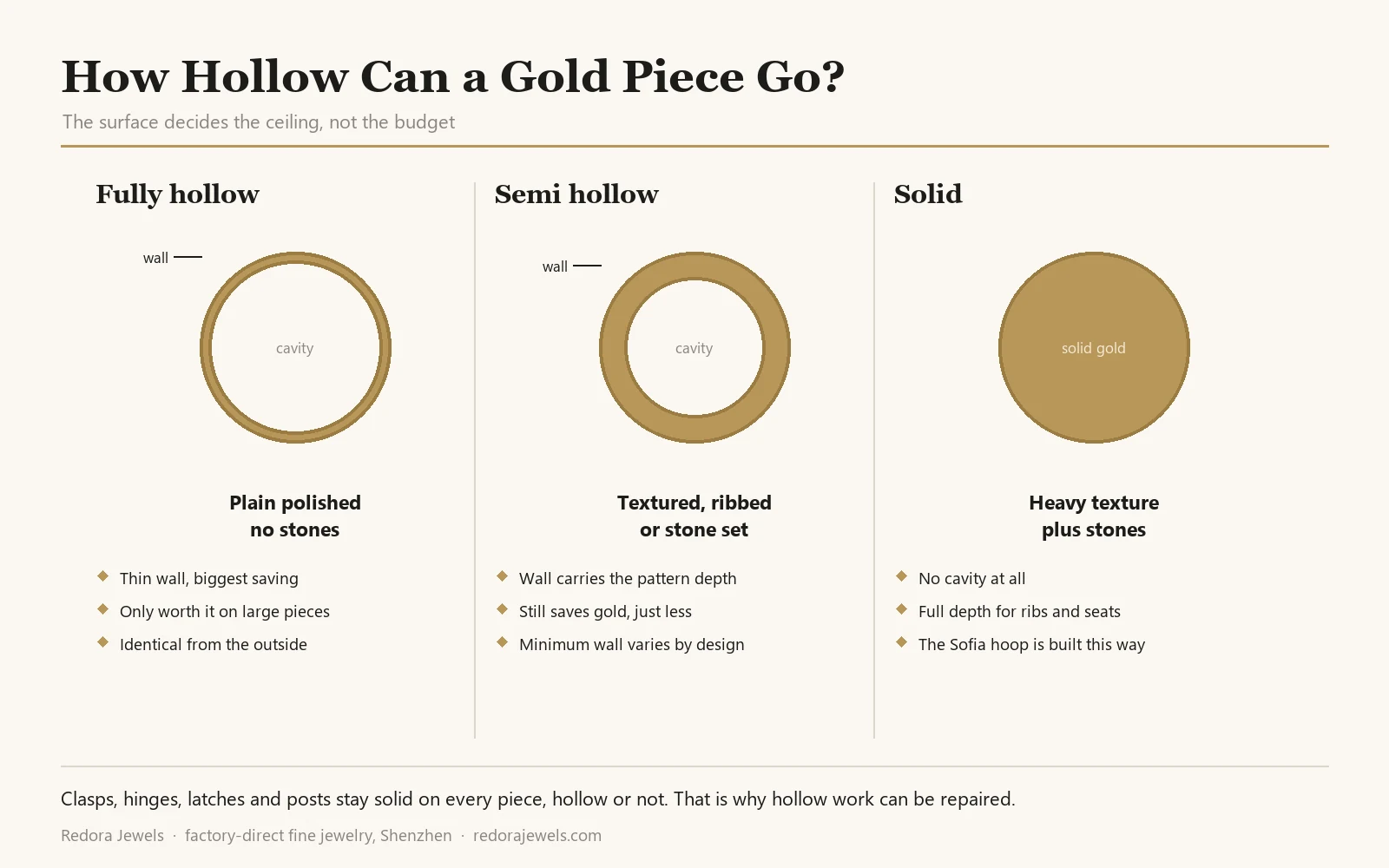
Hollow does not mean the whole piece is empty
This is the first thing worth correcting. A hollow piece is not a shell throughout. Only the body is hollow. Every part that carries load or moves is still solid metal.
On a hollow chain the tube is hollow and the clasp is solid. On a hollow bangle the band is hollow and the hinge and catch are solid. On a hoop earring the curve of the hoop can be hollow while the hinge, the post, and the latch stay solid.
That split is the reason hollow pieces can be repaired at all. The parts that break are almost always the parts we never hollowed.
Where hollowing saves, and where it saves almost nothing
What you are buying in gold is weight, and weight follows volume. A hollow tube removes volume from the middle of a section, so the saving scales with how thick the piece is to begin with.
The Sofia hoop we produce is a useful reference because it sits at the small end. It is 15.46 mm across the outside and 4.46 mm at its widest point.
| Construction | 18k gold weight, per pair | Comment |
|---|---|---|
| Solid | about 15 g | What we ship |
| Hollow | 6 to 7 g | Achievable, but see the ceiling below |
Under half the gold for the same outside dimensions, on a hoop that is only 15.46 mm across. On a piece three or four times that size the ratio gets better still, which is why hollowing is normal on wide cuffs and thick chains and rare on anything small. Below a certain section there is not enough wall left to work with, and the labor to form and close a very thin tube costs more than the gold it saves.
Two other numbers sit behind any quote we give. Casting and polishing lose about 11% of the metal that goes in, and a finished piece lands near 90% of what the CAD file predicts. Those apply to solid and hollow alike, but they matter more on hollow work because the margins are thinner.
The parts we never hollow
Clasps, hinges, latches, posts, jump rings, and anything that opens and closes repeatedly stay solid. So does any point where the piece takes a pull, such as where a chain meets a clasp or where a pendant hangs from a bail.
This is not a Redora policy so much as how the trade works, and it is worth knowing because it changes what a hollow piece actually is. A hollow chain is a solid clasp joined to a hollow tube. A hollow hoop is a solid hinge and latch joined to a hollow curve.
Texture and stones set the ceiling
Here is the part that decides most of our answers, and the reason the Sofia hoop is solid rather than hollow.
Anything cut into the surface needs metal depth to be cut into. The Sofia carries angled ribs around the full circumference of the hoop. Those ribs are formed in the gold itself, which means the wall has to be thick enough to hold the full depth of every ridge and still leave structure underneath. The same applies to stones: a setting needs enough metal below the seat to hold a stone properly, and that metal has to come from somewhere.
So the options are not simply hollow or solid:
| Surface | How hollow it can go |
|---|---|
| Plain polished, no stones | Fully hollow |
| Textured, ribbed, or engraved | Semi hollow only |
| Stone set | Semi hollow only |
| Heavily textured and stone set | Usually solid |
Semi hollow means a cavity smaller than a full tube, with enough wall left for the surface work. It still saves gold, just less of it. We do not publish a minimum wall thickness because it changes with the depth of the texture, the size of the stones, and the diameter of the piece, and a number quoted out of context would be wrong more often than it was right.
The practical consequence for a buyer is simple. A big plain gold hoop can be hollow and will look identical to a solid one. A hoop with ribs cut around it, or with a row of stones set into the face, cannot be hollowed to the same degree, and a seller offering one at a fully hollow price is either selling something thinner than it looks or has shallower texture than the photograph suggests. This sits a layer below where retail operates, which is why the question rarely comes up before a piece is bought.
What can be repaired, and what leaves a mark
A retail jeweler commenting under a jewelry video wrote that he will never sell hollow chains because “It broke again” always comes back to his counter. That is a real experience, and it is worth taking seriously. It also describes a sales problem more precisely than it describes a metal problem.
Break it into two kinds of damage and the picture is clearer.
Damage we can repair properly. A snapped link, a failed solder joint, a worn jump ring, a loose clasp, a hinge that no longer holds tension. These are all solid metal at the point of failure, and repairing them is ordinary bench work on hollow and solid pieces alike.
Damage that leaves a trace. A dent or a crushed section in a thin wall. Repairing that means pushing the metal back out rather than adding metal in, and metal that has been stretched once does not return to exactly where it started. On a plain polished surface the result is usually invisible after refinishing. On a textured surface some of the pattern is lost across the repaired area, because the ribs sitting on that wall get flattened along with it.
So the honest framing is not that hollow pieces break and solid ones do not. Plenty of people wear hollow gold daily for years without trouble. The difference is that a solid piece has more material to absorb a knock, and that a dent in a textured hollow piece is the one failure mode where the repair does not fully undo the damage.
On a hinged hoop the weak point is not the wall
Worth separating out, because it applies whether the hoop is hollow or solid. On hinged hoops the part that fails first is the hinge, not the body. It is the only component that moves every time the earring is put on, and it is small.
We fit and test the hinge and the latch after the stones are set rather than before, and closing tension is checked by hand on every pair. It is a small step, and it addresses the failure that actually happens rather than the one buyers usually ask about.
How we answer the question now
When a client asks whether we can hollow a design, we work through it in this order: how large is the piece, what is on the surface, and where does it take load. Large and plain gets hollowed. Small gains little. Textured or stone set gets semi hollow at most. Load bearing parts stay solid regardless.
Across our earrings and the rest of our fine jewelry range the same logic applies, and we will quote a design both ways so the trade off is visible before anything is cut.
Common questions
Is hollow gold real gold?
Yes. Hollow refers to the shape of the metal, not its purity. A hollow 18k piece is the same alloy as a solid 18k piece. We run 18k at 755 parts per thousand against a 750 minimum, hollow or not.
Can hollow gold jewelry be repaired?
Most of the time, yes. Clasps, hinges, solder joints, and snapped links are solid metal and repair normally. A dent in a thin wall can be pushed back out, but if the surface carries texture, some of that texture will be lost across the repaired area.
How much lighter is hollow gold?
On the small hoop above, about 15 g solid against 6 to 7 g hollow for a pair, so a little under half the gold for the same outside dimensions. On larger and thicker pieces the proportion improves. On very small pieces it is not worth doing.
Can a textured hoop be hollow?
Semi hollow at most. The ribs are cut into the gold, so the wall has to carry the full depth of the pattern and still hold its shape. A fully hollow version of a heavily ribbed hoop is not something we would produce.
Should I choose hollow or solid?
For hollow gold hoop earrings the answer turns on size and surface. Hollow is a reasonable choice on a large plain piece where the alternative is not buying it at all, which is the situation it exists for. Solid is the better choice on anything small, anything textured, and anything you expect to keep for decades. If budget is the constraint, dropping the karat or the dimensions is often a better lever than hollowing a small piece.
About the Author and Review Process
Edwin Lin is the founder of Redora Jewels, a factory-direct fine jewelry manufacturer based in Shenzhen with on-site production. He works directly with the production team on construction methods, metal specification, and the quality standards that decide how a piece holds up over years of wear. This article was written from Redora’s own production practice, including the weight figures for the hoop discussed above, and from recurring questions clients ask when they are weighing a design against a budget.
Redora Jewels has operated as a manufacturing facility since 2011. If you want the same design quoted both hollow and solid before you decide, you can start a custom project with Redora’s production team.