Quick answer
Wrap a strip of paper around the base of your finger, mark the exact point where it overlaps, measure that length in millimeters, and match the number to the chart below. A 54.4 mm circumference is a US size 7.
Measure in the afternoon at room temperature, take the reading three times, and choose the larger size if your knuckle is wider than your finger base or the band you want is 6 mm or wider. If you would rather not measure freehand, print the ring sizer further down this page at actual size and use the cut-out strip.
Getting your ring size right before you order matters more than most buyers realize, especially when the piece is being made to your exact specifications. A ring that is even half a size off can feel wrong within weeks, and resizing a finished piece, particularly one with channel-set stones or an intricate setting, is not always straightforward. This guide covers every method you can use at home, the printable sizer we produced for clients who want a physical tool, the points where at-home readings usually go wrong, and a full conversion chart so you can order with confidence.
Why Ring Sizing Goes Wrong at Home
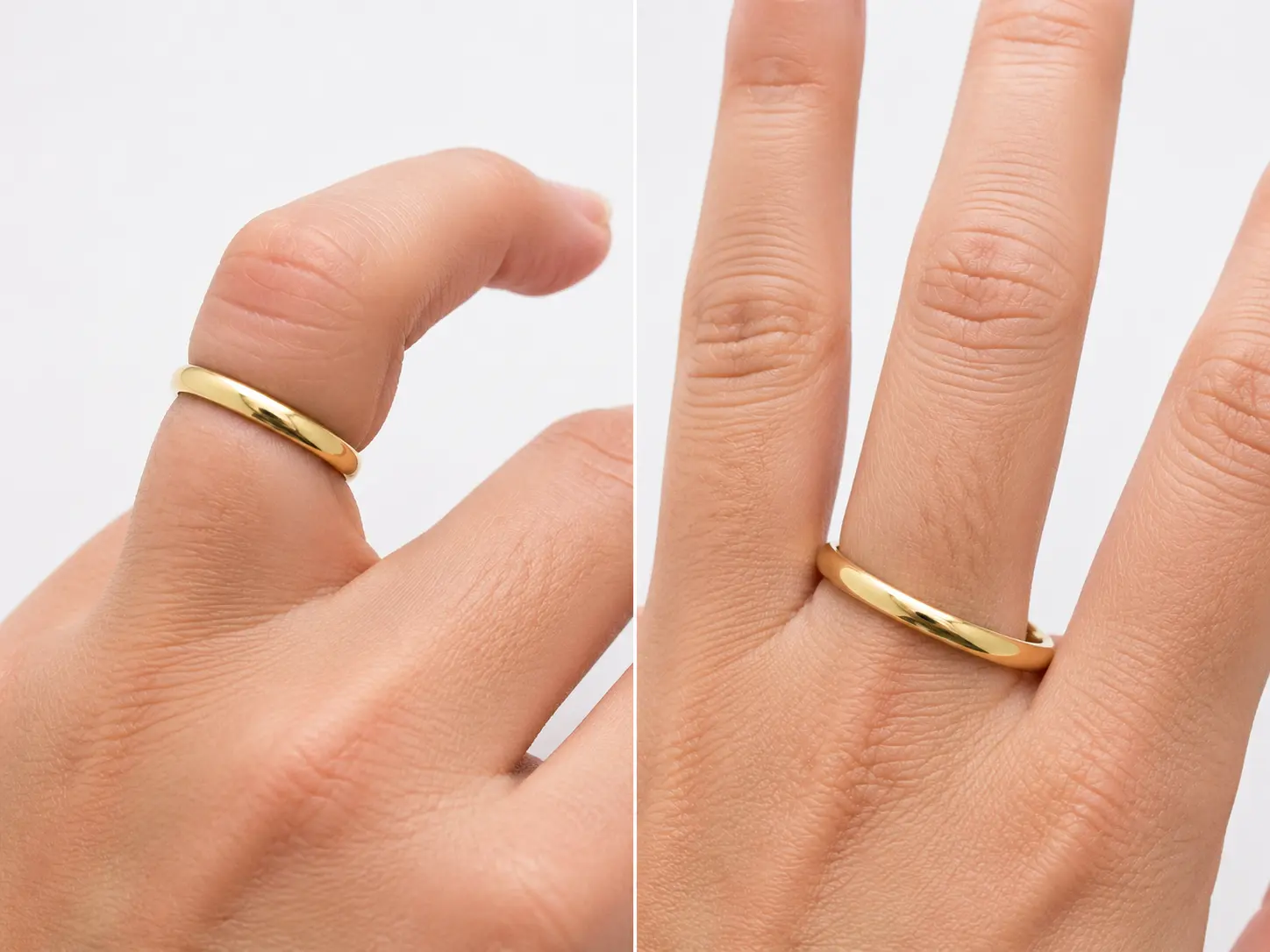
At-home sizing errors usually trace back to three practical causes: the strip is pulled too tight, the wrong finger or hand gets measured, or the result is taken once under unusual temperature conditions. Finger size shifts through the day and with the weather, so a single reading is a starting point, not a conclusion.
For a usable result, measure when your hands feel normal and are at room temperature. Avoid measuring straight after coming in from the cold, after strenuous exercise, or when your fingers feel swollen. Repeat the measurement later in the day and compare the readings before you commit to a size.
The factor that catches most buyers off guard is the gap between their knuckle and the base of their finger. Many people have knuckles that are meaningfully wider than the finger base. A ring sized for the base may not pass over the knuckle at all. A ring sized for the knuckle can spin freely once it settles at the base. Neither is comfortable, and understanding that trade-off before you order is what separates a ring you wear daily from one that stays in a drawer.
Band width adds a further layer. A ring 6 mm or wider sits tighter than a narrow solitaire at the same nominal size, because more metal means more contact with the skin. For a wide band, half a size up from your normal measurement is a sensible starting point rather than a fixed rule.
How to Measure Your Ring Size at Home: Four Methods
The most practical approach is a non-stretch paper strip plus a millimeter ruler, cross-checked against the chart below. No at-home method is foolproof. Repeat the measurement, and confirm with the maker directly when the band is wide, hard to resize, or being produced to order.
Method 1: The Paper Strip Method
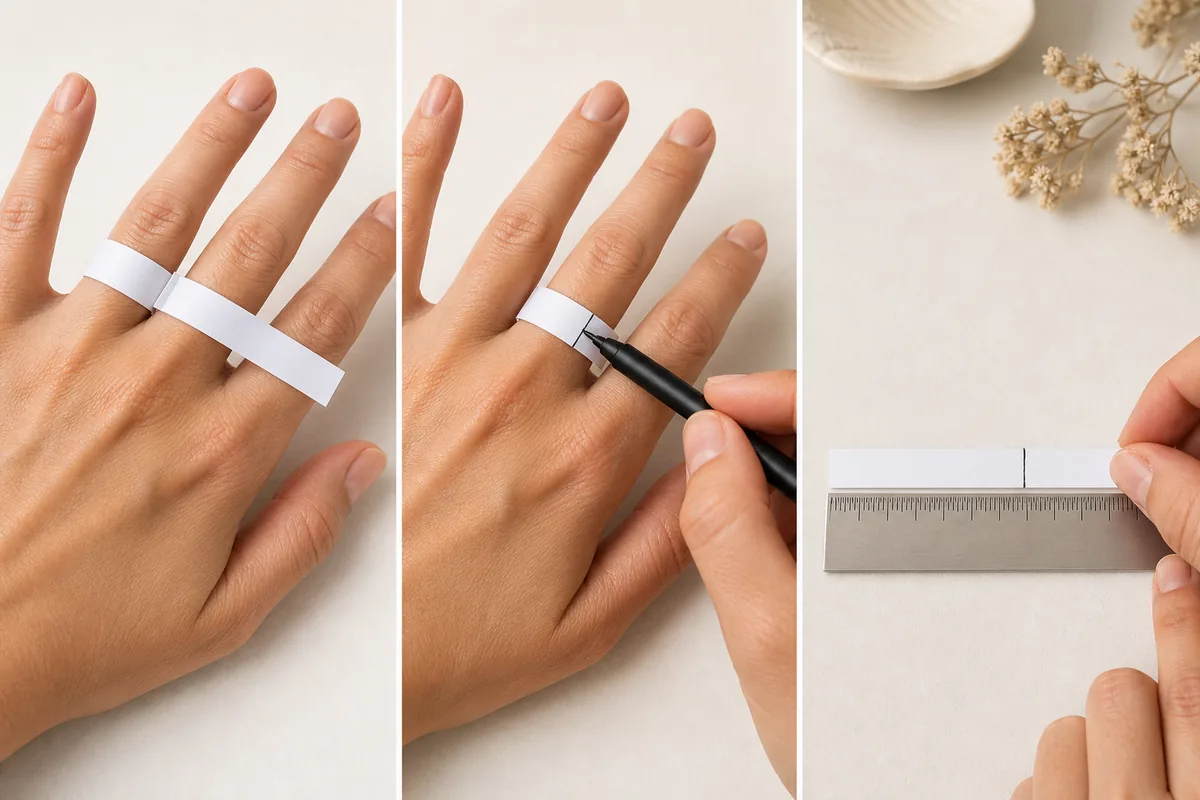
- Prepare the strip. Cut a straight strip of ordinary paper about 8 to 10 mm wide. Do not use elastic, string, ribbon, or any material that stretches.
- Wrap the correct finger. Place the strip flat around the base of the finger on the hand where the ring will actually be worn. It should touch the skin without leaving an indentation.
- Mark the overlap. Keep the strip level and mark the exact point where the free end crosses over.
- Measure in millimeters. Lay the strip flat, align its end with zero on a millimeter ruler, and measure to the mark. That number is your finger circumference.
- Repeat before choosing. Take at least two more readings. If they disagree, start again with a fresh strip rather than averaging a loose reading and a tight one.
Paper-strip accuracy check
- The strip lies flat and does not twist.
- The paper touches the skin but does not compress it.
- The mark sits at the exact overlap point.
- The strip is measured from its true end, not from the edge of the ruler.
- The result is checked against the knuckle if the knuckle is wider than the finger base.
Match the circumference in millimeters to the chart below. If the reading falls between sizes, or the ring has a wide band or stones around most of the shank, confirm the final size with the maker before production starts.
Method 2: Measure a Ring That Already Fits
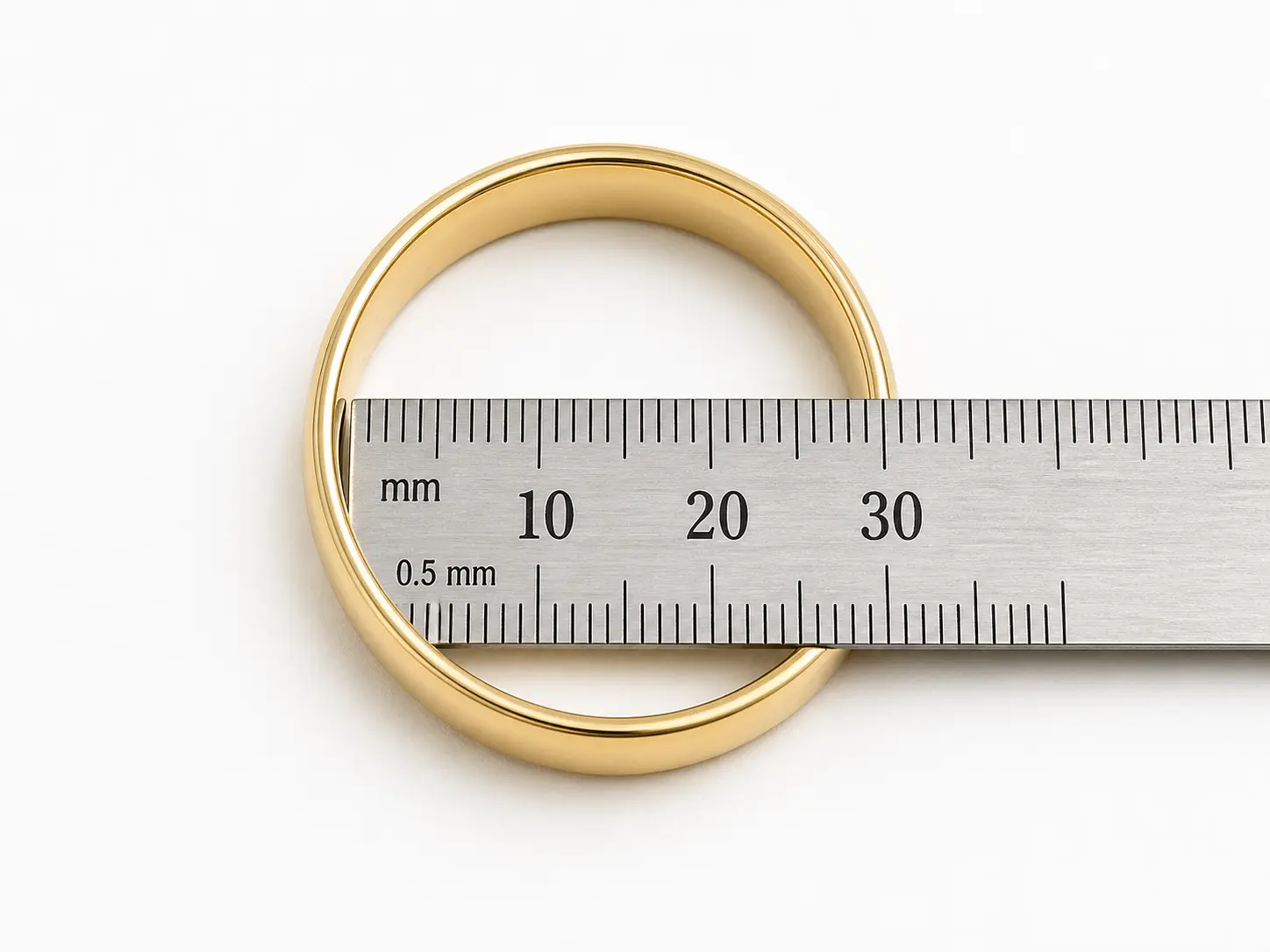
If you already own a ring that fits the right finger, place it on a flat surface and measure the inside diameter with a millimeter ruler, across the widest internal point of the circle. That diameter matches directly to the chart below.
This method is the one to use for surprise purchases, since you can borrow a ring from someone’s collection without them knowing. Make sure you are measuring a ring worn on the same finger and the same hand you are ordering for. Sizing differs between fingers, and often between the left and right hand on the same person.
Method 3: Print a Ring Sizer at Actual Size
A printable sizer only works when the file is built for actual-size printing and you verify the scale before using it. Ours includes a calibration bar for exactly that reason.
Free download
The Redora Printable Ring Sizer
One page, drawn true to scale. It holds a cut-out measuring strip marked in US sizes and millimeters, a set of circles for measuring a ring you already own, and a calibration bar so you can confirm the page printed correctly. Prints on A4 and US Letter.
Three points decide whether a printed sizer gives you a real number or a misleading one:
- Print at 100 percent. Select Actual size or 100% in the print dialog and switch off “Fit to page” and “Shrink to fit”. Scaling of even a few percent moves the result by a full size.
- Check the calibration bar first. Hold a ruler against the 100 mm bar on the sheet. If it does not measure 100 mm exactly, the page printed at the wrong scale and every reading from it will be wrong.
- Use ordinary paper. Thick card does not wrap cleanly around the finger and will read a size large.
Cut out the strip, cut the slot, wrap it around the base of your finger with the printed side facing out, feed the pointed end through the slot, and pull it comfortably snug. Read the size at the slot edge.
Method 4: No Ruler and No Printer
Wrap and mark the paper strip as described in Method 1 regardless. Once the overlap is marked, the measurement is captured and you can read it against any ruler later.
To get a reading immediately, use a bank or ID card as the reference. Every card of that format has a long edge of 85.6 mm, and the standard is the same in every country. Lay the marked strip along the card’s long edge, starting flush with one corner, and see where your mark lands:
- Around halfway along the card is about 43 mm, which sits below the smallest commonly stocked size.
- Around two-thirds along the card is about 57 mm, which is close to a US 8.
- Around three-quarters along the card is about 64 mm, which is close to a US 11.
Judging a fraction by eye narrows you to a range of two or three sizes rather than a single one, so treat this as a way to get close before confirming with a ruler or with us. If string is genuinely all you have, be careful: string stretches under tension and usually reads larger than the true circumference. Wrap it with almost no tension, mark the overlap, then take it off and lay it flat without pulling before you measure.
Mistakes That Throw the Measurement Off
- Measuring a different finger, or the opposite hand.
- Pulling the paper tight enough to leave an indentation in the skin.
- Using string, elastic, or anything else that stretches.
- Measuring once, or measuring when the hand is unusually cold or swollen.
- Ignoring a knuckle that is wider than the finger base.
- Applying the same assumption to a narrow solitaire and a wide wedding band.
- Printing a sizer without checking its calibration bar.
For a high-value or made-to-order ring, use the home measurement to narrow the likely size, then send the maker your circumference, your knuckle measurement, the intended band width, and the sizing system you are quoting.
Ring Size Chart: US, UK, EU, Japan, and Millimeter Conversions
The table covers the US, UK and Australian, European, and Japanese systems alongside inner diameter and circumference in millimeters. These figures align with the standards used across the industry. Variations of 0.2 mm to 0.3 mm between manufacturers are normal production tolerance, so if your measurement sits very close to the boundary between two sizes, confirm with the manufacturer before the order is finalized.
| US Size | UK / AU | EU Size | Japan | Diameter (mm) | Circumference (mm) |
|---|---|---|---|---|---|
| 3 | F | 44 | 4 | 14.1 | 44.2 |
| 3.5 | G | 45-46 | 5 | 14.5 | 45.5 |
| 4 | H | 47 | 7 | 14.9 | 46.8 |
| 4.5 | I | 48 | 8 | 15.3 | 48.0 |
| 5 | J-K | 49-50 | 9-10 | 15.7 | 49.3 |
| 5.5 | K-L | 51 | 11 | 16.1 | 50.6 |
| 6 | L-M | 52 | 12 | 16.5 | 51.9 |
| 6.5 | M-N | 53-54 | 13 | 16.9 | 53.1 |
| 7 | N-O | 54-55 | 14 | 17.3 | 54.4 |
| 7.5 | O-P | 56 | 15 | 17.7 | 55.7 |
| 8 | P-Q | 57 | 16 | 18.1 | 57.0 |
| 8.5 | Q-R | 58 | 17 | 18.5 | 58.3 |
| 9 | R-S | 59-60 | 18 | 18.9 | 59.5 |
| 9.5 | S-T | 61 | 19 | 19.4 | 60.8 |
| 10 | T-U | 62 | 20 | 19.8 | 62.1 |
| 10.5 | U-V | 63 | 21 | 20.2 | 63.4 |
| 11 | V-W | 64-65 | 22 | 20.6 | 64.6 |
| 11.5 | W-X | 66 | 23 | 21.0 | 65.9 |
| 12 | X-Y | 67 | 24 | 21.4 | 67.2 |
| 12.5 | Y-Z | 68 | 25 | 21.8 | 68.5 |
| 13 | Z | 69 | 26 | 22.2 | 69.7 |
How to Read the Chart from a Millimeter Measurement
Which column you use depends on which method you used. A paper strip or a printed sizer gives you circumference, so read the last column and take the closest match. Measuring a ring you already own gives you inner diameter, so read the second-to-last column instead. Mixing the two is the single most common misreading, and it produces an error of several sizes rather than a fraction of one.
If your number lands between two rows, note both sizes and read the section below before choosing. For reference, women ordering engagement rings most often fall between US 5 and US 7, and men’s sizes tend to cluster between US 9 and US 11. Those are population tendencies rather than predictions, and your own measurement always takes priority over an average.
Caught between two sizes? Weigh the intended band width against our ring styles, then send us the circumference and knuckle measurements before a custom ring goes into production.
When to Size Up or Down
The right ring size is not always the one your measurement produces. Several situations shift the calculation, and knowing them before you order is worth more than any chart.
Prominent Knuckles
If your knuckle is noticeably wider than the base of your finger, measure both and consider splitting the difference toward the larger number. A ring that cannot pass the knuckle is unwearable. A ring slightly loose at the base can often be corrected with a sizing bead added by the manufacturer or a ring size adjuster insert. If you are ordering a custom piece and your two measurements differ significantly, send both numbers so the fit can be planned around them.
Wide Band Rings
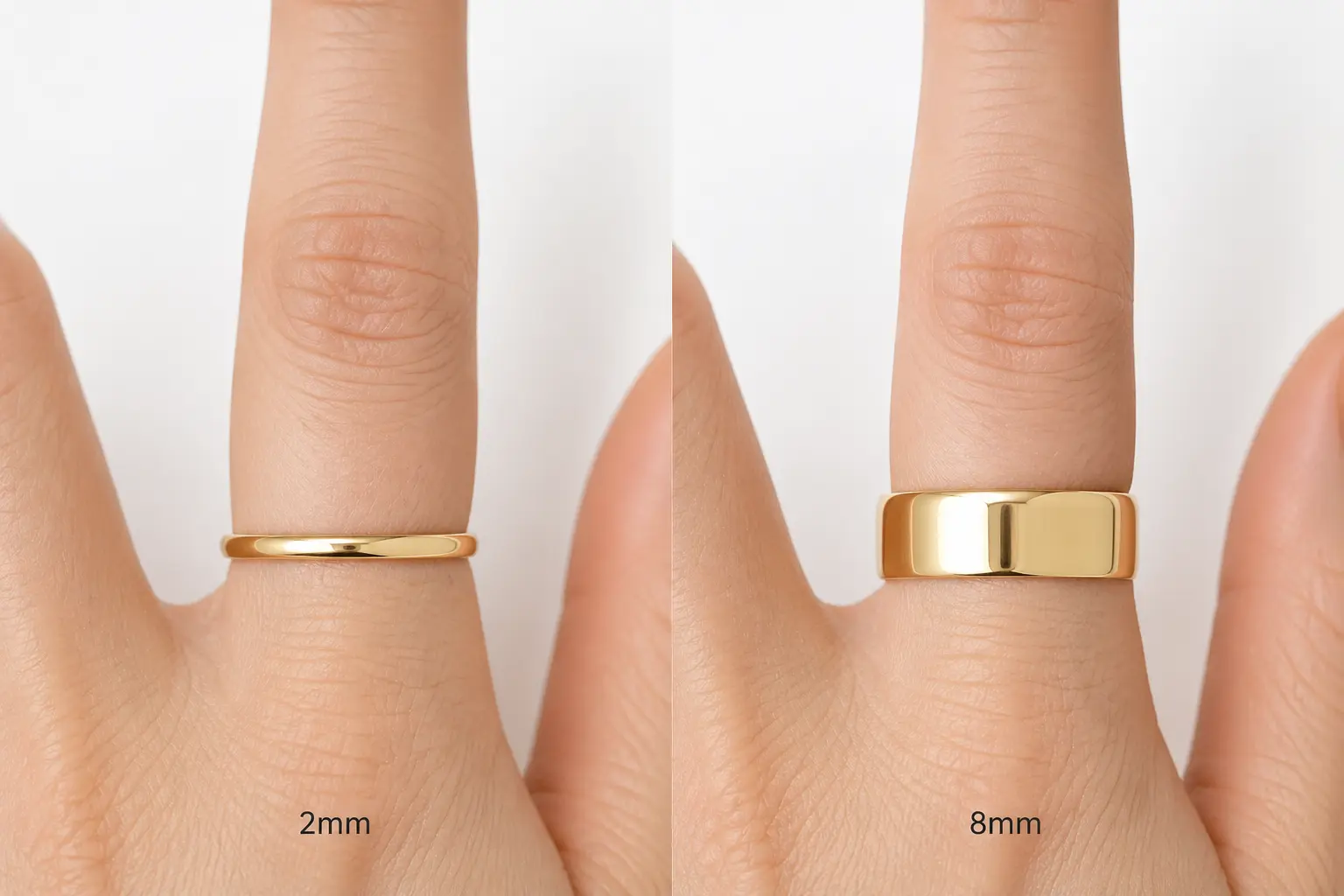
A band 6 mm or wider will feel tighter than a standard 2 mm to 3 mm solitaire shank at the same nominal size, because the extra surface area grips more skin. The effect grows with width, so an 8 mm band is noticeably tighter again than a 6 mm one. As a working rule, start half a size larger than your usual size for any wide band. This is also the one case where the paper strip can be calibrated to the design: cut the strip to the width of the band you are ordering rather than a thin strip, and the reading will reflect how that specific band will actually feel.
Temperature, Season, and Hydration
Fingers run smaller in cold conditions and larger in heat or humidity. If you live somewhere with a wide seasonal swing, your comfortable size in January may not be your comfortable size in July. For a ring you plan to wear daily, measuring in moderate conditions rather than at either extreme gives the most wearable long-term fit. If you are buying for someone in a very different climate, that is worth factoring in when choosing between two close sizes.
Pregnancy and Significant Weight Changes
Pregnancy and significant weight changes both affect finger size. If your size is actively changing, consider delaying a made-to-order ring, or discuss a future resizing plan before you settle on the design. Full eternity bands, channel-set rings, and other stone-heavy shanks offer less resizing flexibility than simpler bands.
Metal Type and Resizing Limits
Whether a ring can be resized depends on both the metal and the construction. Many gold and platinum designs can be adjusted, but the safe range varies with the setting, stone coverage, engraving, and band structure. Tungsten carbide and ceramic rings generally cannot be resized the way precious-metal rings can, and titanium is design-dependent. Confirm the resizing limits for the exact ring before ordering rather than relying on a universal number of sizes. We break the construction side of this down in rings that cannot be resized, including how far the working range drops once stones reach the shoulders.
Ring Sizing Questions Buyers Ask Us
How can I tell my ring size at home without a ring sizer?
Use the paper strip method above, or measure a ring you already wear on that finger. Both need only paper and a millimeter ruler. The printed sizer on this page gives you a physical tool if you would rather have one, and it costs nothing but a sheet of paper. What all three have in common is that they are more reliable than guessing from a glove size or a family member’s size.
How do I determine my ring size with string?
String is the least reliable option because it stretches under tension, which pushes the reading larger than the true circumference. If string is genuinely all you have, wrap it with almost no tension, mark the overlap, then remove it and lay it flat without pulling before you measure. Compare that number against a second reading taken with paper. Where the two disagree, trust the paper.
How accurate is measuring your ring size at home?
A careful paper measurement, repeated three times at a sensible time of day, usually lands within about half a size of the correct answer. That is close enough to order a simple band with confidence, and close enough to narrow the choice to two adjacent sizes on anything more complex. It is not equivalent to being measured on a professional mandrel, and for a wide band or a stone-heavy shank that half-size margin is the difference between comfortable and unwearable. Treat the home reading as a strong starting point that you confirm with the maker.
How do I figure out someone else’s ring size without asking?
Borrowing a ring they already wear on the target finger and measuring its inner diameter is the most accurate approach by a wide margin. If you cannot borrow one, tracing the inside outline of one of their rings on paper gets you close. Asking a close friend or family member who may already know is the next best option. Failing all of that, ordering at a common size and planning for a resize after the proposal is entirely normal, and most solitaire and halo settings can be resized within a range without affecting the stone or the setting.
What if my measurement falls between two sizes?
Take the larger size if your knuckle is wider than your finger base, if the band is 6 mm or wider, or if you tend to run warm. Take the smaller size if the band is thin, your knuckle is not pronounced, and your hands run cold. When the piece is being made to order, send both readings rather than choosing yourself, since the production team can build to the measurement instead of rounding to a stock size.
Does the time of day really change your ring size?
Yes, and enough to matter. Fingers are at their smallest in the morning and swell modestly through the day, with heat, salt, and exercise all adding to the effect. Measuring at the two extremes can produce readings that fall on different sides of a size boundary, which is exactly why a single reading is unreliable. Late afternoon at room temperature is the most representative moment for a ring you intend to wear every day.
Can I measure my ring size with a phone app?
Phone-based sizers work by asking you to place a real ring on the screen and scaling it against a reference object, so their accuracy depends entirely on the screen calibration step being done correctly. They are convenient for a quick estimate, but they carry the same weakness as an uncalibrated printout: if the scale is off, so is every reading. If you use one, cross-check the result against a paper measurement before ordering.
How do I know when a ring actually fits?
A correctly sized ring should slide on with light resistance, need a gentle push to clear the knuckle, and resist slightly when you pull it straight off. It should rotate around the finger without effort but should not slip off when your hand hangs down. If it spins freely and slides off easily, it is too large. If you cannot get it past the knuckle without soap, it is too small.
Ordering a Custom Ring When You Are Not Sure of the Size
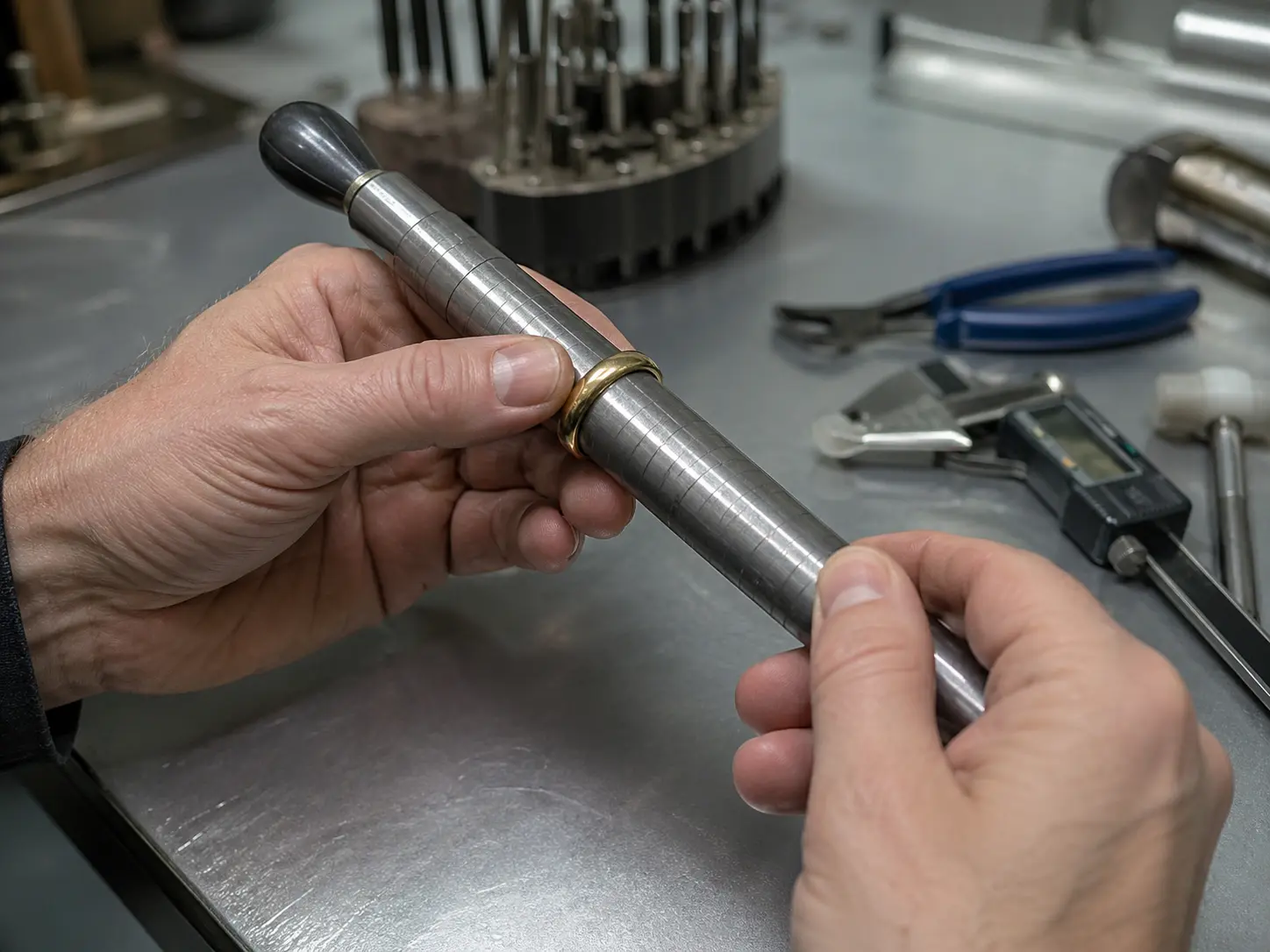
Custom fine jewelry ordered directly from a manufacturer allows more flexibility on sizing than most buyers expect. When a ring is made to order rather than pulled from stock, the target size goes into the piece from the beginning, which is inherently more precise than adjusting a finished ring afterward.
If you are ordering an engagement ring as a surprise and cannot get an accurate measurement, the approaches in the FAQ above reduce the risk considerably. For wedding bands, the process is usually simpler, since both partners can be measured in advance with no element of surprise.
When you commission a fully custom jewelry piece, sharing both your finger base measurement and your knuckle measurement lets the production team optimize the fit for your specific anatomy, which an off-the-shelf piece cannot do. At Redora we ask clients for both numbers whenever the design calls for it, and our production team treats sizing as part of the manufacturing process rather than an afterthought.
If you are ready to move forward, you can send your sizing details and open a custom ring inquiry with our production team directly from our site. It starts with a straightforward consultation, not a sales pitch.
About the Author and Review Process
Edwin Lin is the founder of Redora Jewels, a factory-direct fine jewelry manufacturer operating in Shenzhen with on-site production oversight and direct involvement in client consultations from first inquiry through delivery of the finished piece. Edwin’s background spans custom jewelry manufacturing, gemological quality evaluation, and the practical realities of producing fine jewelry at scale while holding individual fit and finish standards.
The guidance here was developed from two sources. The first is the set of sizing questions and fit problems that Redora’s production team encounters when clients submit custom orders, particularly on engagement rings and wedding bands, where a sizing error is most consequential. The second is the established industry standard for ring sizing, including the diameter and circumference conversions that align with the tolerances professional jewelers work to. The printable sizer on this page was drawn to those same figures and proofed against a physical ruler before publication. Where research surfaced common misconceptions, such as the idea that one measurement at one time of day is enough, this article addresses them directly rather than repeating generic advice.
This article exists to answer one practical buyer question: how do I measure my ring size accurately at home before placing a custom order, and what do I do when I am still not certain? If your sizing question is not covered here, our team is available before you commit to an order.
More from Redora: all jewelry buying guides