An initial ring is worth it when it is built to survive daily wear, and a disappointment when it is not. The letter looks the same in a product photo either way. What separates the two is construction: how the letterform is made, how the stones are held, and whether the thin parts of the letter have enough metal behind them. Below is what to check before you buy, in the order that actually matters.
The two ways a letter ring is built
Almost every initial ring falls into one of two categories, and the difference affects both price and lifespan.
Solid cast letter. The letter is cast as one continuous piece of gold, then small stones are set into holes drilled along its surface. This is the stronger build. The letter is a single piece of metal, so there is no weak joint to fail. It also reads as gold first and sparkle second, because the metal body of the letter is what you see.
Linked bezel letter. There is no gold letterform underneath. Each stone sits in its own small bezel, and the bezels themselves are joined together to draw the shape. The letter is made of stones rather than decorated with them. This produces a much lighter, brighter effect, because the line of the letter reads as light rather than as metal.
The trade is straightforward. A linked bezel letter looks better and is structurally more demanding, since each connection between bezels is a place the ring could bend or break. The lab diamond letter ring in our own line is built this second way, with forty-six stones forming the letter and nothing solid underneath.
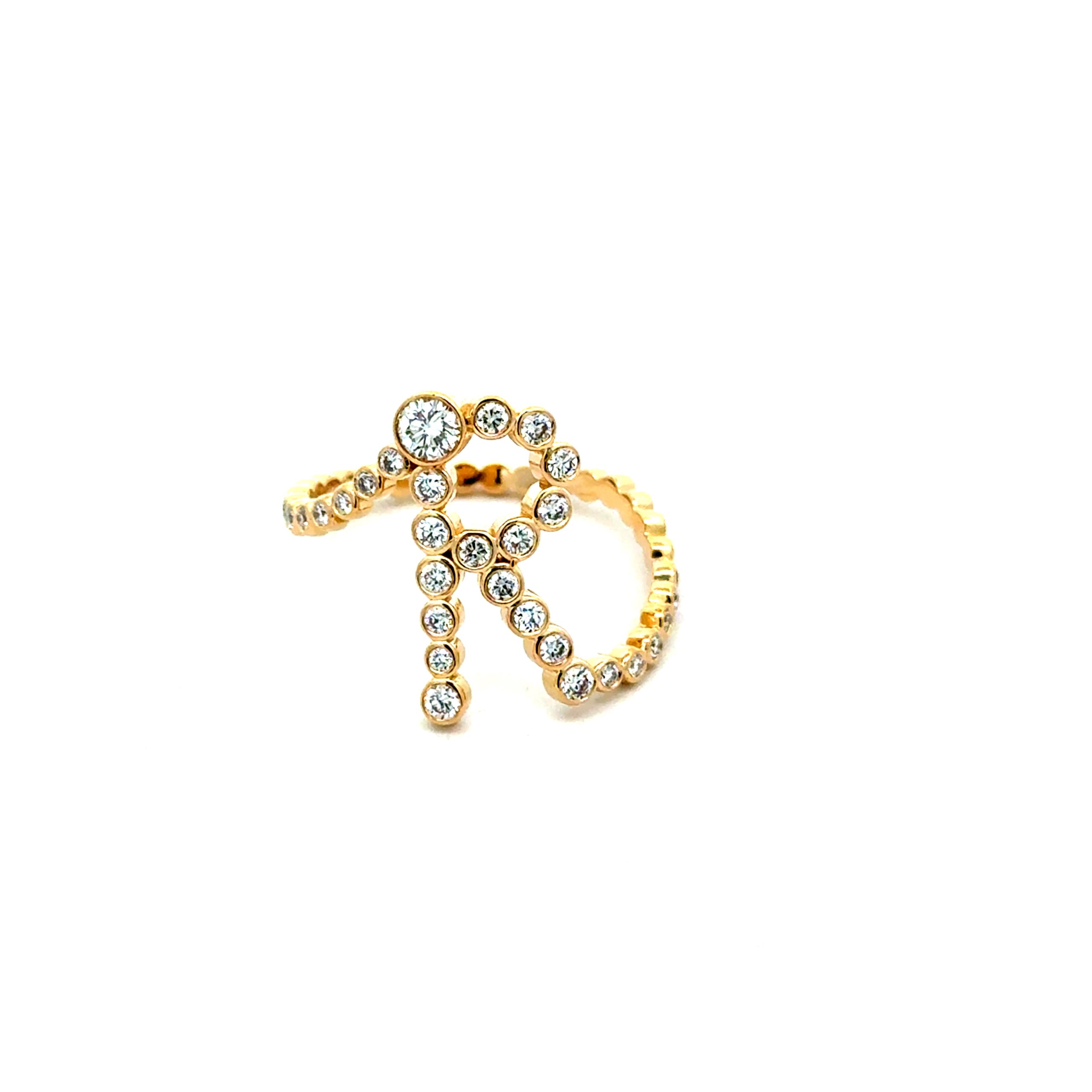
Neither is wrong. But if a seller cannot tell you which one you are buying, that is worth noting.
Why round letters cost more than straight ones
This surprises most people, and it is purely geometric.
A letter with continuous curves, such as R, S, G, C, or O, needs many more small stones to keep the line smooth. Every added stone means another seat cut into the metal and another connection between settings. An angular letter such as L, T, I, or E can be drawn with far fewer stones along straight runs.
So two rings in the same metal, same total carat weight, and same finish can differ noticeably in price and production time purely because of which letter was ordered. If you are quoted the same price for every letter in the alphabet, the design is probably a solid cast letter, or the stone count is low.
What actually fails on a poorly made initial ring
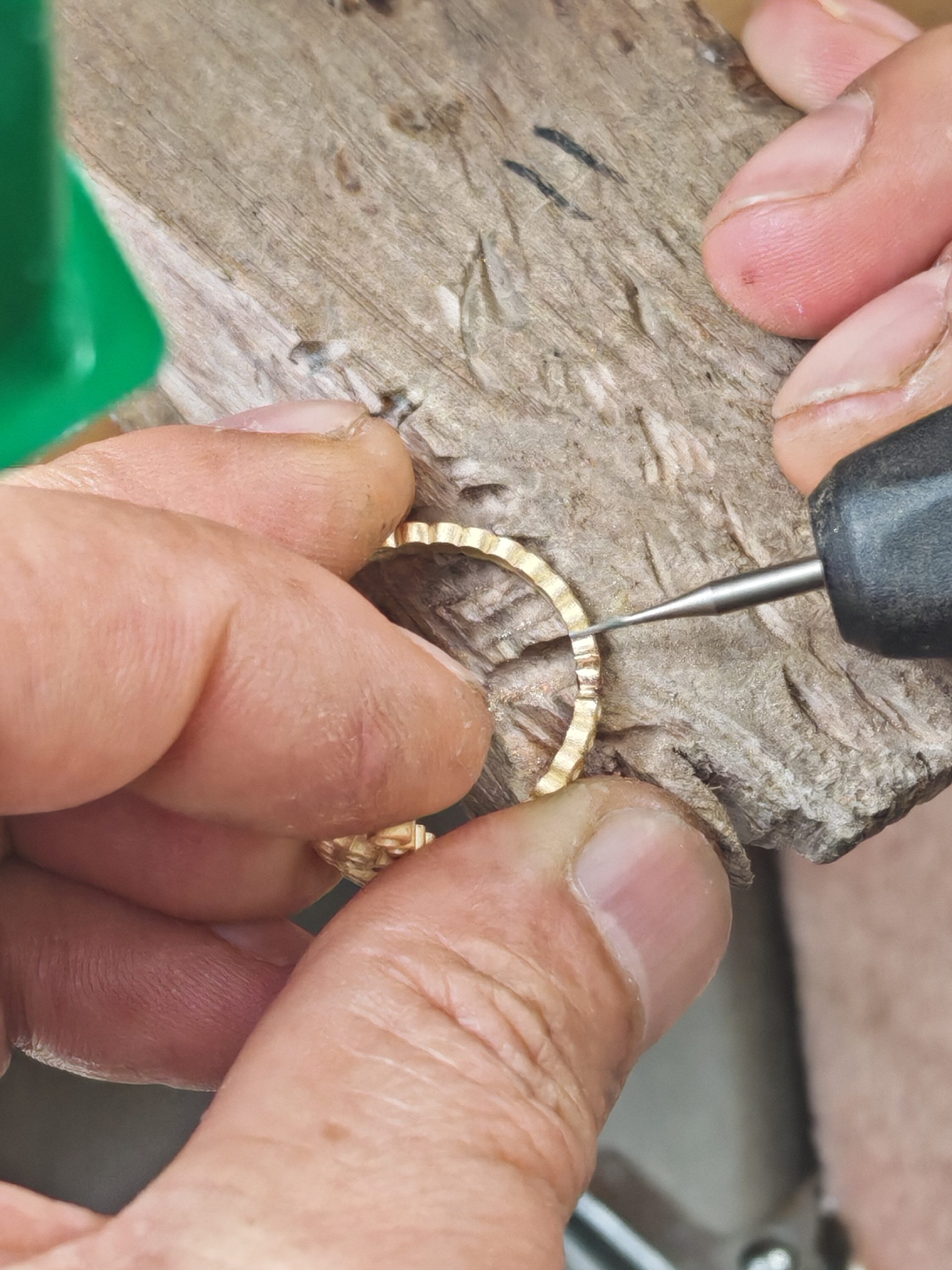
In practice the failures cluster in a few predictable places, and none of them involve the letter simply falling apart.
- Bent connections. On a linked bezel build, the bridges between settings are the thinnest metal on the piece. If they are undersized, ordinary wear slowly distorts the letter until it stops reading cleanly.
- Stones sitting too high. A setting seat cut too shallow leaves the stone proud of the metal, where it catches on knitwear and pockets. This is the most common complaint about letter jewelry and it is entirely a workmanship issue.
- Dark stones. A seat cut too deep sinks the stone below the surrounding metal, and it stops returning light. From a distance the letter looks patchy rather than even.
- Shadowy recesses. The gaps between settings cannot be reached by a standard polishing wheel. If they were not finished by hand, they read as grey shadow and the letter loses its crispness within weeks.
None of this is visible in a catalogue image. It becomes visible on a hand, in daylight, after a few months.
Stone choice: what matters at this size
Letter jewelry uses very small stones, often around two hundredths of a carat each. At that size, individual stone quality matters less than consistency across the whole set.
One stone that is slightly warmer in colour or cut a little differently will break the line of the letter, and your eye will land on it every time. Matching forty or more stones closely is the real requirement, not chasing a high grade on any single one.
This is one area where lab grown diamonds genuinely help, and not for the reason usually given. Consistent small stones are simply easier to source in matched sets, which is exactly what an even letterform needs.
Metal and karat for something worn every day
Initial rings tend to be worn constantly rather than kept for occasions, so the metal choice should follow that.
- 14k is the practical default for daily wear. It is hard enough to resist the small knocks that distort fine detail.
- 18k gives a richer colour and is a little softer. It suits a design with more metal mass and slightly less exposed fine detail.
- 9k and 10k are harder still and more affordable, which is why they appear often in letter pieces such as this personalized initial bracelet.
Gold plated and vermeil versions of letter jewelry exist at much lower prices. They photograph identically. The difference appears when the thin plating wears through on the raised parts of the letter, which happens quickly on a piece that is handled every day.
Sizing, and why it is not a small detail
A plain band can usually be resized in either direction without much trouble. A letter ring often cannot.
When stones run around the band, or when the letter sits across the top and the shank carries settings on both sides, there is limited plain metal available to cut and rejoin. Resizing may be restricted to a very narrow range, or ruled out entirely.
The practical implication: measure carefully before ordering, and ask directly whether the specific design can be resized later. For a piece intended as a gift, this question matters more than it does for a plain band.
So are they worth it?
For a piece you intend to wear daily, yes, provided you are buying solid metal and honest construction rather than plating and a photogenic angle. The letter is personal in a way a generic band is not, and a well built one holds up for decades.
What makes the difference is not the design on screen. It is the setting seats, the thickness of the connections, and the hand finishing in the places a machine cannot reach. Those are decided during production, and they are the reason two visually identical rings can behave completely differently after a year.
The same logic applies across personalized fine jewelry, whether that is a letter ring, a bracelet, or a custom diamond name necklace. Small stones and fine linework raise the standard of workmanship required.
Frequently Asked Questions
Do initial rings bend out of shape?
A well made one does not. Bending happens when the connections between settings are too thin for the wearer’s daily activity. Ask about construction rather than assuming all letter rings behave the same.
Why is my letter more expensive than my friend’s?
Most likely because your letter has curves. Round letters need more stones and more individually cut settings than angular letters, even at identical carat weight.
Can an initial ring be resized?
Sometimes, within a narrow range. It depends on how much plain metal exists in the shank. Confirm before ordering rather than after.
Are gold plated initial rings worth buying?
For occasional wear, they are reasonable. For daily wear they are not, because plating wears through fastest on exactly the raised detail that makes the letter readable.
What stone size is normal in a letter ring?
Very small, often around 0.01 to 0.03 carats per stone. Total carat weight below one carat is normal, and matched consistency matters more than any individual stone grade.
Is a letter ring a good gift if I do not know their ring size?
A letter bracelet or necklace is safer, since sizing is more forgiving. If a ring is the goal, confirm the size first, because resizing options are limited on stone set designs.
About the Author and Review Process
Edwin Lin is the founder of Redora Jewels, a factory-direct fine jewelry manufacturer based in Shenzhen with on-site production and hands-on gemology oversight. He works directly with the production team on stone setting, letterform development, and the quality standards that determine how fine detail holds up to daily wear. This article draws on Redora’s production experience with letter and personalized jewelry, along with recurring questions from customers comparing designs before ordering.
If you want a letter piece built for everyday wear rather than for a photograph, from the construction method to the stone matching, you can start a custom project with Redora’s production team. You can also see how we approach personalized work across our custom jewelry service, or view the wider rings range.
More from Redora: all jewelry buying guides