How this guide was prepared: This article combines common buying questions from custom jewelry clients, production-side observations from our Shenzhen facility, diamond shape proportion standards, and practical comparisons used when advising buyers on sparkle, face-up size, wearability, and style direction.
Choosing a diamond is one of the most personal decisions in fine jewelry. Yet for many buyers, the first major decision is one that often gets overlooked: the shape. Before you consider carat weight, color, or clarity, the outline of the stone sitting on the finger defines everything about the look, feel, and personality of a piece. This guide walks through all the major options, explains what the research and numbers actually mean for everyday wearers, and helps you zero in on the right choice for your style, budget, and lifestyle.
Quick summary: Round brilliant diamonds are usually the best choice for maximum sparkle. Oval, pear, and marquise shapes often look larger for the same carat weight. Emerald and asscher cuts suit buyers who prefer clean lines and higher clarity. Cushion, oval, and radiant shapes are often the easiest balance between beauty, wearability, and budget.
Diamond Shape vs. Cut: Key Differences Explained
Definition: Diamond shape is the outer outline you see from above. Diamond cut is the quality of the faceting inside that outline and how effectively it handles light.
Diamond shapes refer to the geometric outline of a stone as viewed from above. It is the silhouette: round, square, oval, rectangular, or pear-shaped. The cut, by contrast, describes how the facets are arranged inside that silhouette to interact with light. Two diamonds can share the same shape but have dramatically different cut quality grades, and therefore dramatically different levels of brilliance.
This distinction matters because many buyers confuse shape with cut when shopping. A poorly cut round diamond will look dull no matter how familiar and classic that outline appears. A beautifully cut emerald-shaped stone will glow with a completely different character from a well-cut round, but it will still glow. Understanding that these are separate variables gives you far more control over the final result.
When helping a buyer compare shapes, Redora’s production team looks at the face-up outline, millimeter dimensions, visible light pattern, vulnerable corners, and the setting that will protect the stone. Shape is the starting point; an individual diamond still needs to be assessed on its own proportions, polish, symmetry, and visual performance.
Brilliance, Fire, and Scintillation: What Changes by Shape
Brilliance is the white light returned to the eye. Fire is the separation of light into spectral colors. Scintillation is the pattern of bright and dark flashes seen as the diamond, light, or viewer moves. Buyers often group all three under the word “sparkle,” but they do not look identical.
Brilliant and mixed faceting usually breaks reflections into many smaller, lively flashes. Step cuts such as emerald and asscher use long parallel facets that create broader, more mirror-like flashes. Neither character is universally better: one feels energetic, while the other feels calm and architectural.
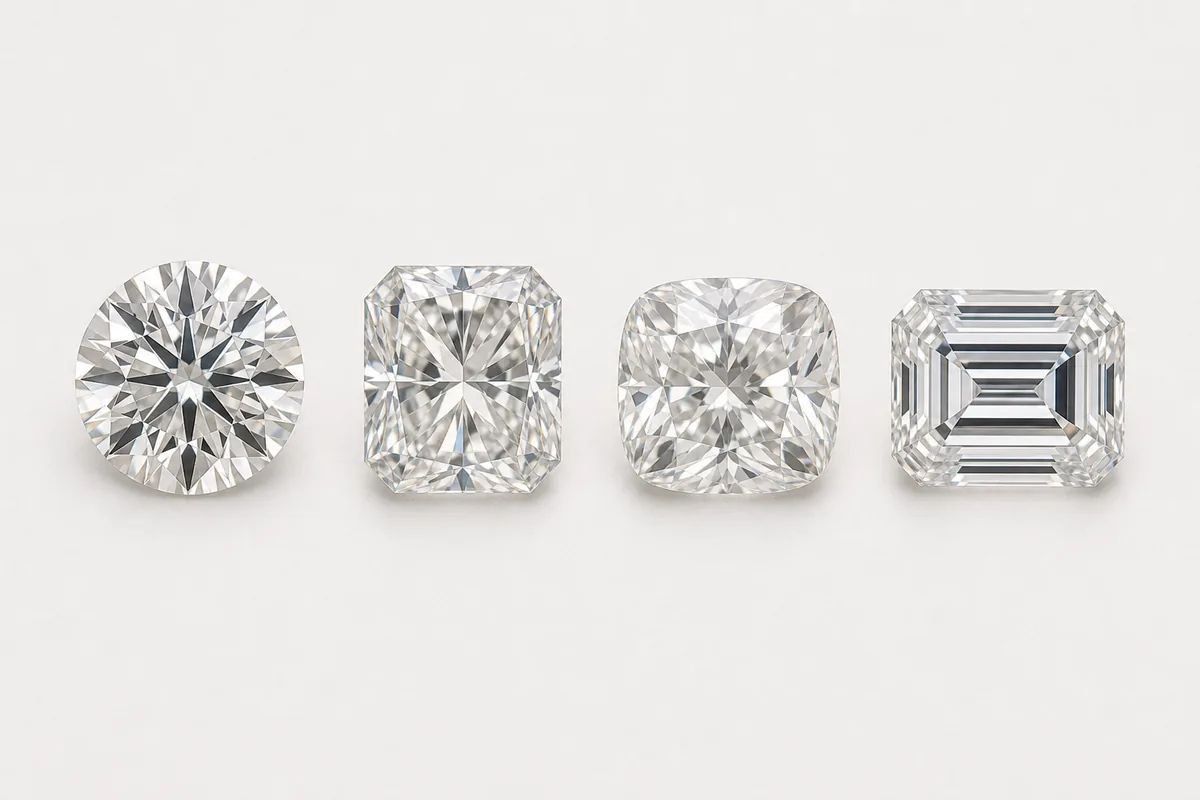
Practical comparison: Ask to see the actual diamond face-up in video under diffused daylight and a more directional light. Look for brightness across the whole stone, balanced contrast, and any persistent dark area. A static image can explain facet character, but it cannot grade the performance of an individual diamond.
Top 10 Diamond Shapes: Features, Facets, and What to Expect
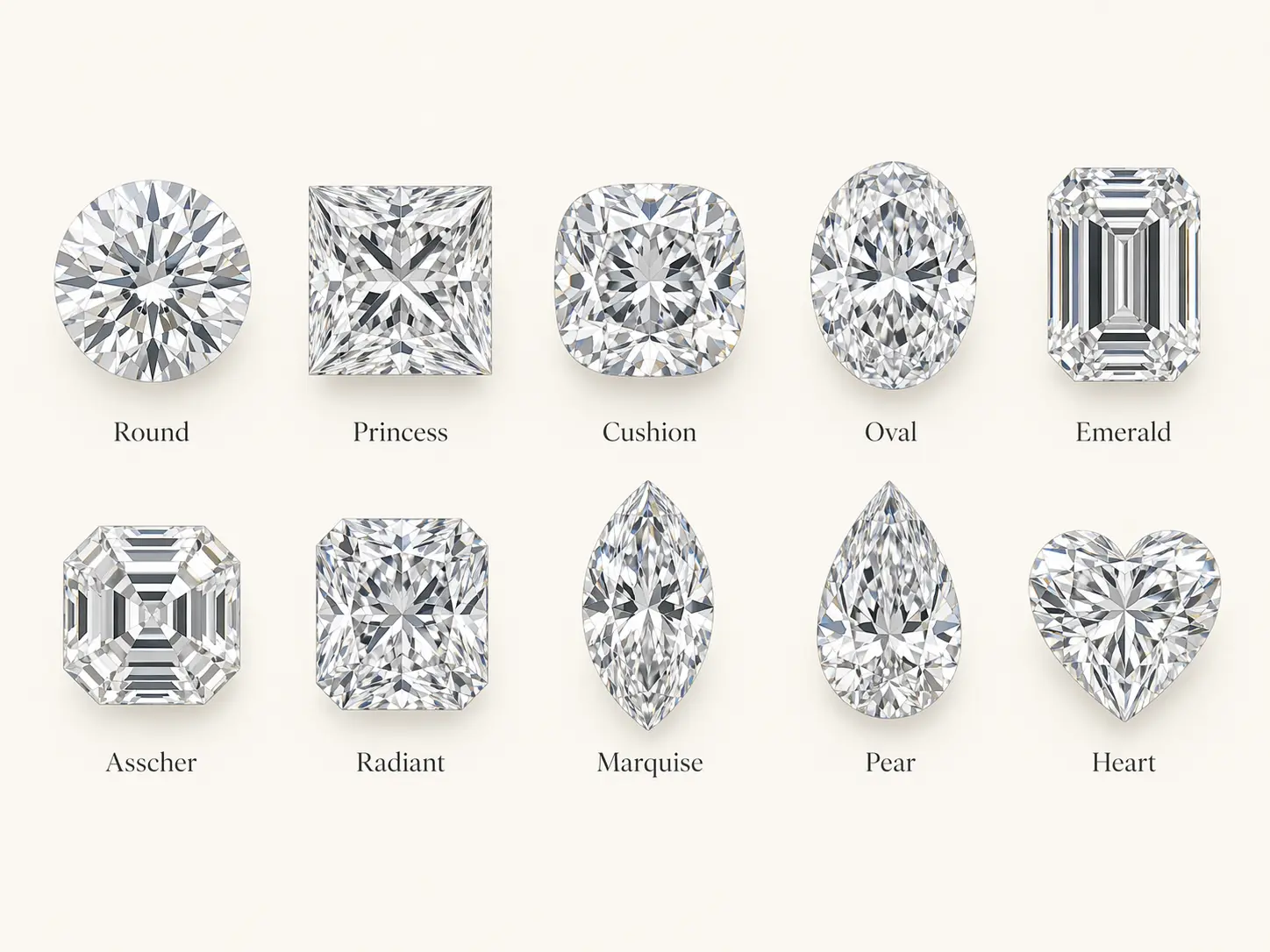
Ten core shapes account for the vast majority of diamonds set in engagement rings and other jewelry worldwide. Here is a practical overview of each, including visual character, value considerations, and the type of buyer each shape tends to suit best.
Round Brilliant
The round brilliant is the most standardized shape for comparing cut quality and is often chosen when lively white-light return, fire, and scintillation are the priority. Many modern round brilliants have 57 or 58 facets depending on whether a culet is counted, but facet count alone does not guarantee strong performance. Proportions, symmetry, polish, and the individual stone’s light pattern matter more. Round diamonds also often command higher per-carat pricing than fancy shapes, although market price varies by grade and supply. The shape also anchors multi-stone layouts well, as in our round three stone vintage engagement ring.
Choose round brilliant if your top priority is maximum sparkle and timeless familiarity.
Princess
The princess cut is one of the most popular square diamond shapes in bridal jewelry. It is a square silhouette with pointed corners and a modified brilliant faceting pattern that produces strong sparkle. Its sharp corners require protective prong settings to reduce chipping risk.
Choose princess cut if you want a square diamond with crisp lines and lively brilliance.
Cushion
The cushion cut blends a square or rectangular outline with rounded corners and larger facets that scatter light in a softer, more romantic pattern. It works well in both vintage-inspired and contemporary settings, and its softer corners generally make it easier to wear than sharper square shapes.
Choose cushion cut if you want softness, warmth, and a versatile shape that works in many ring styles.
Oval
The oval combines an elongated outline with brilliant-style faceting. It can provide more length across the finger than a round diamond of the same weight, but actual face-up spread depends on millimeter measurements, depth, and cut execution. There is no universal “ideal” length-to-width ratio: many buyers prefer something between about 1.30 and 1.50, but the right outline is a style choice. Bow-tie visibility must be checked on the individual stone rather than predicted from ratio alone.
Choose oval cut if you want lively sparkle with a softer, elongated outline.
Oval Diamond Length-to-Width Ratio: Shorter vs. More Elongated
Length-to-width ratio is calculated by dividing the diamond’s length by its width using the dimensions on a grading report or a calibrated measurement. The ratio describes outline only; it is not a cut-quality grade.
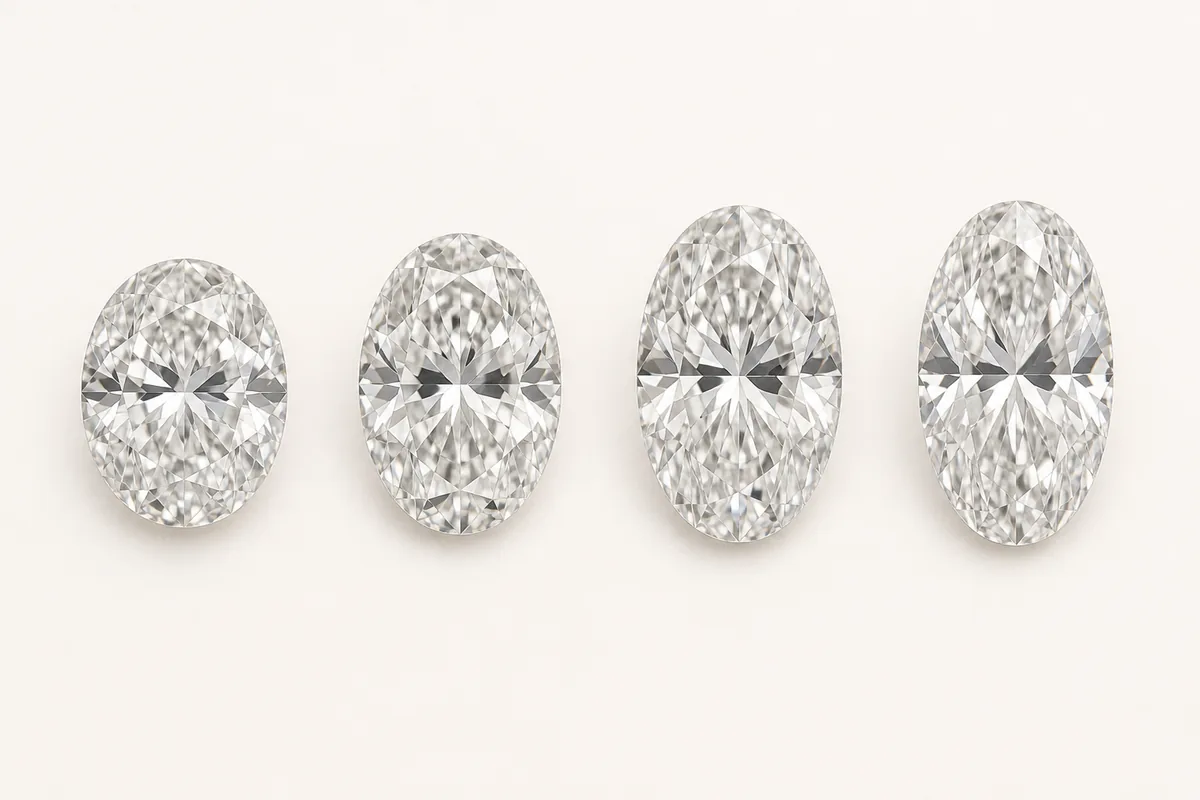
- About 1.25: shorter and more rounded.
- About 1.35: balanced oval with moderate elongation.
- About 1.45: clearly elongated and more finger-lengthening.
- About 1.55: slender, dramatic outline that needs careful visual review.
A more elongated oval is not automatically better, and ratio alone does not determine bow-tie visibility, brightness, or face-up size. Compare the actual stone’s dimensions and video before choosing.
Emerald
The emerald cut is a rectangular step-cut shape with cropped corners and long, parallel facets arranged in concentric rows. It creates a hall-of-mirrors effect rather than the flash of brilliant cuts. It is particularly well suited to higher clarity stones because step-cut facets reveal inclusions more easily. The same clean-lined geometry works beyond rings too, as seen in our emerald cut diamond huggie earrings.
Choose emerald cut if you prefer elegant structure, visible clarity, and a quieter kind of beauty than round sparkle.
Asscher
The asscher is essentially a square emerald cut with a higher crown and smaller table, producing a more octagonal silhouette. Like the emerald, it relies on clarity and uses step-cut facets. It carries a strong Art Deco association and appeals to buyers who want architectural elegance over maximum flash.
Choose asscher cut if you want a square diamond with vintage discipline, clean lines, and strong symmetry.
Radiant
The radiant cut combines a rectangular or square outline with cropped corners and a hybrid brilliant faceting pattern. It usually shows more small, lively flashes than an emerald step cut while retaining a similarly clean-lined silhouette. Its mixed light pattern can also make body color appear differently from one stone to another, so compare the actual diamond rather than relying on the shape name.
Choose radiant cut if you want a more modern geometric shape without giving up too much brilliance.
Marquise
The marquise is an elongated shape with pointed ends, usually carrying a strong length-to-width ratio. Its pointed tips create one of the strongest finger-elongating illusions of any shape, and it often appears larger face-up than its carat weight might suggest. The pointed ends do need secure protection, which is one reason marquise stones are often set into contoured designs such as our marquise curved vine wedding band.
Choose marquise if you want maximum length, dramatic shape, and a larger visual spread for the weight.
Pear
The pear combines a rounded base with a single point at the top, producing an asymmetric teardrop silhouette. The pointed tip creates the same slimming illusion as marquise and oval shapes, and the shape works beautifully in pendants as well as rings.
Choose pear shape if you want something more expressive than oval but softer than marquise.
Heart
The heart shape is a modified brilliant cut that requires exceptional symmetry in the two lobes, the cleft at the top, and the point at the base. It tends to work best at larger visible sizes so the outline remains easy to recognize.
Choose heart shape if emotional symbolism and a recognisable silhouette matter more than subtlety.
Round Brilliant: Timeless Sparkle and What to Compare
Best for: Buyers who prioritize a lively, symmetrical sparkle pattern and accept that rounds often command a higher per-carat price.
Diamonds grow naturally as octahedral crystals, which look like two pyramids joined at their bases. The round brilliant shape is uniquely efficient at leveraging this geometry. Even so, the round still sacrifices more rough material than any fancy shape because so much is ground away to achieve the perfectly circular girdle.
A well-proportioned round brilliant is designed to return light through a symmetrical pattern of crown and pavilion facets. In practice, buyers should compare brightness across the face, contrast pattern, movement, polish, and symmetry rather than relying on facet count alone.
For a custom Redora project, we compare candidate stones by grading-report dimensions, face-up images or video, and how the center stone will sit in the chosen setting. The goal is to match optical character, size, and budget to the buyer’s priorities rather than promise one universal “ideal” appearance.
Summary: Choose round brilliant if a lively, balanced sparkle pattern matters more than elongated finger coverage or the lowest possible per-carat price.
Elongated Elegance: Oval, Pear, and Marquise for a Slimmer Look
Best for: Buyers who want their diamond to look larger and create a longer visual line on the finger.
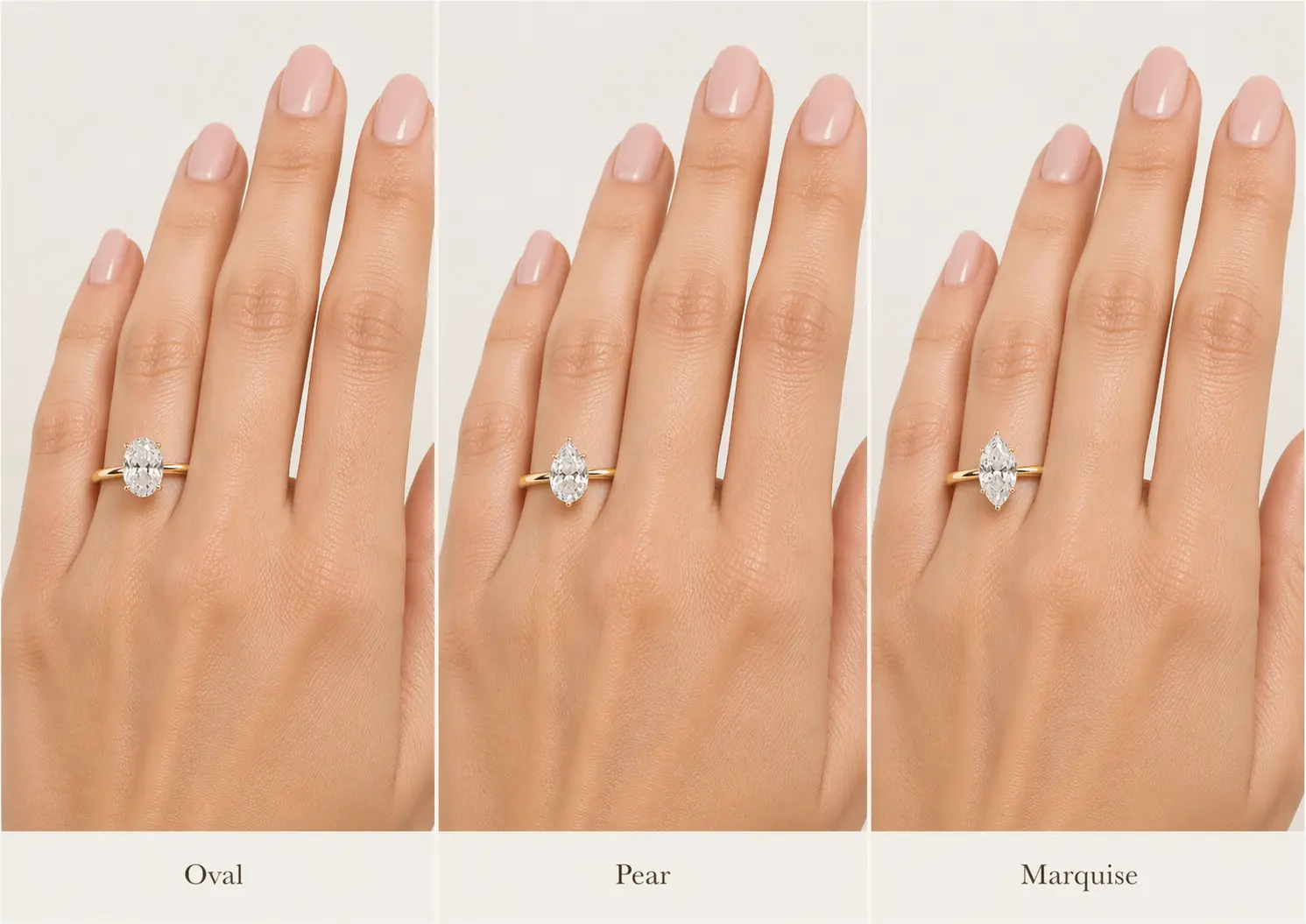
Oval, pear, and marquise diamonds use elongated geometry to create a longer visual line and often provide more finger coverage than a round of similar weight. Price and face-up size still vary with dimensions, depth, cut execution, grade, and supply, so compare millimeter measurements as well as carat weight.
For ovals, a lower ratio looks rounder and a higher ratio looks more slender. Neither direction is inherently better. A bow-tie is influenced by facet arrangement, proportions, and how the stone handles obstruction; the ratio alone cannot predict it. Review the actual diamond in motion and use the comparison above as an outline guide.
The marquise extends the elongation further, creating a strong finger-lengthening effect. Its pointed ends are vulnerable to impact, so V-tip prongs or a protective bezel are worth considering for daily wear. The pear sits between oval and marquise in terms of asymmetry and visual drama, and it also transitions well from ring settings to diamond necklace designs and pendants.
Summary: Oval, pear, and marquise shapes are often the best options if you want a diamond to look larger and longer for the same budget.
Modern Squares: Princess, Cushion, and Radiant Compared
Best for: Buyers choosing between sharper square sparkle, softer square romance, and a modern balance between structure and brilliance.
Square and near-square shapes occupy a distinct visual territory between the classic round and the architectural step cuts. They project a clean, contemporary energy that suits buyers who want a defined geometric look without the vintage associations of step cuts or the traditional familiarity of the round.
Princess, cushion, and radiant are the three primary options in this category, and they differ in meaningful ways. The princess uses a modified brilliant pattern inside a sharp-cornered square silhouette. The cushion softens that geometry with rounded corners and a pillow-like outline. The radiant bridges both worlds by adding cropped corners but keeping a brighter hybrid faceting pattern inside them.
Our custom jewelry consultation page helps clients compare these three shapes based on setting style, finger coverage, and long-term wear concerns.
Summary: Choose princess for sharper square sparkle, cushion for softer romance, and radiant for the most balanced modern square option.
Step-Cut Sophistication: Emerald and Asscher Shapes
Best for: Buyers who value line, clarity, and refinement more than maximum scintillation.
Step-cut shapes operate on a fundamentally different visual principle from brilliant cuts. Where brilliant faceting is designed to maximize the return of fragmented light in a firework-like display, step-cut faceting arranges long, parallel facets in concentric rows that produce broad flashes of reflected light. The effect is often described as a hall of mirrors: deep, architectural, and quietly mesmerizing rather than dazzling.
The emerald cut is the canonical example. Its rectangular outline, cropped corners, and elongated table create a window into the stone rather than a mirror on its surface. Clarity becomes the primary driver of beauty in this shape. Inclusions that a brilliant cut would scatter and hide are more visible through the large open table of an emerald cut.
The asscher shares these characteristics but compounds them with its square proportions and higher crown, which creates a more hypnotic spiral effect as you look into the stone from above. Both shapes pair especially well with lab grown diamond options for step-cut rings, because higher clarity grades are usually more approachable in budget terms than equivalent mined stones.
Summary: Emerald and asscher cuts suit buyers who care more about clarity, line, and elegance than maximum sparkle.
Which Shape Is Right for You? Tips for Every Lifestyle and Budget
Fast answer: Round and oval suit buyers chasing sparkle. Oval, pear, and marquise suit buyers chasing visual size. Emerald and asscher suit buyers chasing clean elegance. Cushion and radiant are often the safest middle ground.
No single shape is objectively best. The right choice depends on how you prioritize sparkle versus elegance, how much visual size you want for your budget, how active your daily lifestyle is, and what setting style appeals to you.
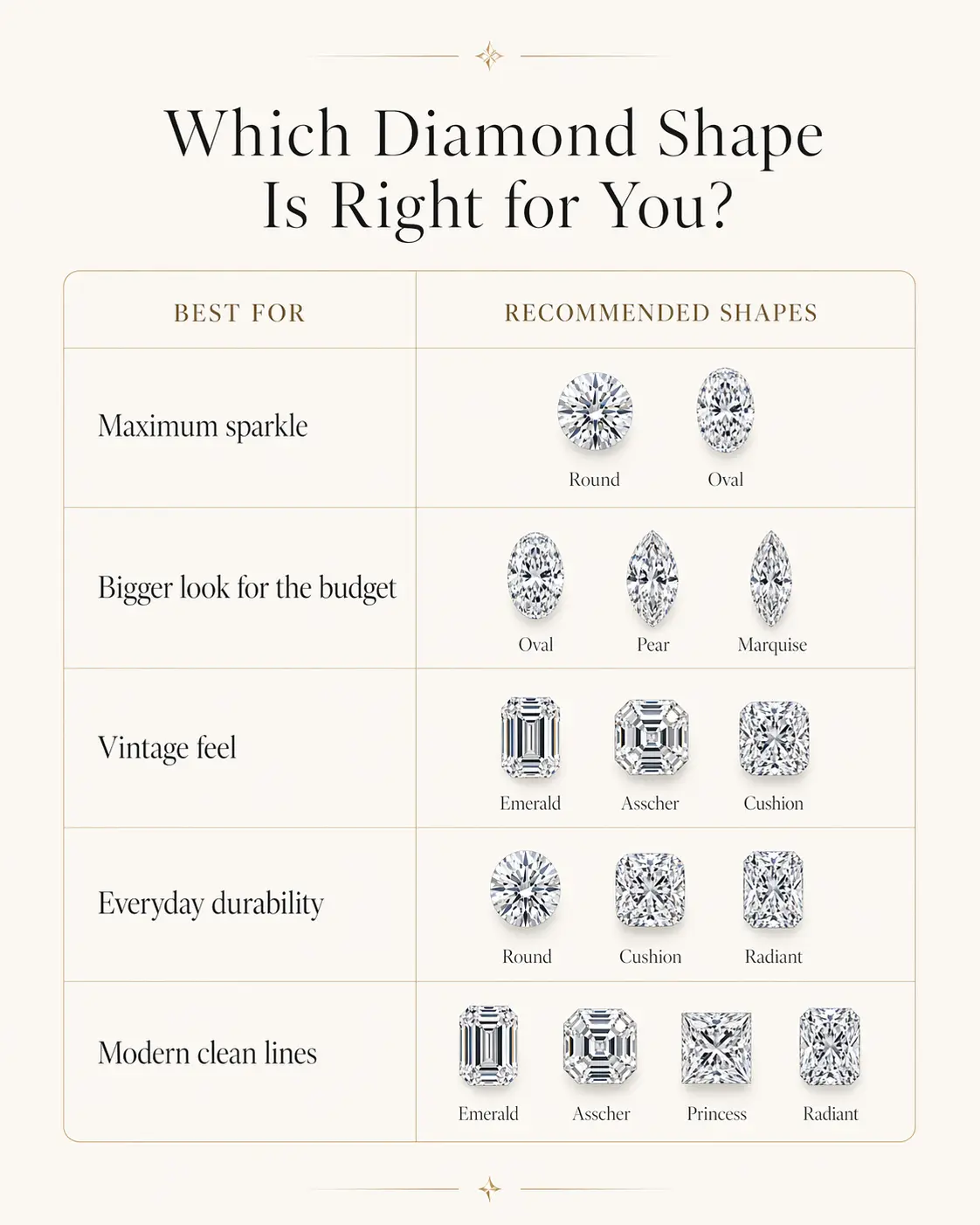
| Best For | Recommended Shapes | Why |
|---|---|---|
| Maximum sparkle | Round, Oval | These shapes usually return the strongest brilliance and lively light performance. |
| Bigger look for the budget | Oval, Pear, Marquise | These elongated shapes usually spread more visual surface area across the finger. |
| Vintage feel | Emerald, Asscher, Cushion | These shapes often align with Art Deco, antique, or softer heirloom aesthetics. |
| Everyday durability | Round, Cushion, Radiant | These shapes avoid the most vulnerable points or soften them for easier daily wear. |
| Modern clean lines | Emerald, Asscher, Princess, Radiant | These shapes create stronger geometry and a more structured visual identity. |
Prioritize Maximum Brilliance
Best quick choice: Round first, oval second.
Choose round brilliant or oval. Both deliver exceptional light performance. The round costs more per carat but is slightly more optically efficient. The oval provides nearly comparable sparkle at a more approachable price point while adding a contemporary elongated look.
Prioritize Size on a Budget
Best quick choice: Oval, pear, or marquise.
Oval, pear, and marquise often provide more visible length across the finger than a same-weight round, but the result is not automatic. Compare millimeter dimensions, depth, grade, and actual price quotes instead of assuming carat weight alone determines visual size or value.
Prioritize a Vintage or Art Deco Aesthetic
Best quick choice: Emerald or asscher for sharper vintage structure, cushion for softer romance.
The emerald cut and asscher are natural choices. Both carry strong historical associations and reward investment in higher clarity.
Prioritize Durability for Active Wear
Best quick choice: Round, cushion, or radiant.
Avoid marquise and pear if chips are a major concern for your lifestyle. Round, oval, cushion, and radiant shapes carry fewer vulnerable points and are generally easier to wear every day.
Prioritize a Modern or Architectural Look
Best quick choice: Radiant, princess, or asscher.
Princess, radiant, and asscher all project clean geometric confidence. The radiant’s cropped corners make it one of the strongest square or rectangular choices if you want both structure and sparkle.
Shape also changes how large a stone reads on the hand at the same carat weight. For the extreme end of that, see how big a 20 carat diamond actually is.
How Redora Helps You Compare Diamond Shapes for a Custom Ring
Buyer advantage: Shape selection is reviewed together with finger coverage, setting construction, corner protection, and the finished ring’s proportions rather than as an isolated stone choice.
For a custom project, useful inputs include your natural or lab-grown preference, budget range, target millimeter coverage, preferred outline or length-to-width ratio, tolerance for a visible bow-tie, and the setting style you plan to wear.
Redora’s Shenzhen manufacturing team can review candidate stone dimensions, grading information, face-up images or video, and how the stone will be secured in the proposed setting. Pointed shapes such as pear and marquise need deliberate tip protection; step cuts need careful clarity review; elongated brilliant cuts should be assessed for uneven darkness.
No honest comparison should guarantee a bow-tie-free oval or identical sparkle from a shape name alone. Ask to review the actual stone and its dimensions before approving a custom center stone.
If you are planning a custom ring, send your preferred shapes, approximate dimensions, and setting reference. We can help narrow the options before production begins.
Frequently Asked Questions About Diamond Shapes
Which diamond shape sparkles the most?
A well-cut round brilliant is commonly the strongest starting point for lively white-light return, fire, and scintillation. However, the shape name alone does not determine performance. Compare the individual stone’s brightness, contrast, polish, symmetry, and movement.
Which diamond shape looks biggest for the carat weight?
Oval, marquise, and pear shapes often provide more visible length across the finger than a round of the same carat weight. Confirm the actual millimeter dimensions and depth, because two stones with the same weight can have different face-up spread.
Which diamond shape is best for everyday wear?
Rounded outlines such as round and cushion avoid exposed pointed tips, but everyday durability also depends on setting design, prong coverage, girdle condition, and the wearer’s routine. Pointed shapes can still work well when the tips are properly protected.
Are emerald cuts less sparkly than round diamonds?
Emerald cuts usually show fewer small scintillation flashes than round brilliants. Their long step facets create broader, mirror-like flashes instead. It is a different light pattern rather than simply a “better” or “worse” version of sparkle.
Which diamond shape is best if I want a vintage look?
Emerald, asscher, and cushion cuts are often the strongest choices for a vintage or Art Deco direction, depending on whether you want sharper structure or softer romance.
Can I customize any of these diamond shapes at Redora?
Yes. We can help you compare shape, dimensions, stone type, and setting direction for a custom design. You can send your diamond shape preferences for a custom quote and our team will review the project with you.
More from Redora: all jewelry buying guides