This month a founder building a contemporary fine jewelry brand in Europe sent us one message that asked everything a new label asks. Solid 18K gold, stamped 750. Lab grown gemstones. Modern, distinctive designs. A reliable manufacturing partner with low minimums, private label, customization, and access to designs we already make. Then four direct questions: the minimum order, the pricing, whether there is a catalogue for 18K gemstone jewelry, and how private label works. It is a representative message, so the answers belong in public. The short version: as a low MOQ jewelry manufacturer working only in solid gold and platinum, our minimum is one piece per design, in every karat, with your mark on it.
Most writing about low MOQs comes from plated brass, stainless steel and silver suppliers, where minimums of 20, 50 or 100 per style are normal and the reasons behind them are real. Solid gold made to order runs on different arithmetic. This is written from the production floor, a layer below the agents and retailers who usually answer these questions.
The short version
| Question | Our answer |
|---|---|
| What is the minimum order? | One piece per design, in every karat. Designs, gold colors and sizes can be mixed freely, with no annual commitment |
| Does adding my logo change that? | No. Your mark goes beside the 750 fineness mark from the first piece, with no tooling charge |
| What sets the price? | Mostly the finished gold weight, priced per gram against the daily benchmark. About $500 to $5,000 for most pieces |
| Is there a catalogue? | A PDF on request, and the current range on our site. Most designs can be quoted in 18K with lab grown stones |
| Who owns my designs? | You do. An NDA before you send files, CAD files released to you on request, nothing shown to other clients |
| How long does it take? | CAD in 1 to 3 days, production 7 to 10 days for most pieces after design details are confirmed, shipping usually 2 to 5 days |
The full commercial terms for brands are on our OEM and private label manufacturing page. What follows is the reasoning behind them, and the parts a founder should plan for that no terms page covers.
Why most jewelry factories ask for 50 or 100 per style
Minimums are not arbitrary. In plated and silver fashion jewelry, production is organized around volume. A master model goes into a rubber mould, the mould is injected with wax many times over, the waxes are cast together, and the castings are plated in batches. Chain and components are bought in bulk. A factory set up that way needs volume on each style before the mould, the plating run and the material order pay for themselves.
So low MOQ means different things depending on who says it. Under a widely watched YouTube video on choosing a jewelry manufacturer, one of the most liked comments named minimum order quantity as the question the video left out, especially for a small label just starting. A manufacturer replying in the same thread described a hundred per design as their normal run, and twenty per design as their concession to small brands. On r/jewelers, someone answering a designer who wanted “reasonable MOQs for a smaller brand” asked whether small meant 5, 10, 20 or 60 pieces. It is the right question. Put it to every supplier, including us.
Branding is the second trigger. A commenter under another video on sourcing jewelry pointed out that asking for a logo on the product is what triggers the minimum, usually because the logo needs its own tooling. A small brand then chooses between no branding, a higher unit cost, or more stock than it wanted.
In solid gold, piece one and piece fifty cost nearly the same
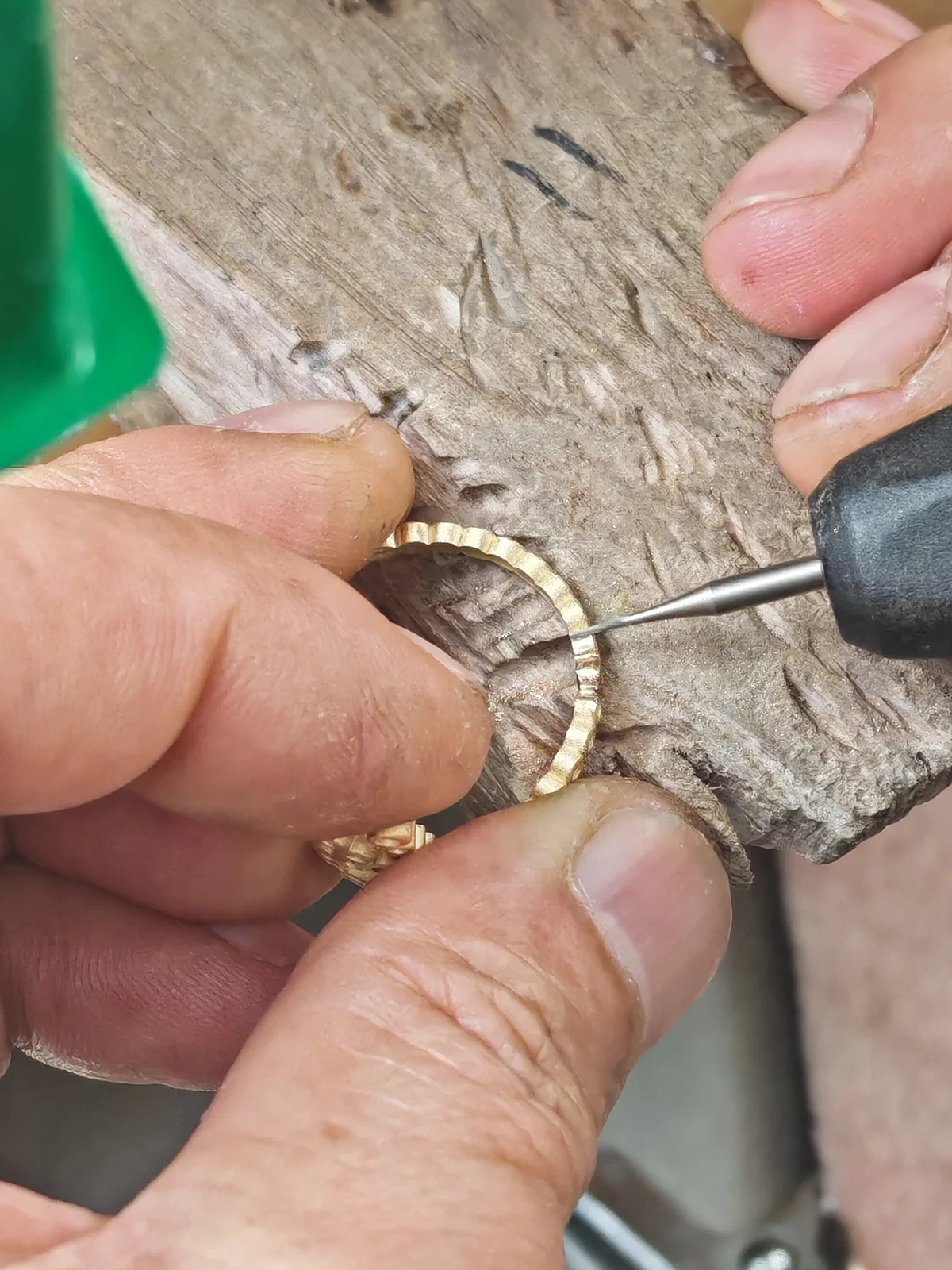
Our cost per piece does not depend on a mould or a batch. Each piece is cast from the approved design, then filed, set and polished on its own by bench staff who are paid per piece. Gold is bought by the gram at the same price whether the order is one ring or fifty. There is no line setup for a larger run to spread out.
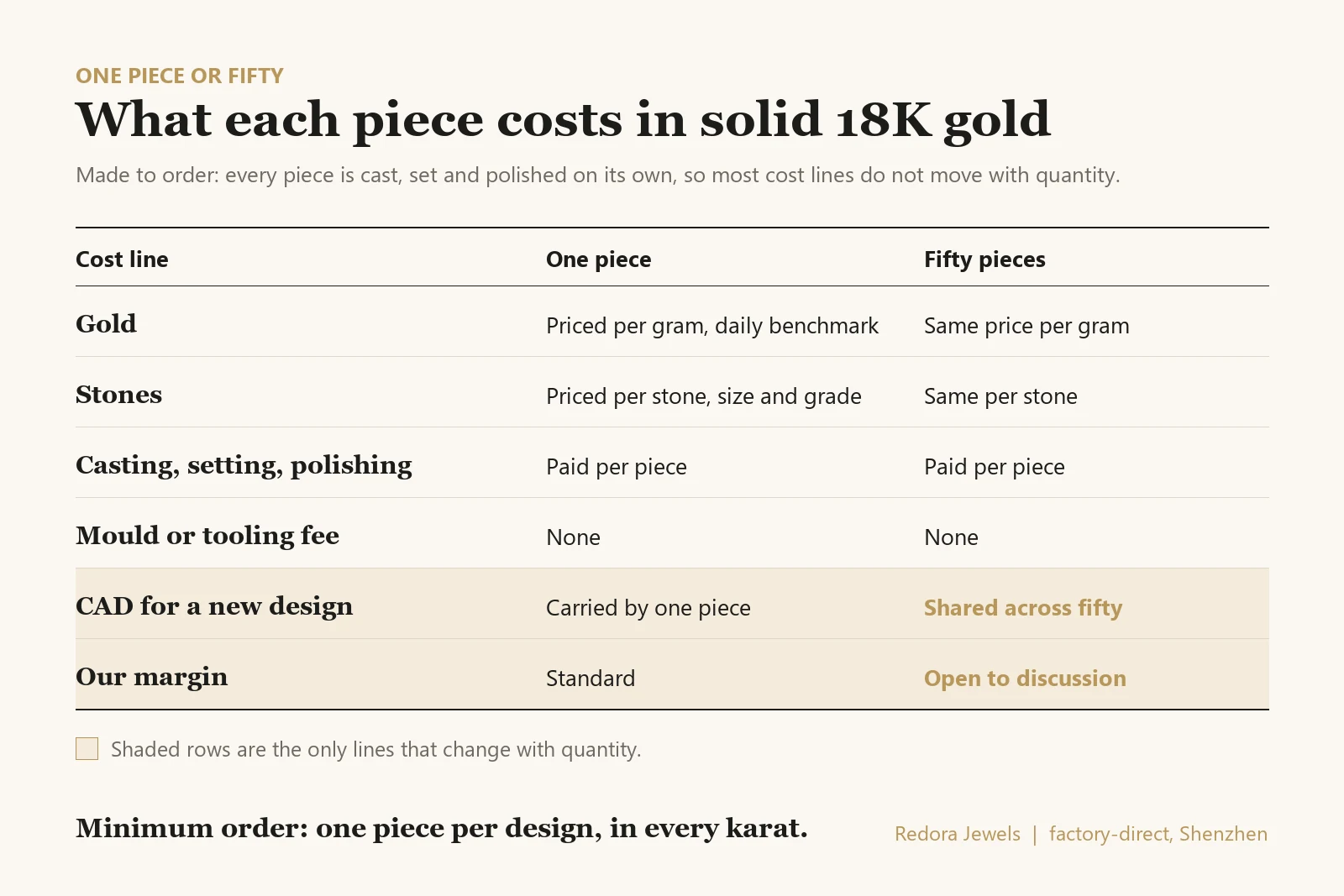
| Cost line | One piece | Fifty pieces |
|---|---|---|
| Gold | Priced per gram against the daily benchmark | The same price per gram |
| Stones | Priced per stone by type, size and grade | The same per stone |
| Casting, setting, polishing | Paid per piece | Paid per piece |
| Mould or tooling fee | None | None |
| CAD for a new design | Carried by one piece | Shared across fifty |
| Our margin | Standard | Open to discussion on the larger total |
Two lines move, and only two. A new design needs CAD work once, so on a single piece that work sits on one unit. And on a larger total we will take less per piece. Everything else is fixed per piece. That is why a one piece minimum is not a loss leader here, and also why our volume price breaks are modest. The fiftieth piece costs us close to what the first one did.
From above, a low minimum looks like a favor a factory grants. From the bench, it is simply how the cost is built. That is the part an agent placing orders with someone else rarely sees.
What sets the price of an 18K piece with lab grown stones
We do not send a price list, because the price of a solid gold piece is mostly arithmetic on its weight. Gold is priced per gram against the daily benchmark, so a quote follows the gold price of the day it is written. For most pieces the result lands at about $500 to $5,000.
Founders who model their margins on spot price times weight usually come in low, because three things sit between the spot price and what the metal in a piece actually costs.
| Factor | 18K figure | Why it exists |
|---|---|---|
| Fineness we actually run | 755 parts per thousand against the 750 stamp | So every piece tests at 750 with margin to spare |
| Refining surcharge over spot | About 8 RMB per gram | Turning bullion into workable 18K alloy |
| Metal lost in casting and polishing | About 11% | A finished 10 g piece takes about 11.1 g of gold into production |
For a plain gold piece, gold is roughly 75 to 80% of our price and labor about 20%. Stones change that split, and lab grown stones change it far less than natural ones. A lab grown diamond costs us roughly 20% of a comparable natural stone, which is why our guide to lab grown diamonds treats them as a budget lever rather than a compromise. On a line built on 18K and lab grown stones, the finished gram weight is the number that decides your retail price. The full arithmetic is in our cost breakdown of a custom diamond ring.
So the most useful thing to ask any manufacturer is not the unit price. It is the finished weight in grams, written on the quote. A finished piece weighs about 90% of the figure in its CAD file, so also ask which of the two a quote is based on. Ours states finished weight, and says so when an early quote has to use the CAD figure.
Three levers lower the price without lowering the karat:
- Construction. Wide bangles, heavy chains and large hoops can be built hollow or semi-hollow in the same 18K alloy at a lower gram weight. It has to be disclosed with the real weight, and on slim or stone-set pieces it saves almost nothing. The limits are in what we can hollow and what we cannot.
- Setting style. Prong, pavé, channel and bezel settings cost about the same in labor. Invisible setting costs about 50% more, and it is also the setting most likely to cause problems on the bench.
- A second karat for a second tier. The same design in 14K finishes at about 90% of the 18K weight and carries less gold in every gram. If the brand needs a lower price tier, that is the cleanest way to build one without redesigning.
Existing designs and your own designs are two different deals
The founder asked about both, and they work differently.
Existing designs are already developed, so there is no CAD work to pay for at the start, and most can be made in 18K with lab grown stones and your mark. They are also public. They sit on our site, and other clients can order the same design. They work well for filling out a first collection or testing a price point.
Your own designs start with an NDA, signed before you send files. They are never shown in our catalogue, on our social channels or to other clients, and the CAD files are released to you on request, so you are not tied to us to reorder your own piece. The fear behind that question is real. Under the same video on choosing a manufacturer, the most liked comment was a designer’s fear of factories stealing designs.
Modified designs sit in between. An existing piece with a different stone, proportion or karat goes through a CAD revision before production. Most projects reach a final CAD in 1 to 2 revisions, and complex ones in 2 to 3.
On the catalogue: we send a PDF on request, and the current range is on the site under fine jewelry.
What private label covers, and what stays your job
Covered from the first piece:
- Your mark beside the fineness mark, 750 for 18K. It does not raise the minimum and carries no tooling charge.
- Your packaging and your documentation. Nothing carries the Redora name unless you ask for it.
- A gold and diamond test certificate with every order. You are welcome to have pieces independently assayed on arrival.
- Engraving, free across the range, with the font and the wording chosen by you.
Three things stay with the brand, and they are easier to plan before the first order than after it:
- Assay office hallmarks. Where hallmarking is compulsory, the UK for gold articles over 1 gram being the best known case, the hallmark is applied by an independent assay office, not by the manufacturer. Other European markets have their own rules on which marks must appear and who may apply them. Check with your national assay authority first, then send us exactly what has to be on the piece.
- What you promise about small stones. Center diamonds from 0.30 ct upward can come with an IGI report. Accent and pavé stones are not graded one by one, so do not promise your customers a report for every stone.
- Disclosure on white gold. If the line includes white gold, it is rhodium plated over solid white gold. The plating wears with friction, fastest on rings, and can be re-plated, and your customers need to be told. The intervals are in how often white gold needs replating.
How a first trade order usually looks
Trade orders rarely look like fifty of one item. A typical one is a single bangle style in two or three gold colors and several sizes, a few pieces of each. Because the minimum is per design rather than per color or size, that order needs no workaround.
Two habits make a first order more useful than its size suggests. Order one difficult piece first, not your easiest one: pavé, a hinge or fine prongs tell you far more about a factory than a plain band does. And ask to see your own order on a live video call from the production floor, which an agent placing orders elsewhere cannot easily arrange.
Our rework rate runs at 1 to 3%, and the most common cause is not a defect. It is the color of a natural stone reading differently once it is set against metal. Lab grown stones are more consistent in color from stone to stone, which helps a brand twice: fewer reworks on the first order, and reorders that match the pieces already sold. The rest of the vetting is in our seven checks for choosing a gold jewelry manufacturer, and what we inspect before dispatch is in the five checks before a piece ships.
Timing and money on the first order
A 30 percent deposit starts the project and covers the design work and the production slot. Materials are not ordered until you approve the CAD rendering, and the deposit is fully refundable until that approval. What it pays for at each step is set out in what a custom jewelry deposit pays for.
CAD renders take 1 to 3 days. Production takes 7 to 10 days for most pieces after design details are confirmed. Simpler designs may complete sooner, often within 5 days, and complex pieces can take up to 15. Finished pieces ship by FedEx, DHL or UPS, usually in 2 to 5 days depending on destination and customs clearance. If a launch date is fixed, give it to us at the quote stage, so we can say whether it is realistic before you pay anything.
Where a one piece minimum is the wrong fit
Two things push back the other way, and a founder should weigh both.
One piece is not the same as cheap. On a new design, the CAD work sits on that single unit. If the goal is to test a design, one is right. If the goal is the lowest unit price on a new design, a few pieces spread the CAD work better.
Volume does not buy steep discounts here. If the plan is hundreds of identical units at the lowest possible unit price, expect the price breaks on solid gold made to order to be modest, because the cost per piece barely falls with quantity. What moves on a large order is our margin, not our cost.
And if the price point needs gold vermeil or plated silver, we are the wrong supplier. Everything we make is solid gold or platinum.
Common questions
Is the one piece minimum per design or per order?
Per design, and in every karat. One order can hold a single piece of each of ten designs, in different gold colors and sizes. There is no annual volume commitment.
How many pieces should a first collection have?
There is no production reason to start larger than you can sell, so the size of a first collection here is a cash decision, not a factory constraint. The trade orders we see are often one or two styles in a few colors and sizes.
Will putting my logo on the pieces raise the MOQ?
No. Your mark is applied beside the 750 fineness mark from the first piece, with no tooling charge, and nothing carries our name unless you ask for it.
Can another brand buy the same design?
An existing design from our range, yes, because it is public. A design you bring to us, no. It is covered by an NDA signed before you send files, and the CAD files are yours on request.
Do you work with lab grown gemstones as well as lab grown diamonds?
Yes. Lab grown diamonds and lab grown colored stones such as sapphire, ruby and emerald are set the same way as their natural counterparts, in solid gold or platinum. In the US, the FTC Jewelry Guides treat it as deceptive to name a lab grown stone without a qualifier such as laboratory-grown or laboratory-created directly before it, so carry that wording through to your own listings.
Do you have a catalogue for 18K gold gemstone jewelry?
Yes, as a PDF on request, and the current range is on our site. Most designs in it can be quoted in 18K with lab grown stones.
Can you work from reference images instead of technical drawings?
Yes. A sketch or a reference image is enough to start, and the dimensions are fixed at the CAD stage. A bangle, for example, needs a wrist size, a width, a thickness and either the stone sizes or a total carat weight. Many clients settle those over one or two rounds of renders.
About the Author and Review Process
Edwin Lin is the founder of Redora Jewels, a factory-direct fine jewelry manufacturer based in Shenzhen with on-site production. The minimum order, the cost lines, the fineness, surcharge and loss figures and the rework rate in this article are the ones our production team works to. The inquiry that prompted it is described without details that would identify the founder who sent it.
Redora Jewels has run as a manufacturing facility since 2011. The commercial terms for brands, including CAD ownership, the NDA, sampling and the deposit, are set out on our OEM and private label manufacturing page. One design with the metal, the stones and the quantity you have in mind is enough for a broken down quote: start a project with Redora’s production team.