The client chose the blues. Our job was to put them in order. This bracelet holds 78 lab grown sapphires, each 2.4 mm across, set in 14K rose gold. Each run of color starts at a deep navy and fades to a pale, almost clear blue, then starts again, four times from one end of the clasp to the other. That is what an ombre tennis bracelet is, and the part that makes one work is not in any drawing.
Most of a tennis bracelet is decided in CAD: the length, the size of every stone, the prongs, the clasp. The color order is not. It is decided on a tray, one stone at a time, before anything is set. This post covers that step, with the numbers from this bracelet.
The short version
| Question | Answer from this bracelet |
|---|---|
| What makes it ombre | The stones shift from deep blue to pale along the bracelet, in four repeating runs |
| Which stones | 78 round lab grown blue sapphires, 2.4 mm each, about 4.7 carats in total |
| Which metal | 14K rose gold, four prongs per stone, 19 cm long |
| Who chooses the colors | The client. We sort the stones into that order before setting |
| Does the CAD set the gradient | No. The CAD sets 78 seats of one size. The color order is decided on the tray |
What the CAD decides
The CAD file fixes everything that has to be exact. For this bracelet that meant a length of 19 cm, 78 round seats of 2.40 mm, four prongs on every stone and a box clasp. The software counts the seats and estimates the metal: 11.8 g of 14K gold and about 4.7 carats of stones, or roughly 0.06 carat per stone.
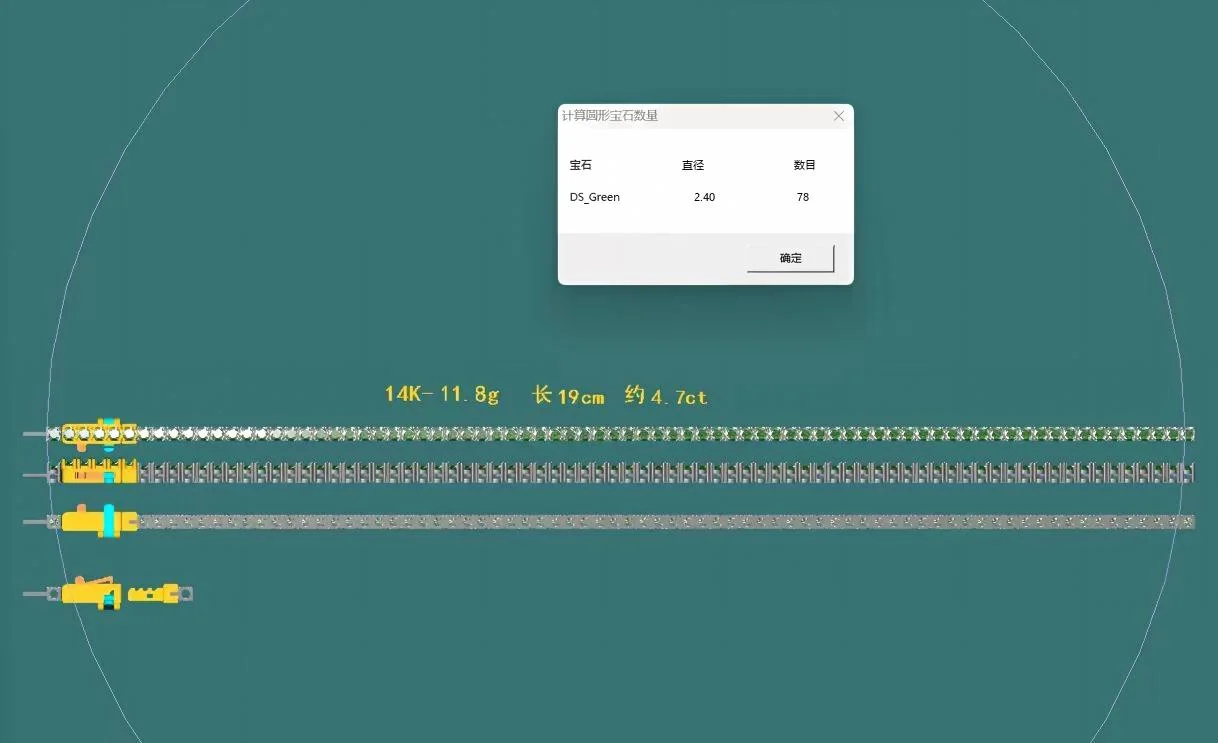
Every seat in the file is identical. The file holds nothing about which blue goes where, and it does not need to. With all 78 stones the same size, color is the only thing that changes from one end of the bracelet to the other.
Sorting the stones
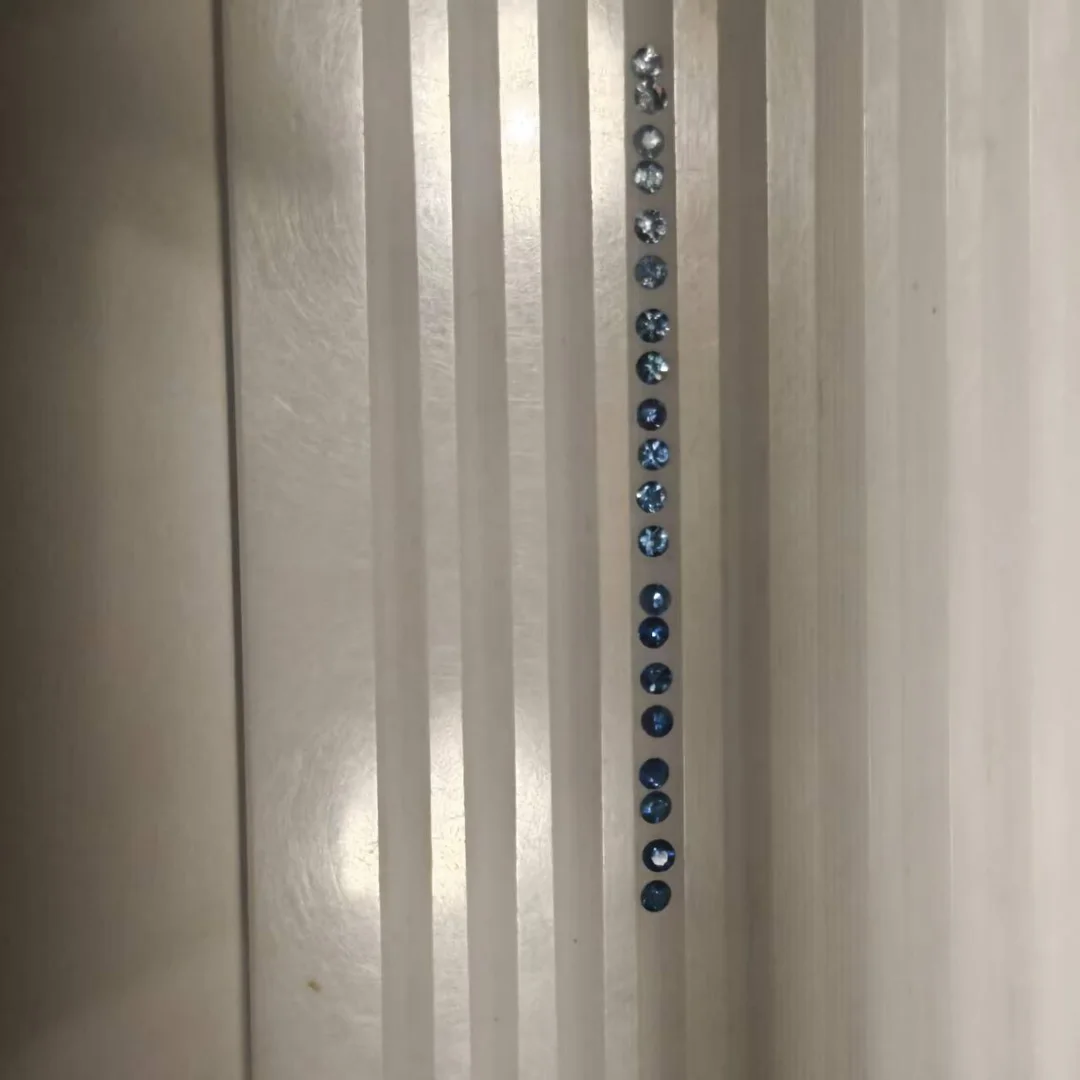
The client chooses the colors. Here that was a single blue, from a deep navy down to a very pale tint. Before anything is set, the stones are laid out in a grooved tray in the order they will sit in the bracelet. Seen in a line, a step that is too big stands out at once: one stone a shade too deep reads as a dark spot, not as part of the fade.
The order is settled on the tray, not after setting, because moving a stone once it is set means opening four prongs and closing them again. The stones then go to the setter in that order.
A colored stone also looks a little different held in metal than it does loose on a tray, under different light and next to different neighbors. On natural colored stones that gap is the most common reason a piece goes back to the bench before shipping. Lab grown sapphires take their color from what goes into the crystal as it grows, so stones of the same shade match each other closely, which is what makes a long, even fade practical.
Why four runs instead of one
A single fade from one end to the other would put all the deep blue on one side of the wrist and all the pale on the other. Repeating the run four times means every part of the wrist shows the whole range, whichever way the bracelet turns.
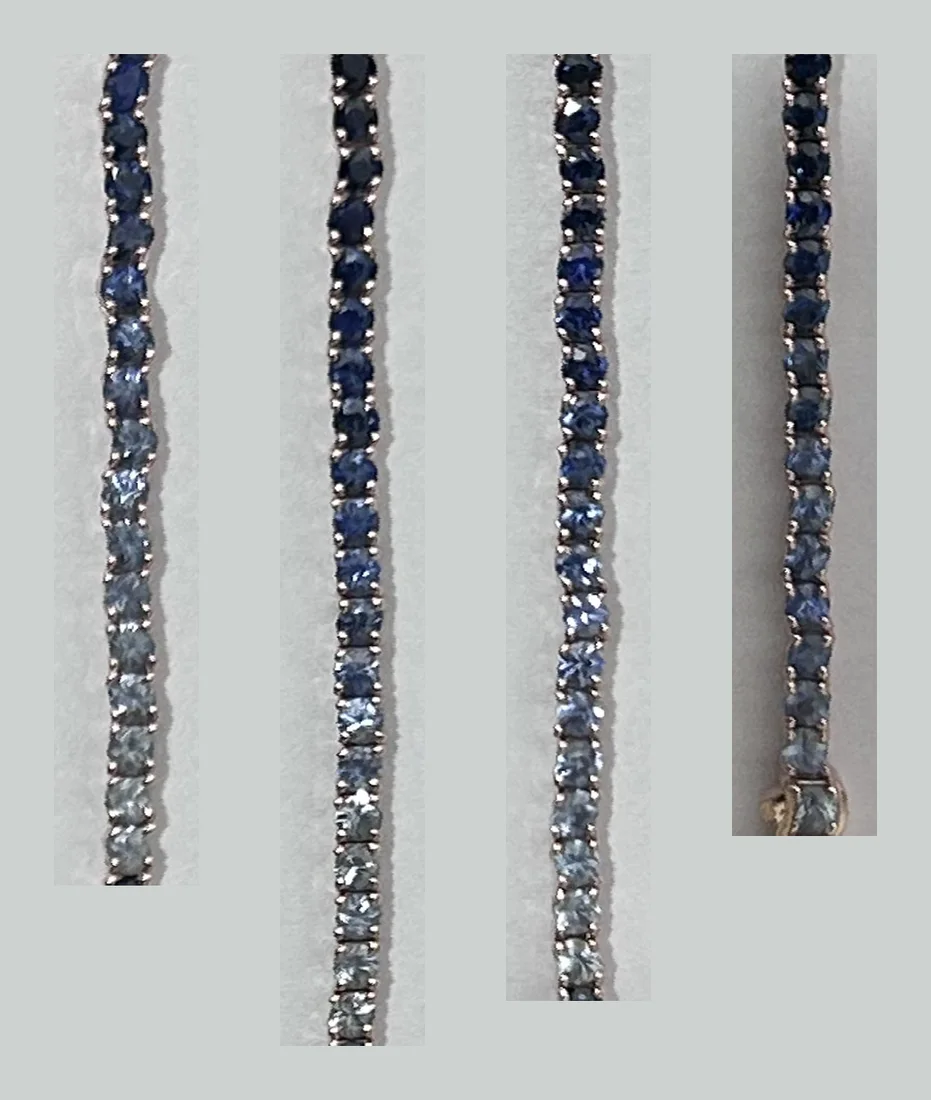
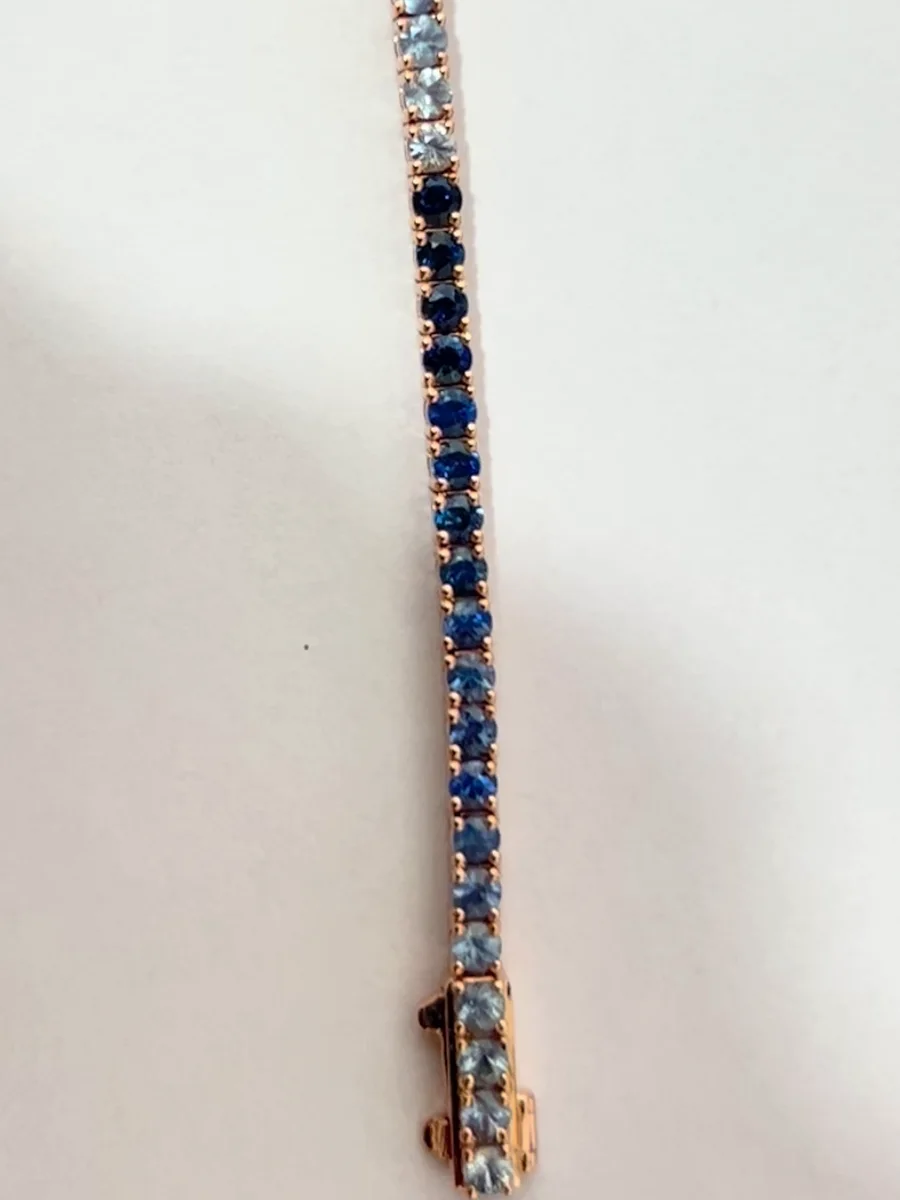
Each run ends on a pale stone and the next starts on the deepest blue. That gives three resets along the bracelet and a fourth at the clasp, because the clasp does not interrupt the line. Stones are set across the top of the box clasp, so the last pale stones of the fourth run sit on the clasp itself, and when the bracelet is closed they meet the deep blue at the start of the first run.
Lab grown sapphire, in plain terms
Every stone in this bracelet is a lab grown sapphire. It is the same mineral as a mined sapphire, corundum, with the same hardness of 9 on the Mohs scale, grown in a laboratory instead of mined. We describe it as lab grown every time, because that is what it is.
Two practical points follow from the size. At about 0.06 carat each, no stone carries its own grading report, which is normal for stones this small. And a 2.4 mm stone in four prongs sits low, so the bracelet wears as a fine line of color rather than a wide band.
The numbers from this bracelet
| Item | This bracelet |
|---|---|
| Stones | 78 lab grown blue sapphires, round, 2.40 mm |
| Total stone weight | About 4.7 carats, from the CAD estimate |
| Color runs | Four, each from deep blue to pale |
| Metal | 14K rose gold |
| Setting | Four prongs per stone |
| Clasp | Box clasp with a safety catch, stones set across the top |
| Length | 19 cm, about 7.5 inches |
| Metal weight in the CAD | 11.8 g |
| Finished metal weight | About 10.6 g, estimated at 90 percent of the CAD figure, not weighed |
The last line is an estimate, and we say so. Across our production a finished piece lands at about 90 percent of the CAD weight, because casting, filing and polishing all take some metal. The same file in 18K would come out roughly a tenth heavier, since 18K is the denser alloy.
Two things to know before ordering one
Shortening it costs more than on a plain tennis bracelet. Any tennis bracelet can be shortened by taking out links, but on an ombre every link carries a step of the fade. Take three links out of one run and that run ends abruptly. That is why the length is worth settling before the stones are sorted, the same reason bracelet length is fixed before CAD on every piece we make.
A lost stone has to match its neighbors, not only its size. On a single color line, any stone of the right size and shade will do. On an ombre, a replacement has to sit at the right point in the fade, so it is chosen against the two stones beside it. A box clasp with a safety catch is there to keep that from happening in the first place; how bracelet clasps fail covers why the second catch matters.
Ordering an ombre tennis bracelet
- The colors: one color from deep to pale, as here, or the shades you want in order. A photo of a gradient you like works as a starting point
- The length, or your wrist measurement. This one is 19 cm
- The stone size, the same for every stone. This one uses 2.4 mm
- The metal: rose, yellow or white gold from 9K to 22K, or platinum. White gold is rhodium plated as its final step
- How many runs: one fade from end to end, or a repeat like the four here
- Engraving, if you want it, which is free in the wording and font you choose
An ombre tennis bracelet is quoted from an existing design, so it follows our standard path. The order starts with a 30 percent deposit, which covers the design work and the production slot. The CAD rendering before production is free, and materials are not ordered until you approve it. The deposit is fully refundable before that approval.
Production usually takes 7 to 10 days after design details are confirmed. We ship by FedEx, DHL or UPS, and delivery usually takes 2 to 5 days, depending on destination and customs clearance.
For the same four prong construction in diamonds, our lab grown diamond tennis bracelet in 14K white gold is a standard design, and the full range sits under tennis bracelets.
Common questions
What is an ombre tennis bracelet?
A tennis bracelet whose stones shift gradually from one shade to another along its length. The stones are usually all one size, so color is the only thing that changes. This one fades from deep blue to pale four times.
Can I choose the colors?
Yes. You choose the colors and how many runs the fade repeats, and we sort the stones into that order before setting. A photo of a gradient you like is a good place to start.
Is a lab grown sapphire the same as a mined sapphire?
It is the same mineral, corundum, with the same hardness. The difference is origin: it is grown in a laboratory instead of mined, and it is always described as lab grown.
How many stones are in a tennis bracelet?
It depends on the stone size and the length. This 19 cm bracelet with 2.4 mm stones holds 78. Larger stones over the same length means fewer of them.
Can an ombre tennis bracelet be shortened?
Yes, by removing links, but every link removed takes a step out of the fade. It is better to settle the length before the stones are sorted.
About the Author and Review Process
Edwin Lin is the founder of Redora Jewels, a factory-direct fine jewelry manufacturer based in Shenzhen with on-site production. The bracelet in this article was made on our production floor. The stone count, stone size, length and metal weight come from our own CAD sheet, the photos were taken by our team, and the finished weight is an estimate, as stated. The client’s name is not published.
Redora Jewels has run as a manufacturing facility since 2011 and makes custom jewelry in solid gold and platinum, one piece at a time. If you have colors in mind, start a project with Redora’s production team.