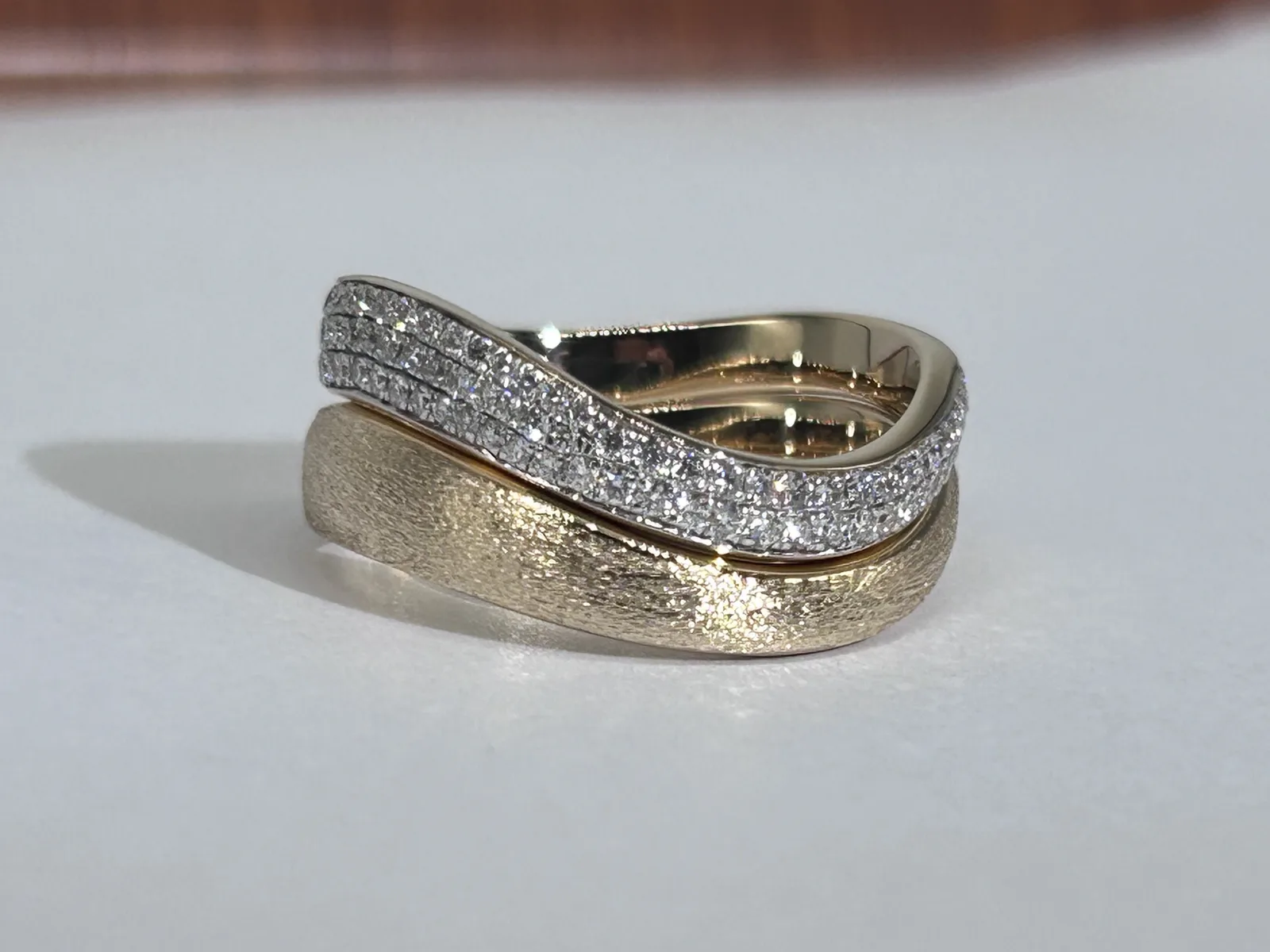
This pair left our production floor this month: two wave shaped bands in 18K yellow gold, made to be worn together. The upper band carries three rows of pavé lab grown diamonds across the front. The lower band has no stones at all. Its outer surface was sandblasted, a step the team at the bench calls 打砂 (da sha, literally hitting with sand). When the pair turns on the stand, the sandblasted gold ring is the one people ask about. They want to know whether it is still solid gold, whether the frost wears off, and whether it can be brought back.
Most writing about matte rings compares the look. This is written from the production floor: what the finish physically is, at which step it goes on, and what happens to it after months on a hand.
The short version
| Question | Answer from the bench |
|---|---|
| Is a sandblasted gold ring solid gold | Yes. Sandblasting textures the surface of the same 18K. Nothing is added to the metal. Both bands here are stamped Au750 |
| How is the finish made | Fine abrasive is blown at the gold with compressed air, after the band is polished. Areas that stay bright are covered first |
| Does it wear off | It cannot peel, because it is not a layer. It slowly burnishes back toward a shine where the ring rubs most |
| Can it be restored | Yes. The band is blasted again and the frost comes back |
| Is it the same as brushed | No. A brushed finish has lines running one way. A sandblasted finish has no direction |
What sandblasting does to the gold
Sandblasting is not a coating and it is not plating. A stream of fine abrasive hits the surface and leaves a field of tiny pits. A polished surface sends light back in one direction, which is where the mirror highlight comes from. The pitted surface scatters it. So the gold reads soft and even, a shade paler than the same alloy polished, with no bright streak running across it.
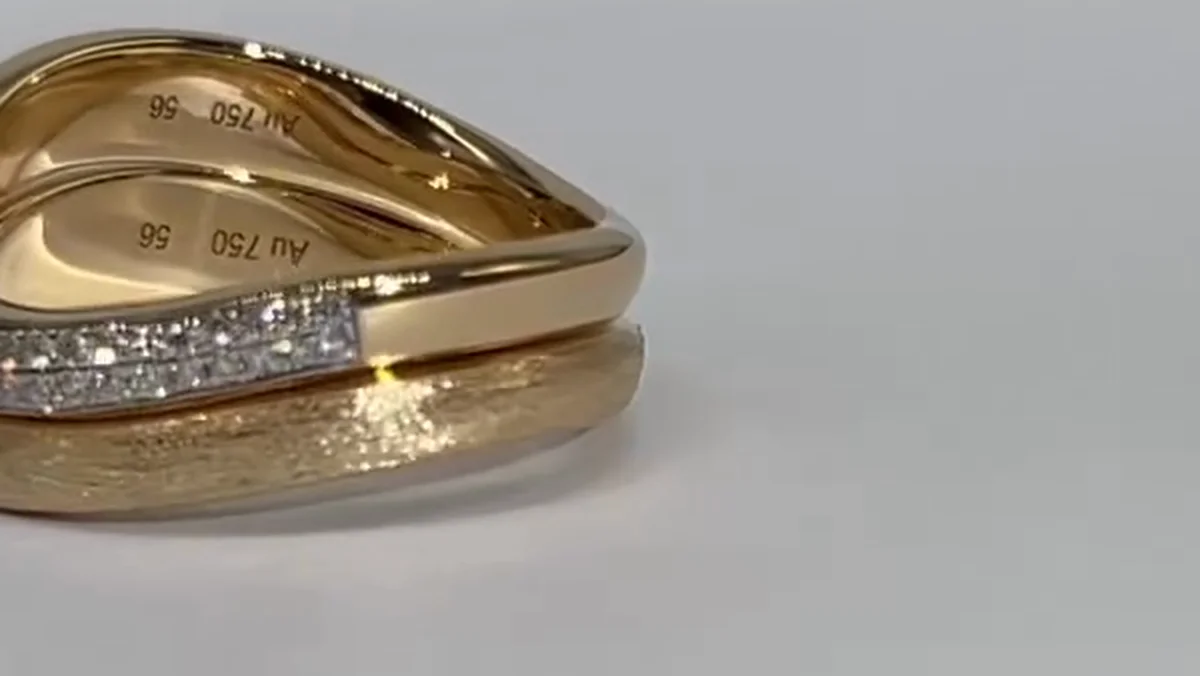
The karat does not change. We alloy 18K at 755 parts gold per thousand, a little above the 750 the stamp promises, and that alloy runs all the way through the band. The frost sits only on the outermost surface. Turn either band over and the inside is mirror polished, with the same Au750 stamp and the size, 56, which is the European size: 56 mm around the inside, about a US 7.5.
Two matte finishes, two names on our floor
Buyers often use matte, brushed and sandblasted as if they were one finish. At the bench they are separate jobs. Sandblasting is 打砂 or 喷砂 (pen sha, spraying sand). The brushed finish is 拉砂 (la sha, pulling sand): an abrasive wheel or pad is drawn across the surface in one direction, which leaves fine parallel lines. Our satin brushed 18K band is finished that way.
| Finish | How it is made | What you see | How it wears | How it is restored |
|---|---|---|---|---|
| High polish | Polishing wheels and compound | Mirror, sharp reflections | Fine scratches show early | Polished again |
| Brushed (拉砂) | Abrasive wheel or pad pulled one way | Parallel lines with a soft sheen | Marks along the grain blend in, marks across it show | Brushed again in the same direction |
| Sandblasted (打砂) | Fine abrasive blown under air pressure | Even frost, no direction | High points burnish to a shine | Blasted again |
Where it sits in production
Sandblasting is one of the last steps, and the order matters. The band is cast, cleaned up and polished first, inside and out. The surfaces that must stay bright, the inside here, are then covered, and only the outer face goes into the blasting cabinet. If the blasting came first, the polishing wheel would take the frost straight back off.
Stones change the plan. Diamond is harder than any common blasting abrasive, so a diamond will not be marked by it. The metal around a pavé stone is a different matter. Each stone is held by small beads of gold that the setter cuts bright, and those bright cuts are part of what makes pavé sparkle. Blast them and they go dull. That is one practical reason this pair puts the two finishes on two bands instead of one: the pavé band stays bright, and the plain band takes the frost. Softer colored stones would be covered before any blasting. How the beads hold each stone is covered in how pavé setting works.
How a sandblasted gold ring wears
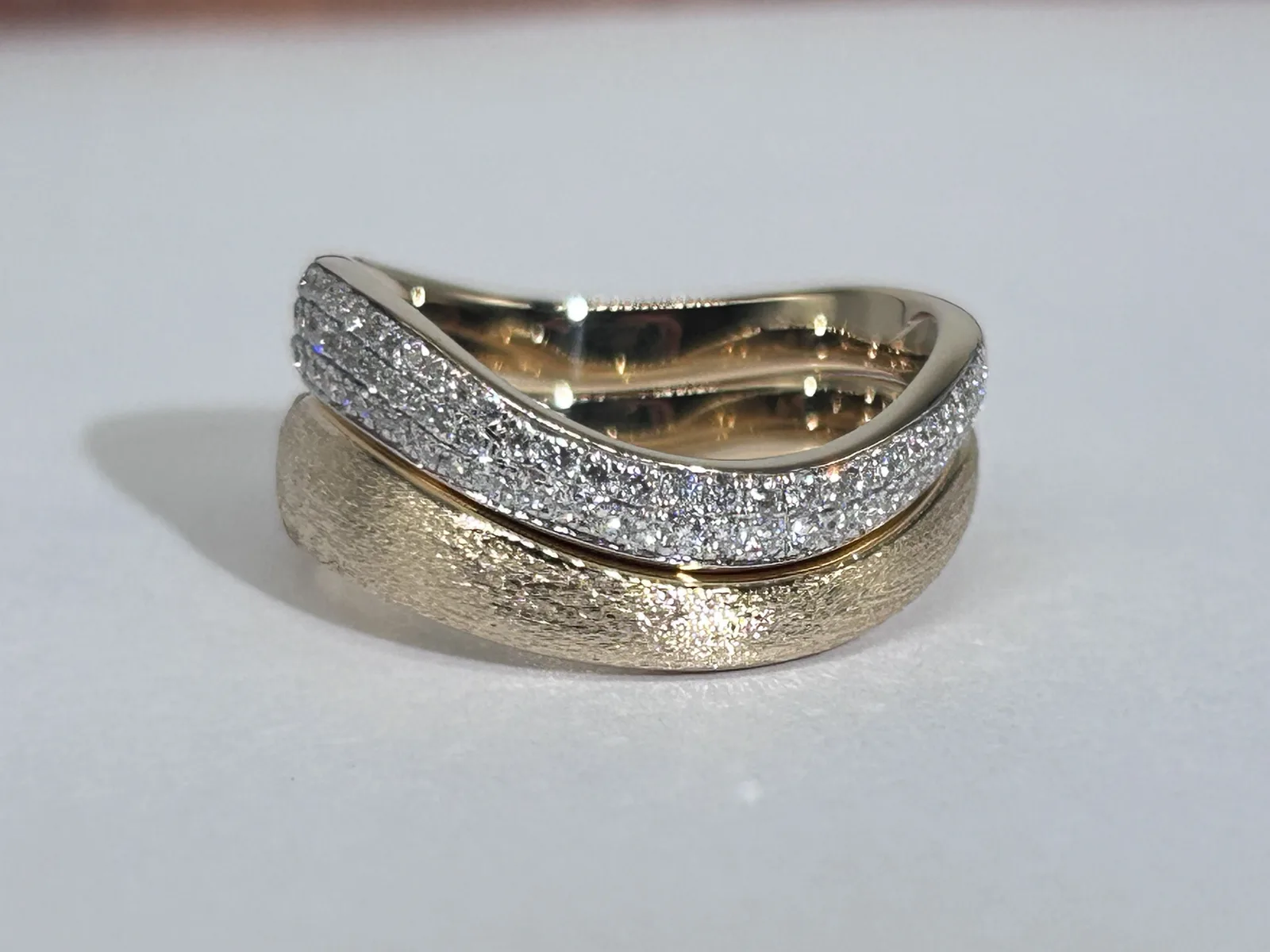
The frost is a field of tiny peaks. Every time the ring meets a desk edge, a door handle or the band next to it, the tips of those peaks are pressed flat, and a flat spot reflects light. So a sandblasted ring does not scratch the way a polished ring does. It slowly polishes.
- The high points go first. The crest of the wave, the outer edges, and the line where this band touches the pavé band will brighten before the rest.
- Fine scratches hide, deep ones do not. A hairline mark disappears into the frost. A gouge from a hard knock shows on any finish.
- It looks dirty sooner. The texture holds skin oil and soap film more than a polished surface, so the gold looks flat and dark before it looks worn. A soft brush and warm soapy water usually bring it back, as in cleaning gold jewelry at home.
How fast this happens depends on the hand. On a ring worn every day and never taken off, expect the high points to show within months, not years. On a ring worn on weekends, much slower.
Bringing the finish back
Because the texture is the metal itself, it can be redone. A worn band goes back into the cabinet with its inside covered and comes out frosted again. It takes very little gold off. The same works in both directions: a sandblasted band can be polished to a mirror if the owner changes their mind, and a polished band can be frosted.
This is the opposite of white gold, where the bright white surface is a rhodium plating that wears through and has to be put back. That case is covered in whether white gold needs to be replated. A sandblasted 18K yellow band has nothing to wear through.
Two things push back the other way
A matte ring does not stay the way it left us. The patchy stage, where the high points shine and the rest is frosted, is part of owning one. Some people like it as a record of wear. Anyone who wants the ring to look exactly as it did on the first day is better served by a polish, which hides nothing but is the easiest finish to restore.
Restoring is also less convenient. Almost every jeweler can polish a ring. Fewer keep a blasting cabinet, so a refinish may mean sending the ring back to whoever made it, or accepting a brushed finish in its place.
Why this pair splits the finishes
The two bands share one wave. The upper band follows the curve of the lower one, so they sit together without a gap and turn as one piece. A wave band only nests properly with the band it was drawn against, which is why a pair like this is designed and made together rather than matched later.
The contrast does the rest. Next to frost there is no mirror highlight competing with the diamonds, so the three rows of pavé read brighter than they would next to a polished band. For other shapes in our wedding bands, the wave diamond eternity ring puts the wave and the diamonds into a single band.
Ordering a sandblasted ring
- Most plain bands can take a sandblasted finish, on the whole outer face or on part of it, with the inside left polished
- Karat and color: 9K, 10K, 14K, 18K or 22K in yellow or rose gold, or platinum. In white gold the band is rhodium plated, as all our white gold is, and the plating wears gradually with friction
- Your ring size, and the band you want it to sit against if it is part of a pair
- Engraving inside, free, in the wording and font you choose
An order quoted from an existing design starts with a 30 percent deposit, which covers the design work and the production slot. The CAD rendering is free, materials are not ordered until you approve it, and the deposit is fully refundable before that approval.
Production usually takes 7 to 10 days after design details are confirmed. We ship by FedEx, DHL or UPS, and delivery usually takes 2 to 5 days, depending on destination and customs clearance.
Common questions
Is a sandblasted gold ring real gold?
Yes. Sandblasting changes the texture of the surface, not the metal. An 18K sandblasted band is 18K all the way through, and it is stamped the same as a polished one.
Does a sandblasted finish wear off?
It does not peel, because it is not a coating. With daily wear the high points slowly polish back toward a shine, starting with the edges and wherever the ring rubs against another ring.
Does matte gold scratch easily?
Fine scratches are harder to see on matte gold than on polished gold, because they blend into the frost. A deep scratch shows on either. Over time a matte ring gets shiny patches rather than a web of scratches.
What is the difference between sandblasted and brushed gold?
A brushed finish is made by pulling an abrasive wheel or pad across the gold in one direction, so it shows fine parallel lines. Sandblasting blows fine abrasive at the surface under air pressure, so the frost has no direction.
Can a sandblasted ring be polished later?
Yes. Polishing removes the frost and leaves a mirror finish. A polished ring can also be sandblasted later. Both are surface work on the same gold.
About the Author and Review Process
Edwin Lin is the founder of Redora Jewels, a factory-direct fine jewelry manufacturer based in Shenzhen with on-site production. The pair in this article was photographed and filmed on our production floor, and the stamps, the alloy figure and the finishing sequence come from our own production.
Redora Jewels has run as a manufacturing facility since 2011 and makes custom jewelry in solid gold and platinum, one piece at a time. If you want a band frosted, polished, or one of each, start a project with Redora’s production team.