Every few weeks a client puts their finished piece on a kitchen scale and writes to ask why it comes in under the number they were quoted. The ring is right, the stones are right, the stamp is right, and the weight is short by two tenths of a gram. It reads like a shortfall. It is not one.
The honest answer has three parts. Some of that difference is normal processing loss and was always going to happen. Some of it is the gap between a design file and a physical object. And a small part of it is the reason we weigh every piece before it ships in the first place, because weight is one of the few checks that catches a real mistake.
Most writing about custom jewelry quality control describes it as a stage on a timeline, somewhere between production and delivery. This is written from the production side, with the actual list and the actual numbers.
The short version
Five things get checked on every piece before it leaves our production floor:
- Whether the client’s specific requests were actually built, not just recorded
- How clasps, hinges, and closures move
- Whether the hallmark and any engraving are legible
- Whether any stone is missing, loose, or sitting at the wrong height
- Whether the finished weight lands where it should
Between one and three percent of pieces go back to the bench at this point. The most common reason is not a workmanship failure. It is colour, on natural gemstones, and it is worth explaining why.
What is on the list before a piece leaves the bench
| Check | What a failure looks like |
|---|---|
| Client requests built | An engraving requested on the inner wall ends up on the outer edge, or a requested comfort fit was noted on the order and never cut |
| Movement | A bracelet clasp that needs two hands, a hinge with side play, a safety catch that closes but does not seat |
| Stamps and engraving | A karat stamp struck at an angle and half legible, letters filled with polishing compound, engraving depth uneven along a curved inner wall |
| Stones | A missing stone in a pave row, a stone sitting proud of its neighbours, a prong that moves under a probe |
| Finished weight | Weight well under the expected range, which usually means wall thickness was cut down too far during finishing |
None of these are exotic. What matters is who runs them. They are checked by people who were part of building the piece, with the approved CAD file, the order notes, and the stone list in front of them. A checker who has never seen the file can confirm that a ring is a ring. They cannot confirm that this ring is the one the client signed off on. Our custom jewelry process puts that sign off before production for the same reason.
The finished weight is always under the CAD figure
This generates more email than anything else on the list, and it sits a layer below where retail operates, so most people selling jewelry have never had to explain it.
A CAD file reports the volume of a solid model multiplied by the density of the alloy. It is an accurate number for the model. It is not a prediction of the object. Between that file and the finished piece the metal goes through casting, sprue removal, filing, seat cutting, rubber wheel work, and polishing. Every one of those removes material. Nothing puts material back.
Our working rule is that a finished piece lands at roughly 90 percent of the CAD weight. Two pieces where we have published both numbers sit either side of it.
| Piece | CAD, gold | Finished, gold | Share |
|---|---|---|---|
| 20.06 ct emerald cut ring, 18K white gold | 4.5 g | 4.13 g | 91.8% |
| Seven stone band, 18K white gold, 0.70 ct lab grown | 4.0 g | 3.57 g | 89% |
Two measurements are still not a rate, so 90 percent is a planning figure, not a guarantee.
One trap when you check this yourself: a CAD file reports gold only, and a scale weighs the whole piece. The seven stone band reads 3.71 g on the scale, and 0.14 g of that is its diamonds, since a carat is 0.2 g. Take the stones off before you compare, or a set piece will look closer to its CAD figure than it really is. We filmed that band on the scale, along with a full day at our manufacturing facility.
Two things push back the other way. Heavier and simpler pieces lose proportionally less, because less of their surface is being worked. And a piece that comes in far below the expected range is a real defect rather than normal loss, which is exactly why the scale is on the list at all.
The practical version for a buyer: if you are quoted from a CAD file, expect the finished piece to weigh about a tenth less, and ask for the finished weight in writing once the piece exists. If you are quoted from a finished sample, the two numbers should match closely.
What actually sends a piece back
Our rework rate before shipping runs between one and three percent. The distribution is not what most people would guess.
The single most common cause is the appearance of natural coloured gemstones. A sapphire or an emerald looks different loose on a tray than it does set in metal, under different light, next to a diamond. Nothing about the stone changed and nothing about the setting is wrong. The piece simply does not read the way it did when the stone was selected, so it goes back and the stone is swapped for a closer match.
That is a perception gap rather than a defect, and it is the honest limit of what any inspection can do. We can confirm that a stone matches its specification. We cannot confirm that it will read to you the way it read to us. Colourless lab grown material behaves much better here, because stones are consistent with each other in a way that natural coloured gemstones are not. The same holds for lab grown coloured stones, which is what made an ombre bracelet of 78 lab grown sapphires practical to sort.
Mechanical failures are the smaller share: a prong that moves, a clasp that does not seat, a stamp that did not strike cleanly. Those are corrected at the bench and rechecked.
All of that sits in a second inspection after the piece is finished, which is exactly the step a hard deadline asks us to skip. It is the main reason we decline some orders outright, and we set out where that line falls in why we turn down rush orders.
The stone swap question has a real answer and a limit
People ask how they can know the stones in the finished piece are the ones they paid for. It is a fair question and it deserves a specific answer rather than reassurance.
For a centre stone large enough to carry its own grading report, the answer is concrete. The report number is laser inscribed on the girdle. You can read that inscription under magnification and check the same number against the grading laboratory’s own database. That is a verification you perform, not a claim we make.
For the small stones the answer is different, and this is where a lot of marketing copy quietly overstates things. Stones at pave and accent size sit below the weight at which laboratories issue individual reports. A 0.08 carat stone does not have its own report and cannot be given one. Any brand saying that every stone in a pave row is individually certified is not describing the situation accurately. What exists is a test certificate covering the metal and the diamonds as a group, supplied on request. Our page on lab grown diamonds sets out what the grading actually applies to.
The real protection sits upstream of certification. Stone counts and sizes are fixed in the CAD file before production, the finished piece is counted against that file, and the weight is checked at the end. A missing or substituted small stone shows up in the count and on the scale.
One band, start to finish
A recent piece makes the numbers concrete. It is a 14K white gold half eternity band, 3.00 mm wide and 2.10 mm thick, with fifteen round lab grown diamonds at 1 1/4 ct total, set across 75 percent of the ring.
| Specification | Value |
|---|---|
| Stone count | 15 |
| Total carat weight | 1 1/4 ct |
| Weight per stone | About 0.08 ct, roughly 2.85 mm |
| Band width and thickness | 3.00 mm by 2.10 mm |
| Finished weight at size 52 | 2.98 g |
| Inner wall marks | Au 585, maker mark, ring size |
Fifteen is a deliberate number. A 3 mm band is more commonly filled with thirty or more stones under 2 mm each. Fewer and larger stones means fewer prongs interrupting the row, and it also means any single stone sitting even slightly high is immediately visible, which makes the setting check stricter rather than easier.
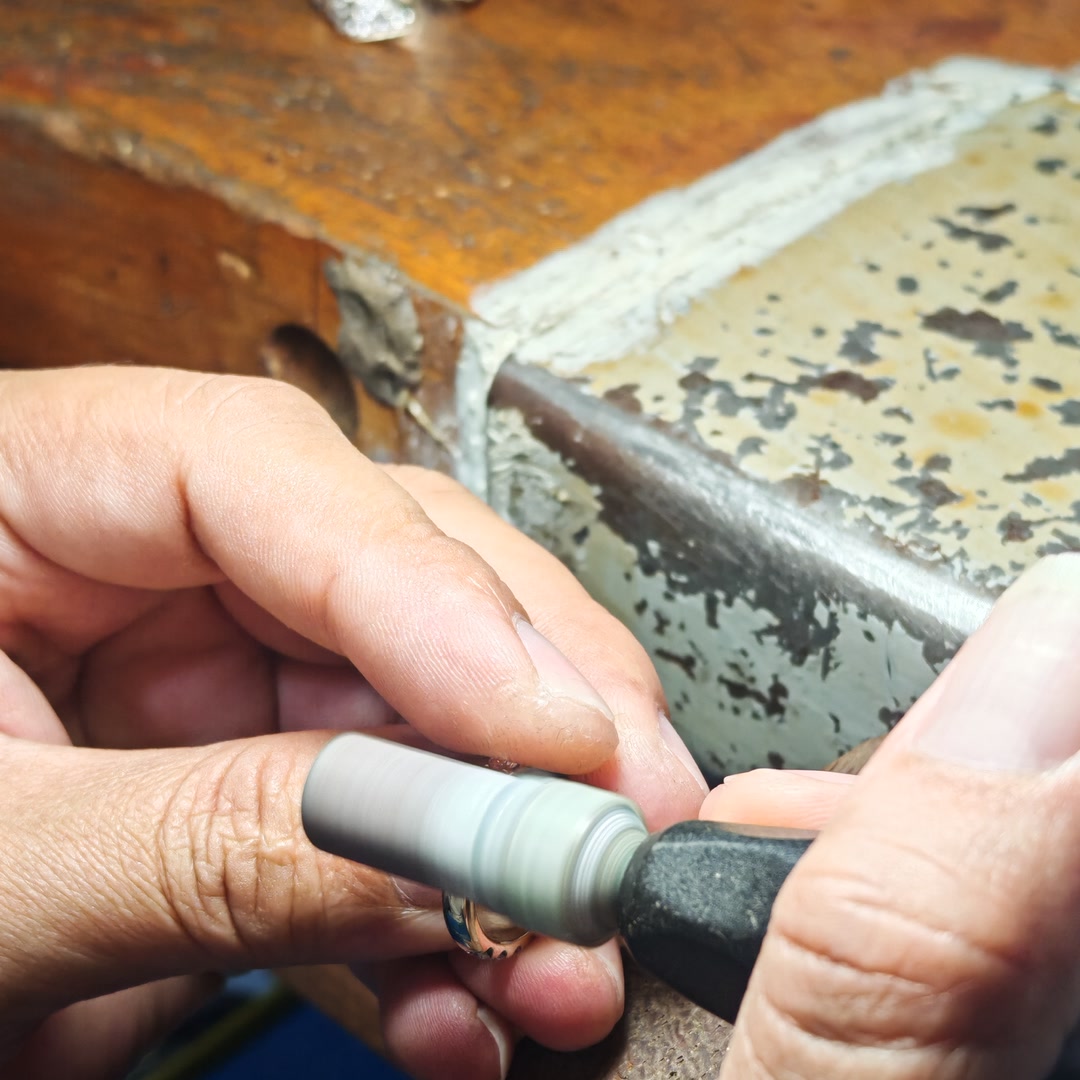
Three stages matter on a piece like this: seat cutting and setting, rubber wheel work to bring the metal back around the row, and final polishing with every stone rechecked afterwards. The finished piece is the shared prong half eternity band on our site.
What to ask for before your piece ships
- The finished weight in grams, measured on the actual piece rather than taken from the file
- Photographs of the inner wall showing the karat stamp and any engraving, since these are the hardest details to correct after delivery
- The grading report number for any centre stone, so you can check the inscription yourself once it arrives
- Written confirmation that each specific request you made, engraving position, comfort fit, coverage, was built rather than only recorded
- For coloured gemstones, a photograph of the stone set in the piece under normal indoor light, not only under bench lighting
None of these are unusual things to ask a producer. A supplier who cannot answer the first two is very likely not the one making the piece.
Common questions
How much should a 14K gold ring weigh?
There is no single figure, because weight follows width, thickness, and profile rather than karat. As a reference point, the 3.00 mm by 2.10 mm half eternity band above weighs 2.98 g at size 52. A plain 2 mm band at the same size sits well under that, and a wide signet can be several times heavier. Ask for the weight of the specific design at your specific size.
Is 14K gold supposed to be light?
14K is 58.5 percent gold by weight, so it is less dense than 18K and considerably less dense than platinum. The same design in 14K will weigh less than the identical design in 18K. That is expected and is not a sign of a hollow or underbuilt piece. A genuine problem shows up as wall thickness you can feel flexing, not as a modest difference on a scale.
How do you know if a jeweler switched a diamond?
For a stone with a grading report, check the laser inscription on the girdle against the report number in the laboratory’s database. For accent stones there is no equivalent check, because no individual reports exist at that size. What can be verified is the count and the total weight against the approved design file, which is what gets checked internally before shipping.
How long does it usually take to make a custom ring?
Most orders take 7 to 10 days in production after design details are confirmed. Simple designs can finish in about 5 days, and complex work may need up to 15. Shipping by FedEx, DHL, or UPS normally takes 2 to 5 days depending on destination and customs clearance.
What happens if a piece fails inspection?
It goes back to the bench and is rechecked before it ships. Mechanical corrections are usually quick. A coloured gemstone that needs replacing takes longer, because the replacement has to be selected and set. We would rather move a delivery date than ship a piece that was signed off under time pressure.
If you are having something made
The checks above are not a differentiator. They are the baseline any producer should be able to describe. The useful question when comparing suppliers is not whether they have quality control, it is whether they can tell you what is on the list and what their own most common failure is. A supplier who has never had a piece go back to the bench is either not producing much or is not checking.
Our custom jewelry work is produced at our own manufacturing facility in Shenzhen, and every number in this article comes from that production floor rather than from an industry average.
About the author
Written by the Redora Jewels production team. Redora operates a fine jewelry manufacturing facility in Shenzhen with on-site casting, setting, and finishing. The inspection list, rework figures, and weight measurements described here come from pieces produced in that facility. Questions about a specific design can go to info@redorajewels.com.