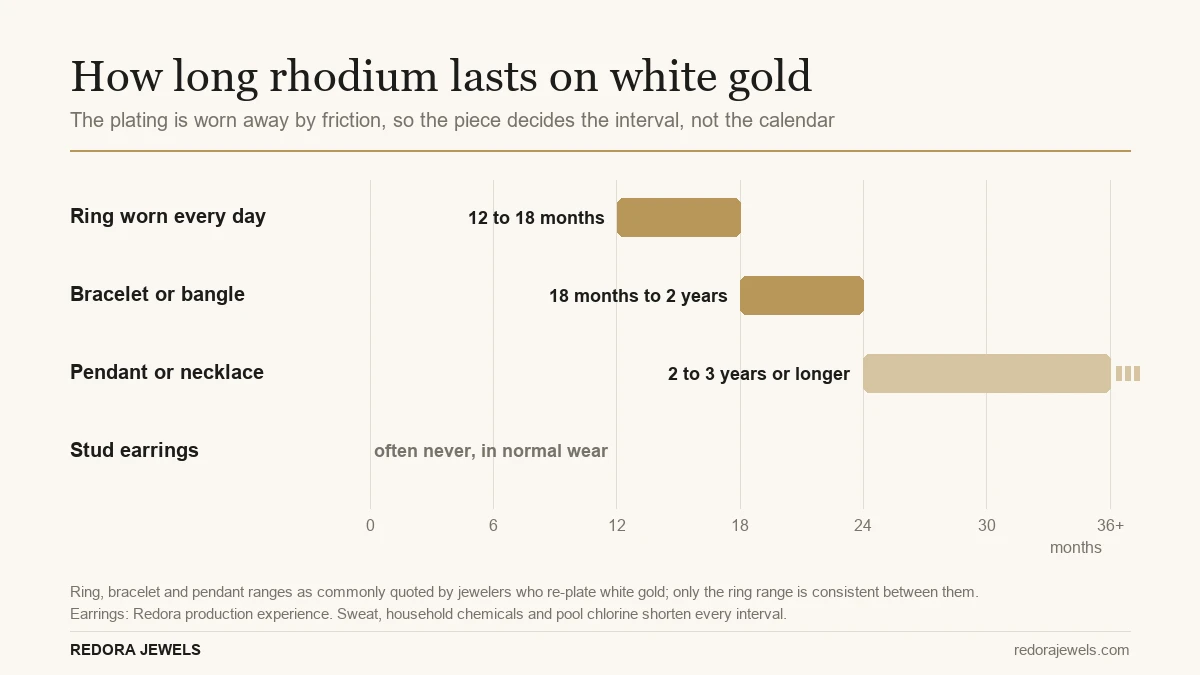
Does white gold need to be replated? Yes, if the piece is a ring you wear every day. Jewelers who re-plate white gold as routine bench work generally put a daily ring at 12 to 18 months between platings, a bracelet at around two years, and a pendant at two to three years or longer. At Redora Jewels, a factory-direct fine jewelry manufacturer in Shenzhen, every white gold piece is rhodium plated as the last step of production, at no extra charge, over a solid white gold alloy that is slightly warm in its own right and contains nickel. Those two facts, the warm base and the nickel, decide how much re-plating should matter to you.
Most writing on this question comes from the retail counter, where re-plating is a service on the menu. This is written from the bench where the plating goes on in the first place, and it covers the part the counter rarely shows: the metal underneath.
White gold is not bright white until the last step
The strip below is a real 18K white gold engagement ring photographed at six stages on our production floor. Look at the third frame. The bare basket is the raw alloy, and it is a pale warm color, not white. The bright finish in the final ring comes from rhodium, applied after setting and final polish.

The reason is arithmetic. We alloy 18K at 755 parts per thousand gold, slightly above the 750 the stamp requires, so three quarters of the metal is gold. The whitening metals pull that toward grey but not all the way. 14K, at 595 parts per thousand, carries less gold and starts a little less warm. The fineness figures are laid out in our custom diamond ring cost breakdown.
Rhodium is a hard, very white metal from the platinum group. It goes on as a thin electroplated layer, which is why it wears, and why US rules treat it as something a seller has to disclose. Under 16 CFR 23.7, failing to disclose a rhodium surface layer on a product described as precious metal is deceptive. Every white gold listing on our site states that it is rhodium plated for that reason.
Friction sets the interval, not the calendar
The plating does not age. It is worn away, and it goes fastest wherever the piece rubs against something harder than skin.
| Piece | Where the plating goes first | Typical interval |
|---|---|---|
| Ring worn every day | Palm side of the shank, which meets desks, steering wheels and door handles | 12 to 18 months |
| Stacked wedding band | The line where it rubs the ring beside it | Sooner than a ring worn alone |
| Bracelet or bangle | The underside, against desks and keyboards | 18 months to 2 years |
| Pendant or necklace | The bail and the clasp | 2 to 3 years or longer |
| Stud earrings | Very little touches them | Often never, in normal wear |
The first four rows follow the ranges jewelers who do this work commonly quote, for example in this re-plating guide from Robinson’s Jewelers. Only the ring figure is consistent from one jeweler to the next; the others vary. The earring row is our own experience, and it applies to pendants too: under normal wear, many of those pieces never need a second coat. Sweat and household chemicals shorten every row, and so does chlorine in pools and hot tubs, which attacks the alloy metals under the plating as well. Our note on wearing gold jewelry in the shower covers the chlorine side.
What yellowing is, and what it is not
When the rhodium thins, the warm base from frame three starts to show through, usually as a faint yellow cast on the palm side of a ring and along its edges. It is the same solid gold it always was. Nothing structural has changed, and the ring is exactly as strong as it was on the first day.
A warm cast is not, on its own, a sign that a ring was plated base metal. Solid white gold turns faintly yellow as it loses its rhodium precisely because it is mostly gold. If a ring shows it within a few months, the usual causes are hard daily use or a thin plating, and a karat stamp plus a jeweler’s acid or XRF test settles the metal question in minutes.
Re-plating is routine work at any jeweler with a plating tank: the piece is cleaned, the surface refreshed, and a new layer of rhodium goes on. It does not need to travel back to the maker.
Nickel is the question to ask before you buy
White gold alloys are whitened with other metals, and in ours that includes nickel. Our yellow and rose gold alloys contain nickel as well. We state it plainly because it is the single fact most worth knowing if your skin reacts to nickel, and because the common advice to switch to yellow gold does not hold with our alloys.
While the rhodium is intact, the skin touches rhodium rather than the alloy underneath. Once it wears through, the alloy is against the skin. That is one reason buyers sometimes describe wearing a white gold ring comfortably for years before a reaction appears.
We do not produce a palladium white gold. For a known nickel allergy the metal we recommend is platinum, which we make at 955 parts per thousand, which contains no nickel, and which needs no plating because it is white all the way through. Our brushed platinum wedding band is one example. If you are not sure nickel is the cause, a patch test from a dermatologist answers that before you commit to a metal.
Two things push back the other way
Platinum is not simply white gold without the maintenance. It is denser, so the same design carries more metal by weight, and its alloying surcharge is about 21 RMB per gram against 8 for 18K. It is also a poor metal to recover: if part of the plan is to melt a piece down into something new one day, karat gold gives far more of its value back.
Letting the plating wear is a legitimate choice. Some people prefer the softer, warmer tone of white gold without its rhodium, and a ring that has lost its plating has lost nothing else. Frame three above is roughly what that looks like.
The choice in one table
| Metal | What sits under the surface | Color upkeep | Nickel in our alloy |
|---|---|---|---|
| 18K white gold | 755 gold, a pale warm alloy, rhodium plated | Re-plate a daily ring every 12 to 18 months | Yes |
| 14K white gold | 595 gold, slightly harder, rhodium plated | Same as 18K | Yes |
| Yellow or rose gold, 14K or 18K | The color runs through the metal | None for color | Yes |
| Platinum 955 | White throughout, no plating | None for color | No |
For most buyers of wedding bands and engagement rings, the choice between these comes down to color, budget and skin. The practical difference is that a white gold ring asks for a visit to a jeweler every year or two, and yellow gold and platinum do not.
Common questions
How often does white gold need to be replated?
On a ring worn every day, jewelers generally suggest every 12 to 18 months. Bracelets usually go around two years, and pendants two to three years or longer. Earrings and pendants worn normally often never need it. The practical trigger is appearance: re-plate when the palm side of the ring starts to look warmer than the top.
Why is my white gold ring turning yellow after a few months?
The rhodium on the palm side has worn thin and the alloy underneath is showing. White gold is mostly gold, so its base color is a pale yellow. Hard daily wear, sweat and chlorine speed it up. A re-plate restores the white finish.
Does white gold have nickel in it?
Many white gold alloys do, including ours. Some makers use palladium instead; we do not. If you react to nickel, ask any maker directly which whitening metal their alloy uses, and consider platinum.
Is white gold plated?
White gold is solid gold all the way through, with a thin rhodium layer on the surface. It is not gold plating over a base metal. The rhodium is a finish on top of solid gold, and a seller should disclose it.
Can white gold be worn without rhodium plating?
Yes. White gold without rhodium is structurally identical to plated white gold. It simply looks warmer, a pale greyish yellow rather than bright white, which is the color in frame three of the photo above.
Is 18K white gold whiter than 14K?
Under the rhodium, no. 18K carries more gold, so its base tone is slightly warmer, and the difference shows more once the plating wears. With fresh plating the two look the same.
What is the best metal for a nickel allergy?
At our end, platinum. It contains no nickel and needs no plating. Our yellow, rose and white gold alloys all contain nickel. A dermatologist’s patch test is the reliable way to confirm nickel is the cause before choosing a metal.
About the Author and Review Process
Edwin Lin is the founder of Redora Jewels, a factory-direct fine jewelry manufacturer based in Shenzhen with on-site production. He works directly with the production team on metal specification and finishing, including the rhodium step described here. The alloy, fineness and surcharge figures in this article are Redora’s own. The re-plating intervals are the ranges jewelers who do that work commonly quote, and the disclosure rule is cited from the US Code of Federal Regulations.
Redora Jewels has operated as a manufacturing facility since 2011, producing fine jewelry and the rest of our custom jewelry range to order. If you want to settle the metal before anything is cast, you can start a custom project with Redora’s production team.