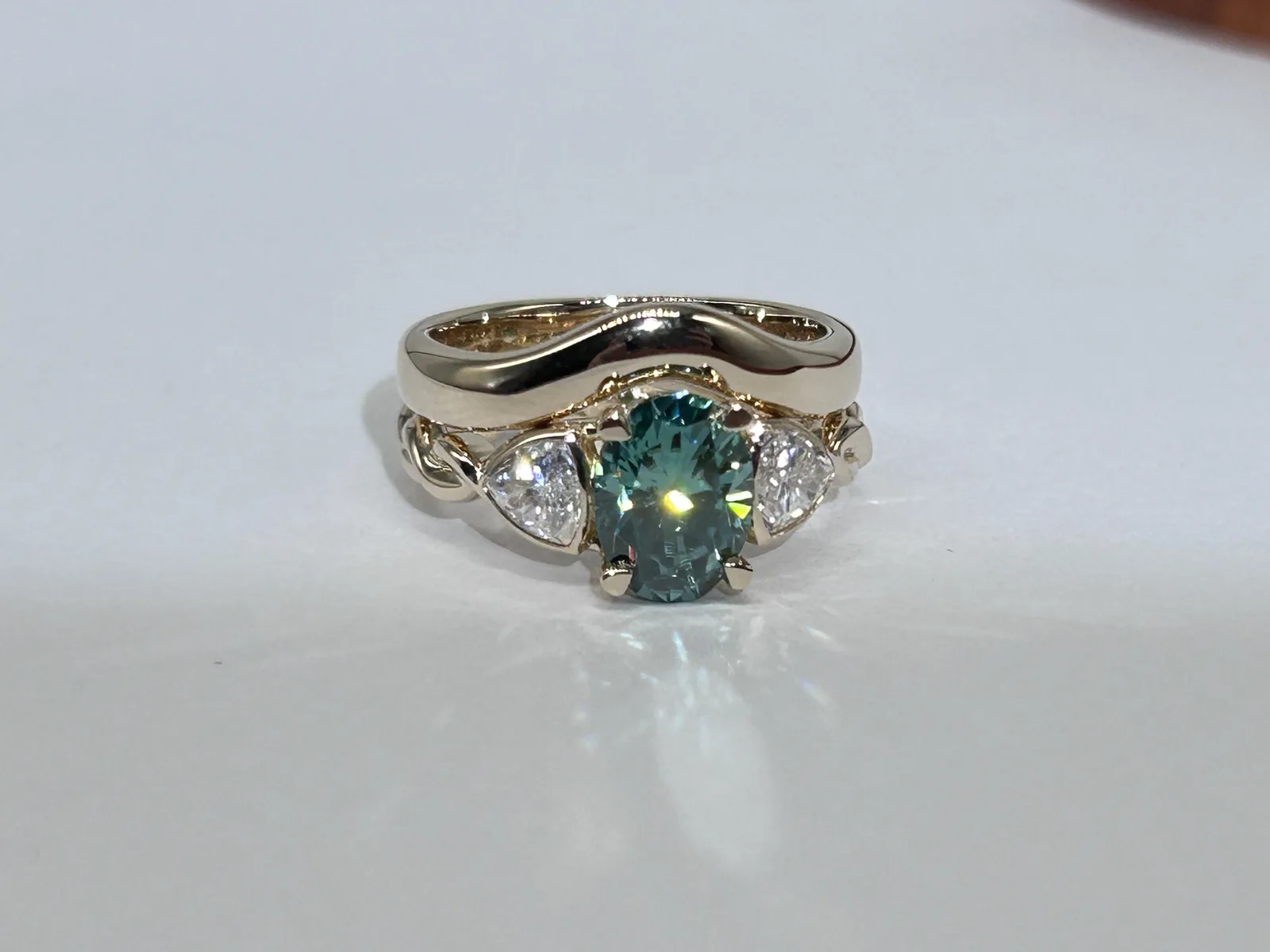
With a three stone engagement ring, the wedding band is often left until later, and that is when the problem shows up: a straight band will not sit against the ring. It touches the side stones first and leaves a gap along the finger. The ring in this article came off our bench this month with its band made at the same time. A teal oval center stone, a trillion lab grown diamond on each side, a twisted 14K yellow gold shank, and a plain polished band that dips around the head so the two sit flush.
Most advice on choosing a wedding band for three stone engagement rings is about style: matching the metal, plain or pavé. This is written from the production floor and it is about geometry: what two side stones do to the space a band needs, and how a band is shaped to fit them.
The short version
| Band | Next to a three stone ring | When it works |
|---|---|---|
| Straight plain band | Meets the side stones before the shank, so it stands off the ring | When the head sits high enough to clear it, or when the wearer likes the gap |
| Straight diamond band | The same gap, plus diamond pressing on diamond at the side stones | Rarely next to trillions. Better with a high set solitaire |
| Curved band, plain | Dips around the head and sits flush along the shank | Made for that ring. This is the pair in this article |
| Curved band with diamonds | Sits flush, with stones close to the side stones | Possible with care over where the stones stop |
What two side stones do to the space
A solitaire head is one stone wide. A three stone head is three stones wide, and the side stones sit lower and further out along the finger than the center. On this ring the oval is flanked by two trillions, triangular stones whose outer edges reach down toward the shank. A straight band slid up against the ring meets those side stones first. It cannot get closer, so it stands off the shank and leaves a visible gap between the two rings.
The gap is not only a look. It lets the two rings twist against each other through the day, and the parts that meet are the side stones. Two facts about diamond matter here. Diamond is the only common material that can scratch a diamond. And a trillion is at its thinnest at the corners, which is where a hard knock turns into a chip. A straight band set with diamonds, pressed against trillion corners every day, puts both risks in the same place.
How a fitted band is made
When we make the ring, the band is drawn around the ring’s own CAD model. The dip follows the outline of the head and the side stones, with a small clearance so the band does not grind on the setting, and it returns to full height where the shank is plain. The client sees both on the same rendering before anything is cast.
The model is not the last word. A cast and polished piece is never exactly the drawing: across our production a finished piece weighs about 90 percent of its model estimate, because filing and polishing take metal off. So after casting, the band is tried against the finished ring at the bench and the curve is adjusted before final polish. That fitting is the step that turns a band that nearly fits into one that sits flush.
A ring made elsewhere can still get a fitted band, but it has to be measured first, and the closer we can work to the ring itself, the closer the fit.
Why this band is plain and polished
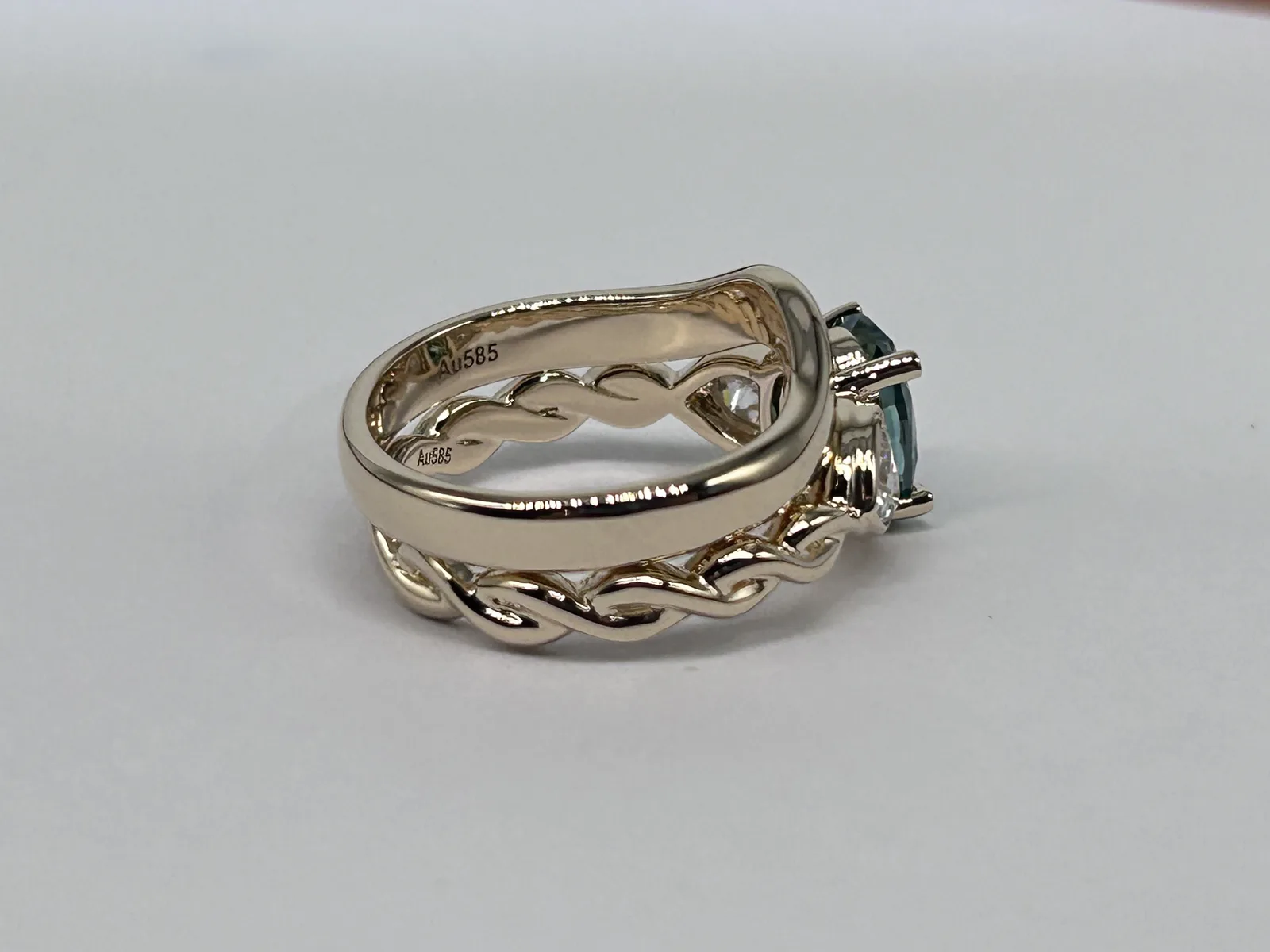
The engagement ring already carries a lot: a colored center, two white side stones, and a shank made of two twisted strands. A plain polished band next to it gives the eye somewhere to rest, and it keeps gold, not stones, against the trillion corners.
Both rings are 14K, stamped Au585. 14K is a little harder than 18K, which suits two rings that will spend years touching, and the same design in 14K weighs about 90 percent of the 18K version. For a band that sits next to a solitaire instead, a diamond band such as our curved diamond wedding band works well.
Two things push back the other way
A curved band fits the ring it was made for, and only that ring. If the engagement ring is ever reset, or the center stone changed for a different shape, the band may stop fitting. A straight band does not care what it sits next to.
Worn alone, a curved band also looks like what it is: a band with a dip in it. Some people like that. Others want a wedding band that stands on its own and are happy to live with a small gap. A gap is not a defect, it is a choice, and on a ring with a high set head it may not appear at all.
Rings that sit flush also rub on each other, and over years they polish each other where they meet. Some couples have the two soldered together after the wedding. That stops the rubbing, but it turns a later resize into a two ring job, and some ring designs cannot be resized at all, as covered in rings that cannot be resized.
Ordering a ring and band together
- The center stone: shape, size and color, lab grown or natural diamond, or a colored gemstone
- Side stones: trillions like these, or pears, rounds or baguettes, each of which changes the curve the band needs
- Karat and color: 9K, 10K, 14K, 18K or 22K in yellow or rose gold, or platinum. White gold is rhodium plated, and the plating wears gradually with friction
- The band: plain or set with stones, and how far the stones should run
- Your ring size, and engraving for either ring, which is free
Our engagement rings and wedding bands can be made as a matched pair this way, including the radiant cut three stone ring with trillion side stones.
An order quoted from an existing design starts with a 30 percent deposit, which covers the design work and the production slot. The CAD rendering is free, materials are not ordered until you approve it, and the deposit is fully refundable before that approval.
Production usually takes 7 to 10 days after design details are confirmed. We ship by FedEx, DHL or UPS, and delivery usually takes 2 to 5 days, depending on destination and customs clearance.
Common questions
What wedding band goes with a three stone engagement ring?
A band curved to follow the head will sit flush. A straight band will usually stand off the ring because it meets the side stones first. Plain gold is the safer choice next to trillions or other pointed side stones.
Can you wear a straight wedding band with a three stone ring?
Yes, if you are happy with a gap between the two rings, or if the head sits high enough for the band to slide under the side stones. Check how far down the side stones reach before choosing.
Do I need a curved band for an oval three stone ring?
Usually, if you want the rings to sit together. An oval center with side stones spreads the head along the finger, and the side stones decide the curve more than the oval does.
Can a wedding band be made for a ring I already have?
Yes. The ring has to be measured first so the curve can be drawn around it, and the band is fitted against the ring before final polish.
Should the engagement ring and wedding band be soldered together?
It stops the two rings rubbing and twisting, which some people prefer. The cost is flexibility: resizing then involves both rings, and you can no longer wear one without the other.
About the Author and Review Process
Edwin Lin is the founder of Redora Jewels, a factory-direct fine jewelry manufacturer based in Shenzhen with on-site production. The ring and band in this article were photographed and filmed on our production floor, and the stamps, the karat weight rule and the fitting step come from our own production.
Redora Jewels has run as a manufacturing facility since 2011 and makes custom jewelry in solid gold and platinum, one piece at a time. If you have a three stone ring that needs a band, or want the two made together, start a project with Redora’s production team.