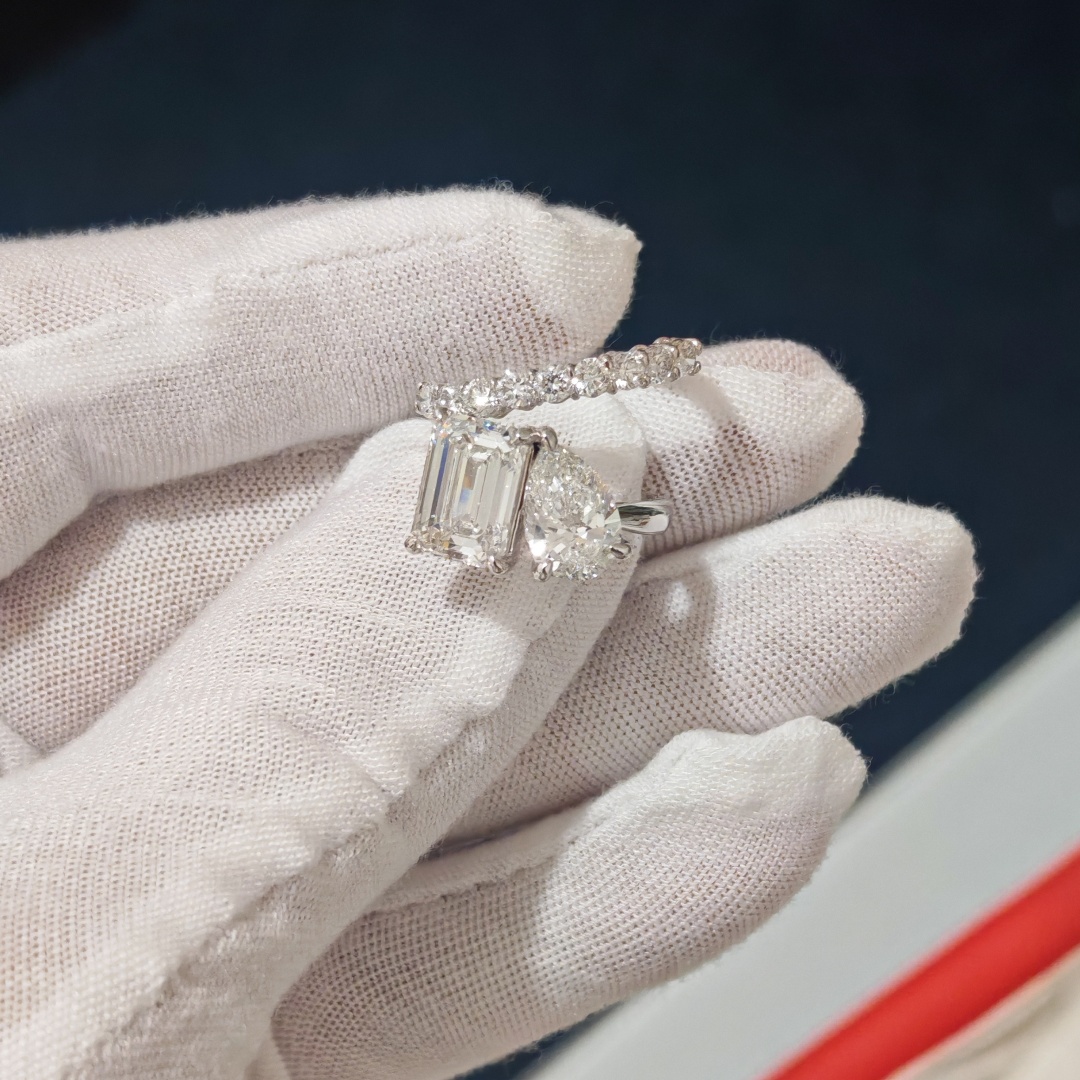

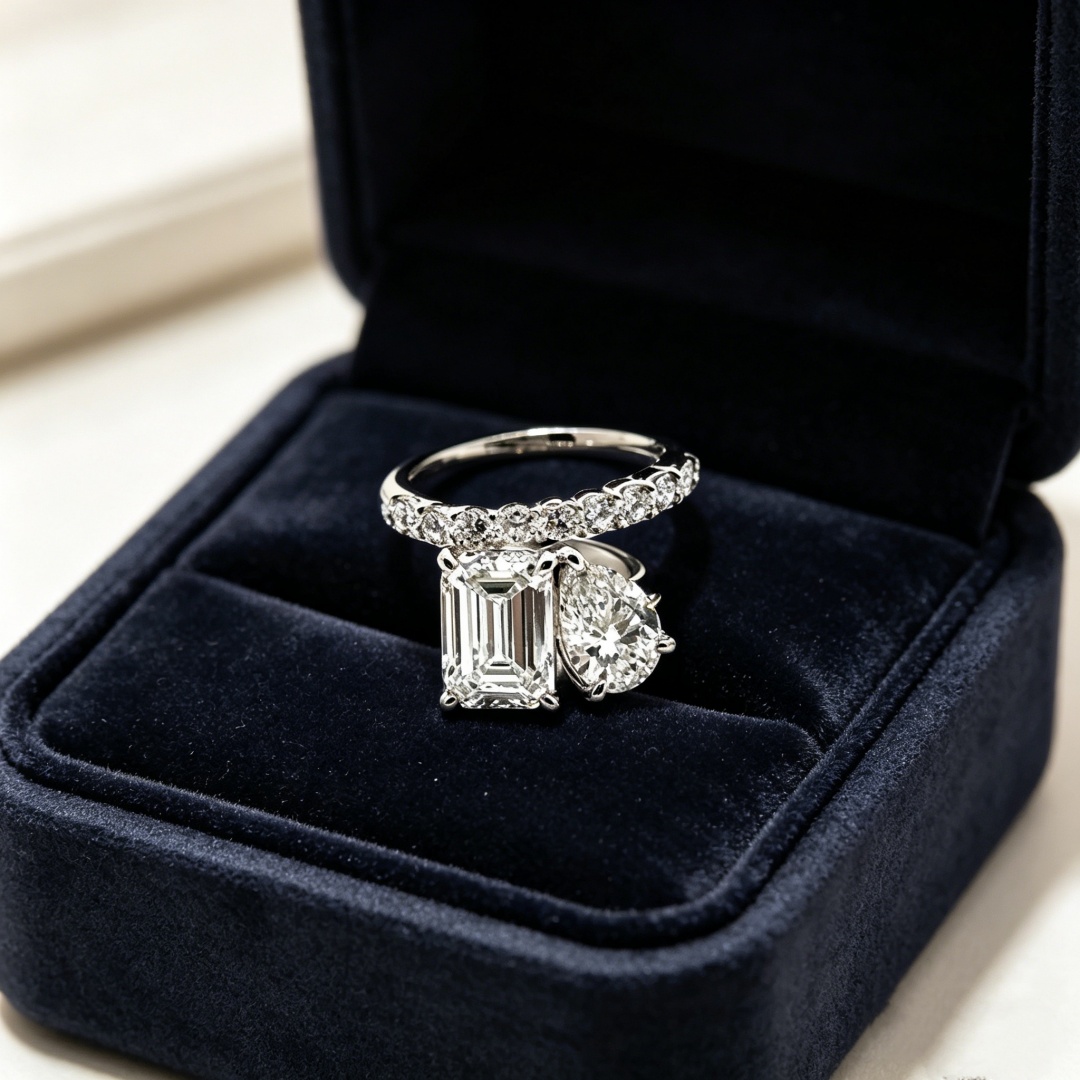

Emerald and Round Cut Toi et Moi Engagement Ring with Pave Band
Two center stones, two prong baskets, one shared gallery. An emerald cut and a round brilliant sized to read as a pair, not a juxtaposition.
Toi et moi engagement ring in platinum 950 with emerald cut and round brilliant lab grown diamonds, approximately 5.5 ct total, shared-prong pave band (33 accent stones), 18.5 mm head height.
~5.5 ct Total
Emerald + Round
Shared Gallery
Pave Band
US 4-13
Available in platinum 950 (default), 14K or 18K white gold. Center stone sizes, stone shape combinations, pave density, and stone type can be specified before production.
Two Stones That Have to Look Like They Belong Together
The toi et moi tradition translates from the French as “you and me”, two distinct center stones on one band representing two people. The structural problem this design has to solve is not the symbolism but the geometry, the two stones must be different enough to read as two individuals but matched closely enough in scale and orientation to read as a pair. This toi et moi engagement ring pairs a rectangular emerald cut with a round brilliant, each held in its own prong basket but joined at a shared gallery, so the two stones sit at the precise angle and clearance where they read as in conversation rather than competition.
- Product type
- Two-stone toi et moi engagement ring with pave band
- Metal
- Platinum 950 (PT950, 95% pure platinum), no plating
- Center stones
- Emerald cut and round brilliant lab grown diamonds, each individually IGI certified
- Total carat weight
- Approximately 5.5 ct including both centers and the pave band
- Accent diamonds
- 33 pave stones (9 at 2.60 mm, 24 at 1.10 mm) shared-prong-set across the band
- Head height
- Approximately 18.5 mm, places this ring in the statement category
- Shank profile
- Tapered from approximately 2 mm at the top to 1.5 mm at the base
- Customization
- Ring size, center stone sizes, stone shape combinations, metal, pave density, stone type
Below the centers, the shank carries two tiers of pave: nine larger accent stones in a visible row, twenty-four smaller stones filling the remaining positions. The double-band gallery visible from the back is an open structure that lets light pass through beneath the centers and prevents moisture pooling against the skin. Within our engagement rings collection, this is the design for buyers choosing two-stone symbolism over single-solitaire convention.
Why Two Baskets, Why Platinum, Why the Gallery Is Open
The two-basket structure is the move that makes a toi et moi work mechanically. A single shared basket holding two different shapes would require the prongs to compromise between two different girdle profiles, the emerald cut needs corner-grip protection at its step-cut edges, the round brilliant needs four-prong support around its curved girdle. Two independent baskets let each stone receive the prong configuration it was designed for, and a shared gallery joins them with enough clearance between the girdles to prevent stone-to-stone contact under daily wear pressure.
Platinum 950 is the material choice for a reason specific to this build, not a generic luxury claim. The two prong baskets share the gallery load, which means the metal at the basket bases carries more structural stress than a single-stone setting does. Platinum holds prong shape under repeated contact significantly longer than 18K white gold, the same alloy benefit that makes platinum the standard for heirloom engagement rings. The 9-gram total ring weight registers on the hand without feeling top-heavy, the taper from 2 mm at the top to 1.5 mm at the base shifts the metal mass upward where the centers sit.
The double-band gallery visible from the back of the ring is open, not solid. This serves two purposes: light enters the pavilions of both center stones from below, which lifts face-up brightness, and air circulates against the skin so moisture does not trap in the ring during long wear. On a 18.5 mm head height, a closed gallery would shadow both stones permanently.
Platinum 950 Milled from Stock and Stones Matched as a Three-Set
The ring body is platinum 950 (PT950), 95 percent pure platinum, milled from solid stock for structural integrity at the gallery-shank junction where the two basket loads converge. Platinum holds its color without rhodium plating, so the metal tone the wearer receives on day one is the metal tone she sees in year 20. Both center stones are sourced as lab grown diamonds graded to VS clarity and E color, each accompanied by an individual IGI certificate. Matching is the critical bench step, the emerald cut and round brilliant must read as paired in face-up tone, and the 33 accent diamonds must come from the same color lot as the centers so the entire ring presents one consistent color across the three stone tiers. Our production team in Shenzhen grades all stones as a three-set (two centers plus pave) before setting begins.
- ◆ PT950 platinum body, milled from solid stock for gallery-shank integrity
- ◆ Two prong baskets configured to each stone shape, joined at a shared open gallery
- ◆ Both center stones individually IGI certified, matched face-up for visual consistency as a pair
- ◆ 33 accent diamonds (9 at 2.60 mm, 24 at 1.10 mm) selected from the same color lot as the centers
- ◆ Prong tips height-aligned and inspected before final polish, gallery alignment verified at QC
Stone Sizes, Stone Shape Pairing, Metal, and Pave Density
This ring is built to order. The two decisions that change this design most are the stone shape pairing (emerald + round is the standard, but the toi et moi format supports many combinations) and the relative center stone sizes (matching the two stones in scale is the bench step that determines whether the ring reads as a pair).
- ◆ Ring size: available from US 4 to 13 including half sizes, confirm before production starts
- ◆ Center stone sizes: the emerald cut and round brilliant can each be adjusted in carat weight, but changing one shifts the visual balance, the production team will discuss matched proportions before confirming
- ◆ Stone shape combination: emerald + round as standard, alternative pairings include oval + pear, cushion + marquise, and emerald + emerald, each requiring different basket configurations
- ◆ Metal: platinum 950 as standard, also available in 18K or 14K white gold (changes weight, density, and prong wear characteristics)
- ◆ Pave density: 33 accent stones is standard, can be reduced for a cleaner shank or extended further (shifts total carat weight and price)
- ◆ Stone type: lab grown diamond as standard at VS / E grade, natural diamond available on request with full IGI certification
Two decisions matter most for a toi et moi: the stone shape pairing (emerald + round, or another combination), and the relative carat weights of the two centers (matching the stones in visual scale is what makes the ring read as a pair rather than a juxtaposition). Send your preferred pairing and your target carat weight for each stone, your ring size, your metal preference (platinum or white gold), and your diamond type (lab or natural). If you have a reference image for a specific stone shape combination, send that too, the production team can work from it.
Made to order
This design is a starting point
Every piece is produced to order at our Shenzhen manufacturing facility, so the version you receive can differ from the one on this page.
Change the specifications
Metal and karat, stone type, carat weight, setting style, and finished dimensions.
Or send your own design
A sketch, a reference photo, or an AI generated image. Our team builds the CAD from it and tells you what has to change to make it wearable.
Free engraving
Included on every piece. Your own text and your choice of font, at no added cost.
Send your image, preferred metal, size, and any changes. You receive a CAD render to approve before production starts. Production runs 5 to 15 days depending on complexity, then 2 to 5 days in transit with FedEx, DHL, or UPS.
Send your design