Buying an engagement ring is one of the larger purchases most people make, and it comes with a surprising amount of conflicting advice. This engagement ring buying guide cuts through the noise. Whether you are working with a defined budget, trying to understand what actually makes a diamond beautiful, or deciding between a natural stone and a lab-grown alternative, the goal is straightforward: help you make a decision you feel good about, not just on the day you propose, but years later.
Setting an Engagement Ring Budget That Makes Sense
The right budget is whatever you can comfortably spend without straining your finances. The old guideline of two or three months’ salary is a marketing invention, not a measure of commitment, and most jewelry professionals have moved away from recommending it. What matters far more is choosing a number that leaves room for the rest of your financial life, including a wedding, a home, and everything that follows.
A more useful starting point is to decide what trade-offs matter to you. A smaller budget does not mean a less beautiful ring. It means making deliberate choices about where to allocate your money. A well-cut one-carat stone in a clean, simple setting will almost always outshine a larger stone that was poorly cut or set in an overly busy design.
Before you look at a single ring, also think about your partner’s lifestyle. Someone who works with their hands, exercises frequently, or prefers understated jewelry has different needs from someone who loves statement pieces and keeps their hands relatively protected. The ring has to work in their daily life, not just look good in a box.
The 4Cs Made Practical: What You Will Actually Notice
The four characteristics that determine a diamond’s quality and price are cut, color, clarity, and carat weight. Understanding how they interact in practice is more useful than memorizing grade definitions.
Cut: The One You Should Prioritize
Cut is the most important of the four. It refers not to the shape of the diamond but to how precisely its facets are proportioned and aligned. A well-cut diamond reflects light efficiently, producing the brightness and scintillation (the pattern of light and dark that flashes as the stone moves) that makes a diamond look alive. A poorly cut diamond looks dull regardless of how high its other grades are.
According to GIA grading standards, cut quality for round brilliants is graded on a scale from Excellent to Poor. For engagement rings, staying at Very Good or Excellent cut is generally worth prioritizing over chasing a higher clarity or color grade.
Color: Where Eye-Clean Judgment Matters
Diamond color is graded on a scale from D (colorless) to Z (visibly warm or yellow). In practical terms, the difference between a D and a G or H is nearly impossible to see once the stone is set in metal and worn on a finger. Stones in the G to I range offer strong value because they face up white in most settings while costing noticeably less than D-to-F grades.
Yellow gold settings are particularly forgiving of warmer color grades because the metal itself adds warmth. If your partner prefers white gold or platinum, staying in the G to H range is a reasonable target.
Clarity: Eye-Clean Is Enough for Most Buyers
Clarity grades measure the presence of inclusions (internal characteristics) and blemishes (surface marks). Flawless diamonds exist, but paying for them is rarely justified because inclusions at SI1 or even SI2 grades are often invisible without a loupe. The practical standard recommended by most gemologists is eye-clean, meaning no inclusions are visible to the naked eye at normal viewing distance.
Where clarity matters more is in step-cut shapes like the Emerald and Asscher, which have large open facets that act like windows into the stone. For those shapes, moving up to VS2 or VS1 is often worth the extra cost.
Carat: Size Versus Beauty
Carat is a unit of weight, not size, though they are related. A well-cut diamond will appear larger face-up than a heavier stone with poor proportions. Elongated shapes such as Oval, Pear, and Marquise also tend to look larger face-up than their carat weight suggests, which is worth considering if size matters on a fixed budget.
Stone Shape and Setting: The Visible Choices
Shape and setting are what most people notice first, and they have the biggest impact on whether the ring suits the person wearing it.
Choosing a Diamond Shape
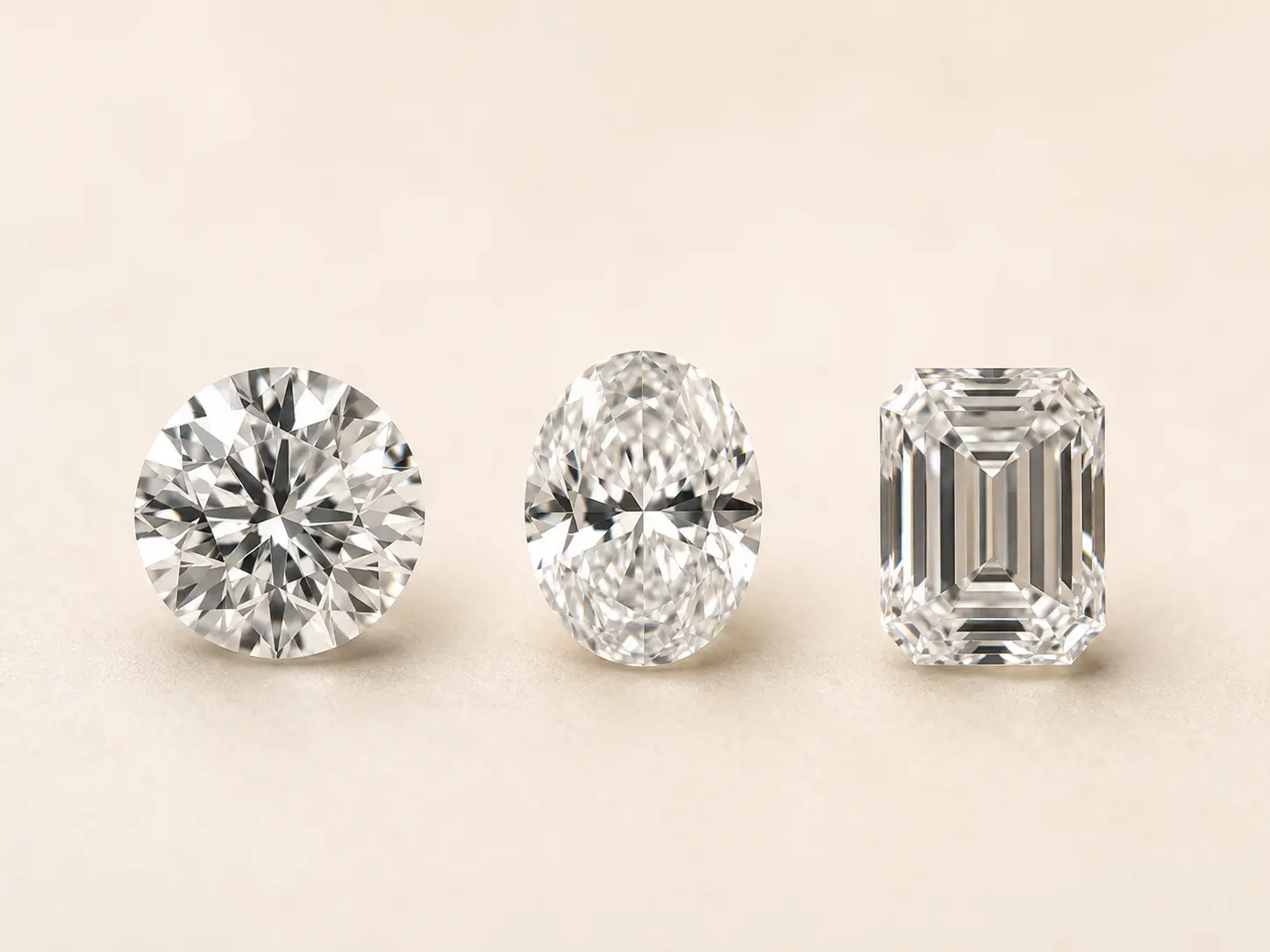
The Round Brilliant remains the most popular choice for engagement rings. Its 58-facet structure is optimized for maximum light return, making it the brightest and most forgiving shape for buyers who want reliable sparkle. The trade-off is that round diamonds typically cost more per carat than fancy shapes because more of the rough stone is lost during cutting. Among fancy shapes, our oval engagement ring with oval side stones shows how repeating one shape down the band changes the proportions on the hand.
Fancy shapes include oval, pear, cushion, emerald, princess, marquise, radiant, asscher, and heart. Each carries a different visual character and practical consideration:
- Best for elongating the finger: Oval, pear, marquise
- Best for vintage or geometric style: Emerald, asscher, cushion
- Best for maximum sparkle at lower cost per carat: Oval, radiant, cushion
Our diamond shapes guide breaks down how each cut handles light and wear in more detail if you want to compare them side by side.
One thing to understand with elongated fancy shapes is the bow-tie effect: a dark shadow that runs across the width of the stone, visible in oval, pear, and marquise cuts when the proportions are off or the depth is too shallow. A mild bow-tie is normal and even adds character; a severe one kills the light in the center of the stone. You cannot evaluate this from a grading report alone. Always view a stone in high-quality video or in person before buying.
For elongated shapes, widely accepted length-to-width ratio targets are:
| Elongated shape | Common length-to-width ratio |
|---|---|
| Oval | 1.35 to 1.50 |
| Pear | 1.45 to 1.75 |
| Marquise | 1.85 to 2.10 |
IGI and GIA grading reports list the measurements you need to calculate this yourself.
Choosing a Setting
The setting protects the stone, affects how it looks on the hand, and determines how comfortable and practical the ring is to wear daily.
A solitaire with four or six prongs is the most classic option. It keeps the stone high and visible, maximizes light entry, and works with almost any band style. The downside is that prongs catch on fabric and hair over time and need periodic checking and re-tipping. A three stone layout is the classic alternative when you want width without a halo, as in our round three stone vintage engagement ring.
A bezel setting encircles the stone with a thin metal rim. It offers stronger protection and a cleaner, more modern silhouette. For active wearers or buyers who dislike maintenance, this is often the more practical choice.
Halo settings surround the center stone with a ring of smaller diamonds, which can make the center stone appear visually larger while adding overall brightness. They tend to suit buyers who prefer a more glamorous look and are comfortable with a slightly more complex cleaning routine.
Pavé and channel-set bands add sparkle along the band itself. They are beautiful but can make future resizing slightly more complicated, so sizing accuracy matters more with these designs.
Metals, Natural Diamonds, and Lab-Grown Options
Choosing the Right Metal
The most common metal choices for engagement rings are platinum, 18k gold, and 14k gold, each available in white, yellow, or rose variations (platinum is naturally white only).
Platinum is denser and more durable than gold, and it is naturally hypoallergenic. Over time it develops a patina rather than scratching through, which some buyers prefer and others do not. It is typically the most expensive option.
18k gold contains a higher proportion of pure gold (75%) and has a richer color than 14k. It is slightly softer, which matters more for settings with very fine prongs. 14k gold (58.5% pure gold) is harder, more scratch-resistant, and costs less. For most daily-wear rings, 14k performs well.
White gold is made by alloying yellow gold with white metals and is finished with rhodium plating, which gives it a bright white appearance. Rhodium wears off over time and the ring will need replating every few years depending on wear. This is a normal and inexpensive maintenance step, but worth knowing about before you buy.
Natural Diamond, Lab-Grown Diamond, or Colored Gemstone
Lab-grown diamonds are chemically and physically identical to mined diamonds. They are grown in controlled environments that replicate the conditions under which natural diamonds form, and they are graded by the same independent bodies, including GIA and IGI, using the same 4C standards. They typically cost significantly less than equivalent natural stones, which means a buyer can either save money or access a noticeably larger or better-graded stone at the same budget.
The honest trade-off is resale value. Natural diamonds retain more secondary market value than lab-grown stones, though most engagement rings are not purchased as investments. If long-term value retention matters to the buyer, natural is the safer choice. If maximizing the visual quality of the ring at a given price is the priority, lab-grown stones offer real advantages. We cover this decision in more depth in our comparison of lab-grown and natural diamonds.
Colored gemstones, including sapphire, ruby, and emerald, are a genuinely beautiful alternative for buyers who want something distinctive. Sapphire in particular is durable enough (rating 9 on the Mohs hardness scale) for daily wear. The key consideration is that not all colored stones are equally suitable for everyday rings, so hardness, toughness, and setting style all matter more than they do with diamonds.
Certification, Ring Size, and Timing
Why Independent Grading Reports Matter
An independent grading report from GIA or IGI is the clearest protection a buyer has against paying for a stone that has been misrepresented. These reports describe the stone’s cut, color, clarity, and measurements based on evaluation by trained gemologists who have no financial stake in the sale. They do not guarantee beauty, but they do provide an objective record of what you are buying.
When reviewing a certificate, focus on cut grade (for round brilliants), the color and clarity grades, and the measurements. The measurements let you calculate the length-to-width ratio for fancy shapes and confirm that the stone’s proportions match what you were shown. Avoid buying any significant diamond without an independent report from one of these two bodies.
Getting the Ring Size Right
If the proposal is a surprise, finding the size discreetly is one of the more practically challenging parts of the process. A few approaches that work: borrow a ring your partner wears on their ring finger and have a jeweler measure it, check if a friend or family member already knows their size, or order a ring slightly larger than your best estimate and plan to resize after the proposal. If you want to estimate it yourself, our guide on how to measure ring size at home walks through the methods. Most rings can be resized one to two sizes in either direction without structural problems, though rings with pavé or eternity-style bands have more limitations.
How Much Time to Allow
Timelines depend on what you are buying. A ready-made ring from existing inventory can ship within a few days. For custom pieces made to order, simple designs are often completed in around five days, most orders take about seven to ten days in production, and more complex designs can require up to fifteen days. Finished rings then ship by FedEx, DHL, or UPS, usually arriving within two to five days depending on destination and customs clearance. At Redora, we confirm a realistic schedule at the start of every custom project, so a proposal date is not put at risk by production surprises.
Protecting the Ring Long-Term
An engagement ring is worn daily for years, sometimes decades. A few maintenance habits make a significant difference in how the ring looks and how secure the stone remains.
Prongs should be inspected by a jeweler at least once a year. Prongs wear down, catch on fabric, and occasionally bend slightly, all of which increases the risk of losing the stone. This is inexpensive to check and fix early, and expensive to ignore until a stone falls out.
Cleaning at home can be done simply with warm water, a small amount of dish soap, and a soft toothbrush. This removes the oils and residue that build up from daily wear and dull the stone’s appearance. Ultrasonic cleaners work well for most diamond rings but should be avoided for rings with fracture-filled stones or certain colored gemstones.
Jewelry insurance is worth considering for rings above a certain value. Standard homeowner or renter’s insurance policies often have low per-item limits for jewelry, and a standalone jewelry insurance policy covers loss, theft, and accidental damage more thoroughly. Get an independent appraisal when you buy and update it if the ring is later modified or if metal prices change significantly.
If you anticipate wanting to upgrade the center stone, modify the setting, or add a matching wedding band in the future, working with a manufacturer directly makes those conversations simpler. There is no middleman interpreting your request, and the people who built the ring originally can assess what is feasible without starting over.
If you are ready to begin the design process, you can start a custom jewelry inquiry with our production team and receive a factory-direct quote based on your specific stone and setting preferences.
About the Author and Review Process
Edwin Lin is the founder of Redora Jewels and is directly involved in day-to-day production operations at Redora’s manufacturing facility in Shenzhen. His work spans stone sourcing, setting design review, quality control, and client consultations for custom fine jewelry projects, including a high volume of engagement ring commissions from buyers across North America, Europe, and Australia.
The guidance in this article draws on patterns observed across hundreds of real client inquiries: the questions buyers consistently ask, the trade-offs they struggle to weigh, and the mistakes that show up repeatedly when people prioritize grades on paper over what they will actually see and feel. It also reflects production knowledge that shapes how Redora approaches 4C specifications, metal selection, and setting design when building custom pieces, rather than selecting from stock inventory. Where grading standards are referenced, GIA and IGI documentation serve as the primary technical basis.
This article exists to answer one core question: how does a buyer without a gemology background make a confident, well-reasoned engagement ring decision? The goal is not to sell a specific ring but to help readers understand the real variables so they can ask better questions, make smarter trade-offs, and end up with a ring that holds up as well in ten years as it does on the day of the proposal.
More from Redora: all jewelry buying guides